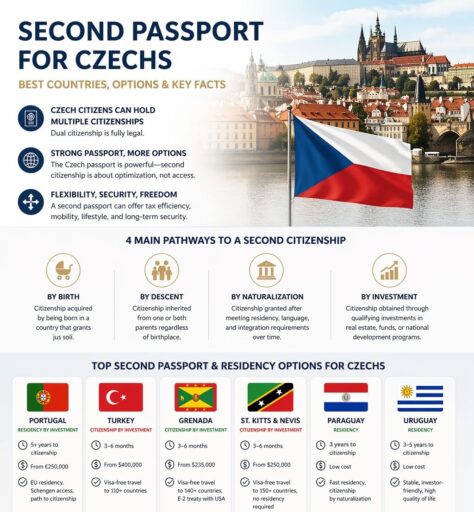
A second passport for Czechs typically involves global programs like Portugal, Turkey, Caribbean citizenship-by-investment options such as Grenada or St. Kitts and Nevis, and South American residency routes like Paraguay or Uruguay, as these best complement an already strong EU passport.
It’s typically used to gain faster mobility options, alternative residency rights, and broader global positioning beyond Europe.
This article covers:
- Does Czechia allow multiple citizenship?
- What are reasons for people to migrate?
- Which country has the highest diaspora?
- What is the best second passport for Czech Republic?
- How powerful is a Czech passport?
Key Takeaways:
- Czech citizens can legally hold multiple citizenships without restriction.
- A second passport for Czech Republic is used for optimization, not access, as a Czech passport is already strong.
- Fastest options come from Caribbean CBI programs and Turkey.
- Residency-based options like Paraguay and Uruguay trade speed for lower cost and long-term flexibility.
My contact details are hello@adamfayed.com and WhatsApp +44-7393-450-837 if you have any questions.
For digital nomad or residence visas that require income, assets, or qualifying investments, we can help structure suitable investment solutions that may align with those requirements, depending on your circumstances.
The information in this article is for general guidance only, does not constitute financial, legal, or tax advice, and may have changed since the time of writing.

Does the Czech Republic allow multiple citizenships?
Yes. The Czech Republic allows dual and multiple citizenship under Act No. 186/2013 Coll. on State Citizenship of the Czech Republic, which removed the previous requirement to renounce other nationalities.
Czech citizens can voluntarily acquire another citizenship without losing their Czech status, and foreign nationals naturalizing in the Czech Republic are generally not required to give up their original citizenship either.
There are no special restrictions on holding multiple passports, but individuals remain subject to the legal obligations of each country they are connected to (such as taxation or reporting rules).
Why do people leave the Czech Republic?
Outmigration from the Czech Republic is primarily driven by economic and lifestyle factors, but recent political and structural developments are also shaping mobility decisions.
- Higher salary opportunities and better working conditions in more developed economies
- International career mobility, especially for skilled professionals in IT, engineering, and healthcare
- Lifestyle preferences such as climate, urban environment, and cost of living differences
- Business expansion, remote work flexibility, or tax and regulatory optimization
Recent trends reinforce these drivers. Emigration to OECD countries has been rising, with many Czechs relocating to nearby economies like Germany and Austria where wages and career opportunities are stronger.
Cross-border living is also increasing, for example, some Czechs are moving to German border towns for cheaper housing while continuing to work in Czechia, highlighting cost-of-living pressures at home.
At the same time, current events are adding a layer of uncertainty.
Political shifts following the 2025 elections, including a more hardline stance on EU policies and migration, as well as large-scale public protests over governance and media freedom, have contributed to a more polarized domestic environment.
Economic concerns tied to EU climate policies and competitiveness have also raised questions about long-term growth prospects.
Which country has the most Czech immigrants?
Germany has the largest Czech immigrant population and is consistently the top destination for Czech emigrants.
Recent OECD migration data shows that out of roughly 14,000 Czech citizens who emigrated to OECD countries in a recent year, around 32% moved to Germany, making it the clear first-choice destination by a wide margin.
The largest Czech diaspora communities are found in:
- Germany (≈32% of Czech emigrants to OECD countries)
- Austria (≈11%)
- Switzerland (≈9%)
- United Kingdom
- United States
This distribution reflects a clear pattern: most Czech migration is concentrated within nearby high-income EU economies, where wage differentials are significant but mobility remains frictionless due to EU freedom of movement.
Germany is acting as the primary hub for both long-term settlement and cross-border commuting.
Which country is best for a second passport?
The best second passport options for Czech citizens are typically Portugal, Turkey, and Caribbean citizenship-by-investment programs such as Grenada and St. Kitts and Nevis, along with lower-cost long-term routes like Paraguay and Uruguay.
The right choice is based on whether the priority is speed, relocation flexibility, or long-term residency planning rather than access alone.
- Pathway: Residency-to-citizenship (naturalization)
- Time requirement: Typically ~5 years legal residency
- Investment/requirement: Residency via investment or qualifying stay (e.g., D7 or Golden Visa routes)
- Why it works for Czechs: EU-based option with lifestyle flexibility, tax planning potential, and a stable long-term second EU passport without leaving Europe
- Pathway: Citizenship by investment
- Time requirement: ~3–6 months processing
- Investment requirement: From around $400,000 real estate investment (or capital alternatives depending on program structure)
- Why it works for Czechs: Fast non-EU citizenship, strong geopolitical diversification, and straightforward acquisition compared to residency-based systems
- Pathway: Citizenship by investment
- Time requirement: ~3–6 months
- Investment requirement: Typically $235,000+ donation option or real estate investment starting around $270,000 (plus fees)
- Why it works for Czechs: Strong travel mobility, including access routes linked to US business visa options, and a relatively low-friction application process
- Pathway: Citizenship by investment
- Time requirement: ~3–6 months (one of the fastest globally)
- Investment requirement: From roughly $250,000 donation option or higher real estate thresholds
- Why it works for Czechs: Speed and simplicity; one of the most established and stable Caribbean citizenship programs
- Pathway: Residency → citizenship
- Time requirement: Citizenship possible after ~3 years residency (in practice varies)
- Investment requirement: Low-cost residency process (no high investment threshold required)
- Why it works for Czechs: Low barrier entry, minimal financial requirements, and a flexible long-term backup citizenship strategy
- Pathway: Residency → naturalization
- Time requirement: ~3–5 years (depending on residency continuity and assessment)
- Investment requirement: No fixed legal minimum, but in practice applicants typically demonstrate around USD 1,500/month for individuals (higher for families) through pensions, remote work, investments, or rental income, verified via bank statements and notarized documentation in Uruguay.
- Why it works for Czechs: Stable political environment, strong legal system, and a credible long-term relocation base in South America
Is Czech a strong passport?
Yes. The Czech passport is a strong global passport, offering visa-free or visa-on-arrival access to around 180 destinations worldwide, along with full EU freedom of movement across 27 member states.
| Index | Ranking (latest available range) | Key insight |
| Henley Passport Index | 7th | Rewards global travel freedom; Czech passport ranks high due to strong Schengen + global visa agreements |
| Arton Capital Passport Index | 6th | Weighs UN mobility balance and travel openness; Czech benefits from EU membership + bilateral agreements |
| Nomad Capitalist Passport Index | 6th | Penalizes tax burden and global tax exposure despite strong travel access, lowering overall ranking |
What are the benefits of having a second citizenship?
A second citizenship for Czech Republic offers expanded global mobility, alternative residency rights outside the EU, access to different banking and financial systems, potential tax structuring flexibility based on jurisdiction, and increased geopolitical security through diversification of legal nationality exposure.
Expanded visa-free travel options improve day-to-day and business mobility by reducing visa friction and widening access to additional jurisdictions, which in turn supports more flexible travel and work arrangements.
That mobility advantage connects directly to backup residency and relocation flexibility, which allows individuals to legally establish a base outside the EU if economic conditions, personal plans, or political developments shift over time.
Once multiple jurisdictions are involved, access to alternative banking and financial systems becomes more relevant, as it enables diversification of currency exposure, financial institutions, and regulatory environments across countries.
This financial diversification naturally ties into tax structuring opportunities, where residency rules, rather than citizenship alone, can influence overall tax exposure depending on how and where an individual establishes their primary tax base.
Together, these factors contribute to greater geopolitical security, as holding more than one citizenship reduces reliance on a single country’s legal, economic, and policy framework.
For Czech citizens, these benefits are about redundancy and optionality, not basic access.
Is it risky to have dual citizenship?
For Czech nationals, holding dual citizenship is generally not risky, as the Czech legal framework fully permits multiple citizenships and does not require renunciation of existing nationality.
In most cases, risks only arise from obligations tied to the second country rather than the Czech Republic itself, particularly tax obligations that may apply depending on residency or income sourcing rules.
In rare cases, certain countries may impose military service or national service requirements, which can still apply even to dual nationals.
There may also be legal or administrative obligations such as reporting requirements, consular duties, or restrictions linked to political rights in specific jurisdictions.
Overall, the main considerations are not about holding dual citizenship itself, but about understanding and complying with the rules of each country involved.
For Czech nationals, the legal framework is permissive, so risks are typically manageable with proper planning.
Tax Residency vs Citizenship for Czech Republic
One of the most misunderstood aspects of second citizenship planning for Czech citizens is the difference between citizenship and tax residency, which are often incorrectly treated as the same thing.
Citizenship determines your legal nationality and passport rights, while tax residency determines where you are taxed on income, and this is typically based on factors such as physical presence, center of life, and economic ties rather than passport ownership.
This means that acquiring a second passport does not automatically change a person’s tax obligations in the Czech Republic or elsewhere unless their residency status also changes under local tax rules.
In practice, countries like Portugal or Uruguay become relevant not because of citizenship alone, but because establishing residency there can potentially shift tax residency depending on the individual’s situation and compliance with domestic rules.
By contrast, fast-track citizenship programs such as those in St. Kitts and Nevis, Grenada, or Turkey generally do not affect tax status unless accompanied by actual relocation.
For Czech citizens, the key distinction is that second citizenship is primarily a mobility and diversification tool, while tax outcomes depend almost entirely on where life is actually based, not what passports are held.
Conclusion
For Czech citizens, second citizenship is about engineering optionality.
With one of the world’s strongest passports already in place, the marginal value of a second passport is not measured in visa-free destinations, but in how it reshapes exposure to different legal, fiscal, and geopolitical systems.
The real decision point is therefore not which passport is best, but what kind of structural flexibility is being built: speed and exit capability through investment routes, long-term jurisdictional repositioning through residency-based systems, or a deliberate split between EU stability and non-EU diversification.
In that sense, second citizenship functions less as an upgrade and more as a hedge against time, policy change, and personal circumstance, where the value is realized not at acquisition, but in the optionality it preserves over the long term.
Because second citizenship can affect tax, residency and long-term planning, Czech citizens may benefit from seeking specialist cross-border advice before applying.
FAQs
Do dual citizens need to show both passports?
Not usually.
Dual citizens generally use only one passport per border crossing, typically the one required by the country of entry or exit, though some travelers may use different passports strategically depending on travel rules.
What jobs are in high demand in the Czech Republic?
High-demand jobs in the Czech Republic are concentrated in IT and software development, engineering, healthcare, and manufacturing or skilled trades, where persistent labor shortages continue to drive employer demand and influence outward and inward migration trends.
Is it difficult to get citizenship in the Czech Republic?
Yes. Czech citizenship is generally difficult to obtain, typically requiring around 10 years of legal residency, demonstrated Czech language proficiency, and proof of integration and compliance with legal requirements.
It is not considered an easy naturalization pathway compared to many other jurisdictions.
What are the 4 types of citizenship?
The four main types of citizenship are by birth (jus soli), by descent (jus sanguinis), by naturalization, and by investment, which represent the primary legal ways nationality is acquired depending on a country’s laws.
Pained by financial indecision?

Adam is an internationally recognised author on financial matters with over 830million answer views on Quora, a widely sold book on Amazon, and a contributor on Forbes.