A second passport for Slovaks is most commonly pursued through countries like Portugal, Argentina, Paraguay, and Brazil, which offer practical naturalization routes for expanded global mobility.
For most Slovaks, it is a strategy to increase relocation flexibility, strengthen travel access, and diversify citizenship options beyond the EU framework.
This article covers:
- Is dual citizenship allowed in Slovakia?
- What are the rules around dual citizenship?
- What is the best second passport to have?
- Where do Slovaks immigrate to?
- What are the advantages and disadvantages of dual citizenship?
Key Takeaways:
- Slovakia allows limited dual citizenship, with key legal exceptions.
- Emigration is driven mainly by income gaps and better EU opportunities.
- Fast-track citizenship is mostly found in Latin America and select EU countries like Portugal.
- A second passport for Slovakia is used for diversification, not necessity, due to Slovakia’s EU status.
My contact details are hello@adamfayed.com and WhatsApp +44-7393-450-837 if you have any questions.
For digital nomad or residence visas that require income, assets, or qualifying investments, we can help structure suitable investment solutions that may align with those requirements, depending on your circumstances.
The information in this article is for general guidance only. It does not constitute financial, legal, or tax advice, and is not a recommendation or solicitation to invest. Some facts may have changed since the time of writing.

Does Slovakia allow multiple citizenships?
Slovakia allows multiple citizenships only in limited and conditional cases under Act No. 40/1993 Coll. on Citizenship of the Slovak Republic, as amended by reforms introduced in 2010 and further adjusted in 2022.
Originally, the 2010 amendment introduced a strict rule that voluntary acquisition of a foreign citizenship would automatically result in the loss of Slovak citizenship.
However, later legal changes have softened this stance.
Today, dual citizenship is still restricted but allowed in specific cases, including:
- Acquisition of another citizenship by birth, marriage, or adoption
- Certain cases involving long-term residence in another country (typically at least five years of registered residence before naturalization)
- Situations where Slovak authorities recognize statutory exceptions under updated provisions of the Citizenship Act
Recent amendments have created a more flexible but still controlled framework in Slovakia, meaning dual citizenship is possible but not guaranteed for all applicants and situations, as the country does not fully prohibit multiple citizenships but regulates them tightly.
Which country is best for a second passport for Slovaks?
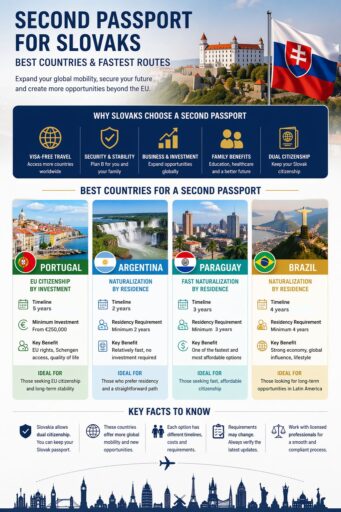
For Slovak citizens, the best second passport options are Portugal for EU-aligned mobility and structured naturalization, Argentina for relatively fast citizenship acquisition, and Paraguay and Brazil for low-cost, residency-based pathways with minimal upfront requirements.
Each option serves a different strategic purpose:
- Type: Residency → citizenship
- Minimum stay: ~5 years legal residency
- Investment (if applicable): ~€250,000+ via qualifying residency routes
- Why it works for Slovaks:
- Maintains full EU mobility and rights, offers a stable legal and economic environment, allows seamless integration within Europe, and is best suited for reinforcing EU citizenship rather than replacing it
- Type: Residency → naturalization
- Minimum stay: ~2 years legal residency (one of the fastest globally)
- Investment: No mandatory investment requirement
- Why it works for Slovaks:
- Extremely fast pathway to citizenship, simple residency-based system, strong long-term mobility in South America, and represents one of the fastest realistic citizenship routes among mainstream countries
- Type: Residency → naturalization
- Minimum stay: ~3 years (after permanent residency)
- Investment: No mandatory bank deposit or investment required under current law; standard residency now only involves administrative fees and documentation processing (typically a few hundred USD, depending on legal assistance and filings).
- Why it works for Slovaks:
- One of the lowest-cost citizenship routes globally, offers a simple residency process, and provides flexible tax residency considerations while serving as a cost-efficient long-term second citizenship strategy
- Type: Residency → naturalization
- Minimum stay: ~4 years (can be shorter in certain cases)
- Investment: Generally no mandatory investment requirement
- Why it works for Slovaks:
- Large, stable Latin American economy, relatively accessible residency pathways, and strong regional travel access within South America, making it a balanced option between accessibility and global relevance
Beyond residency-based pathways in Europe and Latin America, Slovaks also have access to citizenship-by-investment programs that offer a much faster route to a second passport without the need to live in the country long-term.
Citizenship-by-Investment (Caribbean options)
- Dominica
- Saint Lucia
- Grenada
- Type: Direct citizenship-by-investment (no residency required)
- Minimum investment: ~USD $200,000–$250,000+ (donation or approved real estate, depending on country and family size)
- Processing time: ~3–6 months
- Why it works for Slovaks: Provides one of the fastest legal second passports globally, requires no relocation, and offers strong visa-free travel access including the UK and parts of the Schengen area, with speed and mobility diversification as its main advantage rather than settlement or long-term residency benefits
- What you must qualify for: Clean criminal record, verifiable source of funds, successful due diligence clearance, and meeting the minimum investment requirement under the chosen national program
Where do Slovaks immigrate to?
Most Slovak emigrants move to nearby high-income European countries, with Czech Republic as the dominant destination, followed by Austria and Germany, driven by geographic proximity, EU free movement, and significantly higher wages.
Recent migration data show a clear concentration pattern: around 44% of Slovak emigrants move to the Czech Republic, 17% to Austria, and about 7% each to Germany and the United Kingdom.
That means more than two-thirds of all Slovak migration flows remain within these core destinations.
Historically, the Czech Republic has remained the top destination, with estimates showing roughly 6,500 Slovaks annually (around 26% of outflows) choosing it.
These destinations dominate Slovak migration because they combine:
- EU mobility rights (no visa barriers)
- 1.5–3x higher average wages in Austria and Germany
- Established Slovak communities abroad
- Easy cross-border commuting (especially Austria and Czechia)
Overall, Slovak migration is highly regionalized, with most emigrants staying within Central Europe rather than moving to distant global destinations.
Why are people leaving Slovakia?
Many Slovaks are leaving due to a combination of economic pressure, political uncertainty, and widening opportunity gaps within the EU, even though Slovakia remains a member state with free movement rights.
In recent years, this trend has been reinforced by slower economic growth, rising inflation that has reduced real wage gains, and growing public dissatisfaction with domestic policies.
While wages have increased nominally, higher living costs and taxes have reduced perceived financial progress for many households, especially younger workers and skilled professionals.
In addition, political tensions and public protests over austerity measures and governance direction have added to uncertainty, contributing to stronger interest in relocation among working-age citizens.
As a result, migration is increasingly viewed not as temporary work mobility, but as a long-term relocation strategy, particularly among younger Slovaks and skilled professionals seeking stability and higher earning potential abroad.
Is Slovakia a strong passport?
Slovakia has a strong passport globally, offering visa-free or visa-on-arrival access to around 180 countries, largely due to its EU membership and participation in the Schengen Area.
| Index | Ranking position | Notes |
| Henley Passport Index | 7th | Strong EU performance, consistently high mobility ranking |
| Arton Capital Passport Index | 6th | Similar global ranking, emphasizes travel freedom and openness |
| Nomad Capitalist Passport Index | 31st | Evaluates broader factors like tax friendliness, dual citizenship flexibility, and global perception rather than pure visa access |
What are the advantages of having a Slovakia dual citizenship?
Dual citizenship for Slovakia provides a legally secure way to expand global mobility beyond a single national framework while preserving full EU rights and creating redundancy in residency, work, and travel access.
- EU-wide residence and work rights under Slovak citizenship
- Access to public healthcare and education systems across the EU, even when living in another member state
- Schengen mobility, enabling unrestricted travel across most of Europe without border checks
- Strategic diversification of legal identity, useful for relocation, employment shifts, or geopolitical risk hedging
- Backup citizenship structure, reducing dependency on a single passport in case of policy or residency changes
A key but often overlooked benefit is jurisdictional optionality, which is the ability to choose between legal systems for taxation, residency, and long-term settlement planning, especially within the EU framework where mobility rights remain intact.
What are the negatives of dual citizenship?
Slovakia dual citizenship can create legal, tax, and administrative complications when two jurisdictions impose overlapping obligations or conflicting rules.
- Potential tax obligations in multiple jurisdictions, depending on residency and income sourcing rules
- Military or civic obligations in the second country, where applicable
- Increased administrative complexity for passports, renewals, and cross-border documentation
- Legal uncertainty or loss of citizenship risk in countries with restrictive or changing dual nationality laws
- Limited diplomatic protection in certain cases, especially when both countries have competing jurisdictional claims
These factors make careful legal structuring and long-term planning essential before acquiring a second passport, particularly when combining EU and non-EU citizenship regimes.
Current trends shaping demand for second citizenship for Slovaks
Second passport demand among Slovak citizens is increasingly shaped by global policy tightening, slower EU naturalization pathways, and a broader shift toward treating citizenship as a form of long-term mobility insurance.
One major development is the European Union’s stricter stance on investment-based citizenship models, with EU institutions reinforcing that citizenship must be based on genuine ties rather than purely financial contribution.
This has effectively pushed Slovak interest away from any perceived quick EU passport shortcuts and toward structured residency-based or non-EU alternatives.
At the same time, global migration frameworks are shifting toward residency-first and compliance-heavy citizenship systems, particularly in Europe, where naturalization timelines remain relatively long and integration requirements are becoming more formalized.
This reinforces the role of countries like Portugal as long-term EU-aligned pathways rather than fast-track solutions.
Outside Europe, demand is rising for non-EU citizenship options that prioritize speed and mobility diversification, especially in Caribbean jurisdictions that offer direct citizenship through investment within months.
Overall, Slovak second passport demand is being shaped by three clear forces:
- Tightening EU rules around citizenship acquisition and investment pathways
- Continued gap between EU stability (slow) and non-EU speed (fast)
- Growing perception of citizenship as geopolitical and mobility risk diversification rather than identity replacement
Conclusion
For Slovak citizens, a second passport is a planning tool for legal and mobility flexibility, not a replacement for EU citizenship.
Since Slovakia already provides strong regional access, additional nationality only becomes relevant when it adds a different legal framework or changes the speed and structure of access to global mobility.
The key distinction across pathways is functional. EU routes extend existing rights but require long timelines and integration.
Latin American options provide a more accessible entry point into citizenship, while Caribbean programs compress the timeline into months in exchange for investment-based qualification.
What is changing most is the purpose itself.
Second citizenship for Slovakia is no longer viewed primarily as relocation, but as a way to reduce exposure to single-jurisdiction dependency.
FAQs
Who is eligible for a Slovak passport?
Eligibility for a Slovakia passport is based on descent from Slovak parents, birth in Slovakia under specific conditions, or naturalization after a period of long-term legal residence.
Does Slovakia have birthright citizenship?
Slovakia does not grant unconditional birthright citizenship (jus soli). Citizenship is primarily based on descent (jus sanguinis).
What is a golden passport?
A golden passport is citizenship obtained through investment, usually in real estate or government funds, offered by select countries under structured programs.
Is Slovakia a rich or poor country?
According to the World Bank, Slovakia is classified as a high-income developed economy, meaning it is considered a rich country globally, although its average wages remain lower than those in Western European states such as Germany or Austria.
Pained by financial indecision?

Adam is an internationally recognised author on financial matters with over 830million answer views on Quora, a widely sold book on Amazon, and a contributor on Forbes.