Chilean citizens can obtain a second passport through top options like Portugal, Paraguay, Uruguay, and fast-track Caribbean programs without giving up their Chilean nationality.
The available routes for Chileans are shaped by ancestry links, work or residency opportunities, and eligibility for residency and investment-based programs abroad.
This article covers:
- Does Chile allow dual citizenship?
- Why are thousands of people in Chile fleeing their homes?
- Where do most Chileans live outside the country?
- What is the best second passport to have?
- How powerful is a Chilean passport?
- What are some advantages of dual citizenship?
- What are the disadvantages of dual citizenship?
Key Takeaways:
- Chile allows dual citizenship with no renunciation requirement.
- Portugal, Paraguay, Uruguay, and Grenada are second passport options for Chileans.
- Fastest route for a second passport for Chile is citizenship by investment; cheapest is residency-based.
- A second citizenship for Chile enhances mobility, security, and global access.
My contact details are hello@adamfayed.com and WhatsApp +44-7393-450-837 if you have any questions.
For digital nomad or residence visas that require income, assets, or qualifying investments, we can help structure suitable investment solutions that may align with those requirements, depending on your circumstances.
The information in this article is for general guidance only. It does not constitute financial, legal, or tax advice, and is not a recommendation or solicitation to invest. Some facts may have changed since the time of writing.

Can you have multiple citizenships in Chile?
Yes, Chile allows dual (and even multiple) citizenship.
Chilean nationals who acquire another passport are generally not required to renounce their Chilean nationality, and foreigners who naturalize in Chile can often retain their original citizenship, depending on their home country’s rules.
This flexibility is one of the reasons Chileans actively explore a second passport: it expands mobility, financial access, and optionality without forcing a trade-off.
However, dual citizens should still be aware that Chile applies its laws to them while in the country, so local legal and civic obligations continue to apply regardless of any additional nationality.
Why do people leave Chile?
People have left Chile mainly due to rising living costs, limited wage growth, and concerns about long-term economic mobility despite the country’s relative stability.
While Chile remains one of Latin America’s more stable economies, emigration has been driven by a mix of economic pressure and lifestyle considerations.
Key factors include high housing costs (especially in Santiago), wage stagnation relative to expenses, and frustration with inequality.
The 2019 social unrest, followed by ongoing debates over constitutional reform and public services, further highlighted structural issues and pushed some Chileans, particularly younger professionals, to seek better opportunities, education, and income growth abroad.
Where do most Chileans live outside of Chile?
Most Chileans living abroad are concentrated in Argentina, the United States, and Spain, which together account for a large share of the diaspora.
Argentina alone hosts the largest community, with over 190,000 Chile-born residents, followed by the United States (around 190,000 people of Chilean origin) and Spain as a major European destination.
The Chilean diaspora is relatively concentrated in a few key destinations:
- Argentina – the largest destination, driven by proximity and historical migration ties
- United States – a major hub with a growing Chilean-origin population
- Spain – a leading recent destination, attracting nearly half of Chilean migrants to OECD countries in 2023
- Australia and Canada – popular among skilled migrants and students
These migration patterns often influence where Chileans pursue second citizenship, as residency pathways in these countries can lead to naturalization and long-term settlement.
Which country is best for a second passport for Chileans?
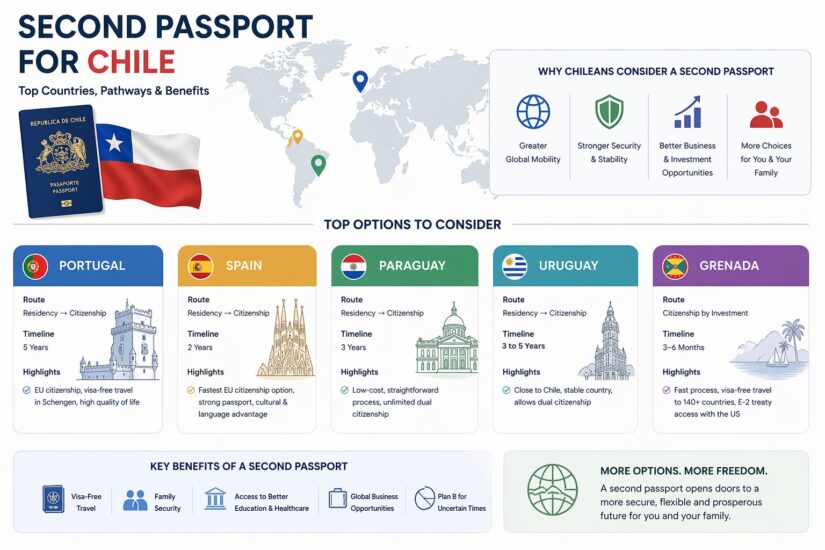
For Chilean citizens, the best second passport options are Portugal, Uruguay, Paraguay, and Grenada, each aligned with different priorities such as EU access, lifestyle stability, lower-cost residency pathways, or fast-track citizenship.
- Route: Residency → citizenship
- Investment: ~€250,000–€500,000 (depending on qualifying investment route)
- Timeline: ~5 years
- Why it stands out: Offers full EU citizenship and strong global mobility; especially attractive for Chileans seeking long-term relocation, business access in Europe, and high-quality public services.
- Route: Residency → citizenship
- Investment: Low-cost residency (no fixed large investment required; proof of income/deposit typically sufficient)
- Timeline: ~3 years (practical timelines may vary)
- Why it stands out: One of the most affordable residency pathways; attractive for Chileans seeking a low-barrier second citizenship route in Latin America with relatively simple bureaucracy.
- Route: Residency → citizenship
- Investment: No formal investment requirement (proof of income/settlement required)
- Timeline: 3–5 years
- Why it stands out: High political and economic stability; similar cultural and language environment makes integration easier for Chileans compared to non-Spanish-speaking destinations.
- Route: Citizenship by investment
- Investment: ~$235,000+ (donation or real estate option depending on program structure)
- Timeline: 3–6 months
- Why it stands out: One of the fastest citizenship programs globally; strong visa-free travel access and unique E-2 treaty with the US, which is valuable for Chileans seeking business mobility.
- Route: Residency → citizenship
- Timeline: 2 years for Latin Americans (including Chileans)
- Why it stands out: One of the fastest EU citizenship pathways for Chileans due to shortened naturalization requirement; strong cultural and linguistic alignment.
- Route: Citizenship by descent
- Timeline: ~2 years of processing (Varies widely)
- Why it stands out: Potential direct EU citizenship without residency or investment if lineage requirements are met, making it one of the most valuable hidden routes for eligible Chileans.
- Route: Residency → citizenship
- Timeline: 3–5 years (depending on immigration pathway)
- Why it stands out: High-quality economy and stable immigration system; attractive for Chileans due to strong living standards, large diaspora presence, and global mobility reputation.
- Route: Residency → citizenship
- Timeline: 5 years
- Why it stands out: Strategic North American hub with strong economic ties to the US; relatively accessible residency options and geographic proximity make it a practical mobility bridge.
- Route: Residency → citizenship / Citizenship by descent (ancestry)
- Timeline: 5 years (residency) or immediate–1 year (if eligible via descent registration)
- Why it stands out: Strong EU passport with high global ranking; English-speaking environment improves integration, and its trusted international reputation supports visa and mobility outcomes.
Each option reflects a different strategy, with Spain offering fast EU citizenship and Portugal focusing on long-term EU strength.
Paraguay and Uruguay provide more accessible or regionally stable pathways, while Grenada enables rapid citizenship with US business access.
Canada, Mexico, and Ireland support long-term settlement, North American mobility, and globally trusted EU access respectively.
What is the easiest second passport to get?
The easiest second passports to obtain globally are typically found in Caribbean citizenship-by-investment schemes such as Grenada, St. Kitts and Nevis, and Dominica, while low-barrier residency routes like Paraguay are often the simplest entry points into eventual citizenship.
- Fastest: Caribbean citizenship-by-investment programs (such as Grenada, St. Kitts and Nevis, and Dominica) can issue citizenship in about 3–6 months, usually without long-term residency.
- For Chileans, the main drawback is the higher upfront investment and limited long-term settlement benefits compared to residency-based EU routes.
- Simplest low-cost route: Paraguay’s residency pathway is widely considered one of the least restrictive globally, typically requiring only a low-cost bank deposit or proof of income (often around US$5,000) and minimal ongoing investment, along with straightforward documentation.
- For Chileans, however, the main limitation is the longer and less predictable naturalization timeline in practice.
Easy rarely means effortless as background checks, documentation, and compliance still apply; but these routes generally reduce complexity compared to traditional immigration systems.
Is Chile a strong passport?
Yes, the Chilean passport is one of the strongest in Latin America, offering visa-free or visa-on-arrival access to around 160–170 countries, including the Schengen Area, United Kingdom, and much of Europe and Asia.
Passport rankings overview
| Index | Chile’s Rank | Key Insights |
| Henley Passport Index | 13th | Consistently top-ranked in Latin America; strong access to Europe and Asia, but still requires visas for the US and Canada (pre-clearance systems apply in some cases). |
| Arton Capital Passport Index | 14th | Slight variation due to methodology; still classifies Chile as a strong mobility passport with high global reach. |
| Nomad Capitalist Passport Index | 48th | Rates Chile highly for visa-free travel, tax friendliness, and perception as a stable, low-risk nationality in global mobility planning. |
What are the advantages and disadvantages of dual citizenship?
Dual citizenship for Chileans offers expanded global mobility, access to more economic opportunities, and added flexibility, but it can also create tax complexity and legal obligations across more than one country.
Advantages
- Greater travel freedom and fewer visa requirements
- Access to more markets for work, business, and investment
- Backup plan for political or economic uncertainty
- Education and healthcare options in multiple countries
Disadvantages
- Potential tax complexity depending on jurisdictions
- Legal obligations in more than one country
- Costs associated with maintaining multiple residencies or statuses
- Administrative complexity (renewals, compliance, reporting)
Dual citizenship is ultimately about optionality, but it comes with added responsibility.
What Chileans Should Consider Before Applying for a Second Passport
Second citizenship for Chileans is best evaluated based on intended use, such as relocation, business expansion, tax planning, or lifestyle flexibility, before choosing a specific pathway.
- Budget and investment capacity: Some routes require significant capital (e.g., Caribbean citizenship-by-investment), while others rely on lower-cost residency pathways over time (e.g., Paraguay or Uruguay).
- Willingness to relocate: Residency-based programs often require physical presence or long-term ties, while investment-based citizenship may not.
- Language and integration: Countries like Spain, Portugal, and Uruguay are easier for Chileans to integrate into due to language and cultural similarity, while Canada or Ireland may involve a steeper adjustment.
- Tax and legal exposure: Holding multiple citizenships can create tax residency implications depending on where a person lives and earns income.
- Time horizon: Some options deliver citizenship quickly (months), while others require several years of residency before eligibility.
Conclusion
A second passport for Chileans is about expanding optionality and access to different legal, economic, and mobility systems rather than replacing an already strong nationality.
Its value lies in what it enables, whether that is relocation opportunities, business expansion, or greater flexibility in how and where life and work are structured over time.
For personalized planning around residency, taxation, and cross-border structuring, it can also be useful to consult a licensed professional, such as a financial advisor in Chile or an international wealth specialist.
FAQs
What problems is Chile facing today?
Chile continues to face structural inequality, rising concerns over crime and public safety, and political polarization alongside ongoing debates over economic and social reform.
While macroeconomic conditions remain relatively stable with moderate growth and easing inflation, public pressure for improvements in pensions, healthcare, education, and security remains strong.
Why are people migrating to Chile?
Chile attracts migrants mainly from neighboring and lower-income countries due to higher wages, relatively stable institutions, and stronger labor market opportunities within the region.
What are the top 3 countries sending migrants?
On a global scale, the largest migrant-origin countries are India, Mexico, and China, which consistently rank among the top sources of international migrants due to population size and labor mobility.
Migration flows from these countries are driven by a combination of economic opportunity, family reunification, and regional labor demand.
Is Chile wealthy or poor?
Chile is classified as a high-income economy by the World Bank and has one of the highest GDP per capita levels in Latin America, although income distribution remains relatively uneven.
Is it hard to get citizenship in Chile?
Citizenship is relatively easy to get in Chile compared to many developed countries, typically requiring around 5 years of legal residency and a clean criminal record.
Processing times and administrative requirements can vary depending on documentation and government workload, so timelines are not always uniform.
Pained by financial indecision?

Adam is an internationally recognised author on financial matters with over 830million answer views on Quora, a widely sold book on Amazon, and a contributor on Forbes.