A second passport for Brazil can open wider global mobility, with many Brazilians exploring options such as Portugal, the United States, Canada, and Caribbean citizenship-by-investment programs.
These pathways offer access to stronger residency rights, travel freedom, and long-term international opportunities.
This article covers:
- Does Brazil allow dual citizenship?
- Why are people immigrating from Brazil?
- Where do most Brazilian immigrants go?
- What is the best second passport to have?
- Who has the cheapest passports in the world?
- Is it a good idea to have two passports?
Key Takeaways:
- Brazil allows dual and multiple citizenships.
- The United States and Portugal are top destinations for Brazilian emigrants.
- Caribbean citizenship-by-investment programs are among the cheapest second passport for Brazilians.
- A second passport is mainly valuable for mobility, stability, and financial diversification.
My contact details are hello@adamfayed.com and WhatsApp +44-7393-450-837 if you have any questions.
For digital nomad or residence visas that require income, assets, or qualifying investments, we can help structure suitable investment solutions that may align with those requirements, depending on your circumstances.
The information in this article is for general guidance only. It does not constitute financial, legal, or tax advice, and is not a recommendation or solicitation to invest. Some facts may have changed since the time of writing.

Can you have two citizenships in Brazil?
Yes, you can have two citizenships in Brazil.
Brazilian law permits dual citizenship, meaning Brazilians can acquire another nationality without losing their Brazilian passport.
Brazil recognizes dual citizenship in cases such as:
- When another nationality is obtained by birth (for example, being born in a country that grants citizenship by jus soli)
- When citizenship is granted automatically by foreign law, without a voluntary application process
This is especially important because some countries require applicants to renounce their original citizenship when naturalizing.
Brazil is more flexible, but it still applies one key limitation: Brazilian citizenship can only be revoked in rare cases, such as voluntary renunciation or a final criminal conviction involving loss of nationality under specific legal conditions.
Which country is best for a second passport for Brazilians?
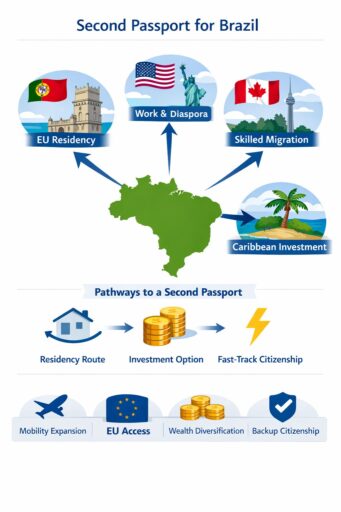
The most relevant second passport options for Brazilians are Portugal, Caribbean citizenship-by-investment programs, Canada, Spain, and Australia, with each choice suited to different priorities such as faster acquisition, lower cost, or long-term residency and settlement pathways
Portugal – residency-to-citizenship route via investment, work, or passive income visas
- Minimum investment: ~€250,000–€500,000 (investment route varies)
- Citizenship timeline: ~5 years of legal residency
- Why it fits Brazilians: shared language, cultural familiarity, and EU access
Caribbean CBI programs (e.g., Dominica, St. Lucia, Antigua and Barbuda) – direct citizenship by investment
- Minimum investment: ~US$200,000–$250,000 depending on program
- Citizenship timeline: ~3–6 months
- Why it fits Brazilians: fastest route to a second passport and strong visa-free travel options
Canada – skilled migration and residency-to-citizenship pathway
- Minimum investment: not required for most skilled routes (points-based system)
- Citizenship timeline: ~3–5 years of permanent residency
- Why it fits Brazilians: high quality of life, education, and immigration-friendly system
Spain – residency route with faster citizenship for Latin Americans
- Minimum investment: varies (visa-dependent, e.g., passive income or property)
- Citizenship timeline: ~2 years for Brazilians (fast-track for Latin American nationals)
- Why it fits Brazilians: cultural and linguistic similarity, relatively fast EU citizenship pathway
Australia – skilled migration and points-based residency system
- Minimum investment: not required for most skilled visas
- Citizenship timeline: ~4–5 years of residency
- Why it fits Brazilians: strong economy, high wages, and stable long-term settlement option
For most Brazilians, Portugal remains the most balanced option, combining cultural proximity with a clear EU citizenship pathway, while Caribbean programs are preferred for speed and Canada for long-term settlement value.
What is the cheapest country to get a second passport?
The cheapest options for a second citizenship for Brazilians are typically found in citizenship-by-investment programs such as Dominica, St. Lucia, Antigua and Barbuda, Vanuatu, Nauru, and São Tomé and Príncipe, with entry costs starting from around US$90,000.
The lowest-cost routes are mainly split between established Caribbean programs and smaller emerging citizenship schemes.
Caribbean citizenship-by-investment (most established low-cost option)
- Dominica – from US$200,000
- St. Lucia – from US$240,000
- Antigua and Barbuda – from US$230,000
These are the most widely recognized low-cost citizenship programs, offering relatively fast processing (often 3–6 months) and stronger global visa-free access compared to newer alternatives.
Ultra-low-cost emerging citizenship programs (alternative tier)
- Vanuatu – US$130,000, fast processing but weaker visa network than Caribbean passports
- Nauru – US$90,000–$120,000, one of the lowest entry points globally but with limited track record
- São Tomé and Príncipe – US$90,000 + US$5,000 submission fee, small developing program with restricted global mobility
These options are among the absolute cheapest ways to obtain citizenship, but they generally come with more limited visa-free travel, smaller international recognition, and less established program history.
What country do most Brazilians immigrate to?
The United States is the leading destination for Brazilian emigrants, hosting the largest share of the Brazilian diaspora, estimated at over 1.9 million people, roughly 40% of Brazilians living abroad, followed by Portugal and other European countries.
- United States – largest Brazilian community abroad, strong job market, and established diaspora networks
- Portugal – language similarity and EU residency pathway leading to citizenship
- Canada – immigration-friendly policies and high quality of life
- Spain – cultural proximity and relatively smooth integration
Overall, around 5 million Brazilians live outside Brazil according to Italianismo, with migration concentrated in the United States and Europe.
Why are so many Brazilians leaving Brazil?
Many Brazilians are leaving Brazil due to persistent economic pressure, rising living expenses, and stronger long-term opportunities abroad, as inflation, currency volatility, and limited wage growth continue to affect middle-class financial stability.
In recent years, migration has also been shaped by broader macroeconomic conditions.
While Brazil has shown periods of recovery, inflation has remained above target levels and borrowing costs have stayed high, reducing purchasing power and slowing upward mobility.
At the same time, global demand for skilled labor in countries like Portugal, the United States, and Canada continues to attract Brazilian professionals seeking higher salaries and more stable economic environments.
Recent economic conditions, including fiscal constraints and high interest rates, continue to weigh on long-term confidence and contribute to sustained outward migration among skilled workers and younger professionals.
Is Brazil a powerful passport?
The Brazilian passport offers visa-free or visa-on-arrival access to around 160 destinations worldwide, placing it in the mid-tier globally, strong for regional travel but weaker compared to top-tier passports like Japan, Germany, or the United States.
Passport rankings comparison
| Index | Brazil’s Ranking | Key insights |
| Henley Passport Index | 15th | Strong access across South America, parts of Europe and Asia, but limited access to US and Schengen Area without visas |
| Arton Capital Passport Index | 12th | Slightly more favorable mobility scoring, reflecting broader short-term travel access and visa-on-arrival options |
| Nomad Capitalist Passport Index | 42nd | Penalized due to taxation complexity, investment environment, and limited global financial mobility compared to higher-ranked passports |
Is it worth it to have two passports?
Having two passports for Brazilians is often worth it for more global mobility, financial flexibility, and long-term security, but it also comes with costs, obligations, and complexity that may not suit everyone.
Benefits
- Expanded visa-free travel and fewer mobility restrictions
- Access to better education, healthcare, and residency options
- Tax planning and wealth diversification opportunities
- Greater political and economic stability
- A backup residency or exit option during periods of uncertainty
Drawbacks
- High costs, especially for investment-based citizenship programs
- Ongoing residency or physical presence requirements in some countries
- Possible tax exposure or dual reporting obligations depending on jurisdictions
- Legal and administrative complexity when managing two nationalities
Residency vs Direct Citizenship Pathways for a Second Passport
For Brazilians, choosing a second passport entails paying for speed through direct citizenship or investing time through residency pathways that lead to stronger passports.
Direct citizenship (citizenship-by-investment)
This route grants a passport without long-term residency requirements.
- Timeline: ~3–6 months
- Requirement: financial contribution or investment
- Common countries: Caribbean programs, Vanuatu
- Residency requirement: none or minimal
- Best for: fast mobility and backup citizenship
Trade-off: faster and simpler, but typically offers weaker passports and limited relocation value.
Residency → citizenship (naturalization route)
This route requires living in a country before qualifying for citizenship.
- Timeline: ~2–5+ years depending on country
- Requirement: legal residency (via work, business, or passive income)
- Common countries: Portugal, Spain, Canada
- Residency requirement: physical presence over time
- Best for: stronger passports and long-term relocation
Trade-off: slower and more complex, but results in higher-quality citizenship with broader rights.
For most Brazilians, the decision comes down to whether the goal is a fast backup passport or a strategic move into a stronger economic and legal system.
Conclusion
A second passport for Brazilians is increasingly tied to risk management and global positioning, not just travel.
Currency exposure, access to international banking systems, and the ability to operate across multiple jurisdictions are becoming just as important as visa-free entry.
The strongest outcomes usually come from stacking options rather than relying on a single move for example, combining a residency pathway in Europe with a faster second passport elsewhere.
This creates flexibility across both short-term mobility and long-term settlement.
Another often overlooked factor is policy stability.
Immigration rules, tax frameworks, and citizenship programs can change quickly, so choosing a country with a predictable legal environment can matter more than marginal differences in cost or processing time.
In reality, a second passport only delivers value when it is actively usable, whether for relocation, structuring assets, or accessing opportunities abroad.
FAQs
What are the 4 types of citizenship?
The four main types of citizenship are birthright citizenship (jus soli), citizenship by descent (jus sanguinis), naturalization (residency-based), and citizenship by investment.
Is it easy to get PR in Brazil?
Yes, permanent residency in Brazil is relatively accessible, with clear pathways through family ties, marriage, work or investment visas, and Mercosur agreements for regional nationals.
What is the weakest passport in the world?
The weakest passports in the world are typically from countries facing conflict or instability, with Afghanistan, Syria, and Iraq consistently ranking lowest due to very limited visa-free access and global mobility.
Pained by financial indecision?

Adam is an internationally recognised author on financial matters with over 830million answer views on Quora, a widely sold book on Amazon, and a contributor on Forbes.