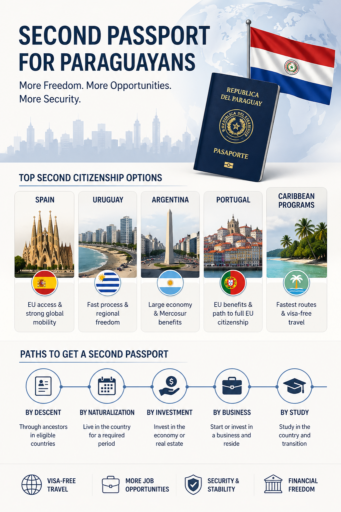
A second passport for Paraguayans is most commonly pursued through fast-track naturalization in Spain or regional pathways in Uruguay and Argentina, with some also opting for investment programs in Grenada or other Caribbean nations to gain wider global access.
These options are designed to unlock stronger passports, wider visa-free access, and the ability to live and work across multiple regions.
This article covers:
- Can you get dual citizenship in Paraguay?
- Why are so many people moving from Paraguay?
- Why are so many people moving to Paraguay?
- What is the best second passport to have?
- How strong is Paraguay passport?
- What are the advantages and disadvantages of dual citizenship?
Key Takeaways:
- Paraguay allows dual citizenship, but recognition is based on agreements.
- Spain and Portugal offer some of the most efficient citizenship pathways.
- Caribbean programs provide the fastest route to a second passport for Paraguayans.
- A second citizenship for Paraguay significantly improves travel freedom and flexibility.
My contact details are hello@adamfayed.com and WhatsApp +44-7393-450-837 if you have any questions.
For digital nomad or residence visas that require income, assets, or qualifying investments, we can help structure suitable investment solutions that may align with those requirements, depending on your circumstances.
The information in this article is for general guidance only. It does not constitute financial, legal, or tax advice, and is not a recommendation or solicitation to invest. Some facts may have changed since the time of writing.

Does Paraguay allow dual citizenship?
Yes, Paraguay allows dual citizenship, but only where it is recognized under its Constitution and formal bilateral agreements.
Under the Constitution of Paraguay and implementing nationality laws, Paraguay generally permits dual nationality only with countries that have reciprocity agreements, such as Spain and Italy.
In practice, this means Paraguayan citizens can legally hold another passport, especially when the second country also permits dual nationality.
However, if there is no agreement in place, recognition of dual citizenship may be limited, so it’s important to check whether your target country requires renunciation or imposes restrictions.
Why are people leaving Paraguay?
Paraguayans leave primarily for better economic opportunities, higher wages, and improved access to education, healthcare, and global mobility abroad.
While Paraguay is known for its low cost of living, outward migration remains steady, with many households relying on income from relatives working overseas.
Economic limitations, particularly slower wage growth and fewer high-paying job opportunities, continue to push citizens to look abroad for long-term stability.
Recent developments also reflect broader migration dynamics.
In 2025, Paraguay saw public protests over governance and corruption concerns, highlighting underlying social and political frustrations among younger populations.
Meanwhile, regional mobility remains strong, with many Paraguayans continuing to move to neighboring economies or Europe in search of better prospects.
At the same time, Paraguay is becoming more attractive to foreign residents due to low taxes and new residency programs, with applications surging significantly in 2025–2026.
This contrast (more foreigners moving in while locals still seek opportunities abroad) underscores a key reality:
- Limited economic opportunities and wage growth
- Access to higher-quality education and healthcare abroad
- Desire for stronger currencies and financial systems
- Greater travel freedom
Many Paraguayans ultimately pursue opportunities in more developed economies where salaries, career growth, and long-term financial security are stronger.
Where is the largest Paraguayan diaspora?
The largest Paraguayan diaspora is in Argentina, where over 500,000 Paraguayans live, making them the country’s largest immigrant group according to Latinometrics.
The bulk of Paraguayan migration remains highly regional.
Argentina dominates due to geographic proximity, open-border dynamics, and long-standing labor migration patterns, with Paraguayan-born residents concentrated mainly in Buenos Aires and nearby provinces.
Other major destinations include:
- Spain – a key European hub due to language, cultural ties, and favorable citizenship laws for Latin Americans
- Brazil – home to roughly 60,000–70,000 Paraguayans, particularly in border states like Paraná and Mato Grosso do Sul
- United States – a smaller but growing diaspora
This distribution highlights a clear pattern: most Paraguayans migrate within South America first, especially to Argentina, while Spain stands out as the main gateway to Europe, particularly for those pursuing long-term residency or citizenship.
Which country is best for a second citizenship for Paraguayans?
The most relevant second passport options for Paraguayan citizens are Spain, Uruguay, Argentina, and Grenada, each aligned with different priorities such as faster citizenship timelines, regional mobility, or broader global travel access.
Spain
- Route: Residency → citizenship (fast-track for Latin Americans)
- Timeline: 2 years
- Investment: No citizenship investment required; only standard residency, physical presence, and integration requirements
- Why it works for Paraguayans: One of the fastest citizenship pathways in Europe due to Latin American eligibility, plus strong language and cultural alignment. It offers a major mobility upgrade from the Paraguayan passport with access to the EU and Schengen area.
Uruguay
- Route: Residency → citizenship (based on continuous residence)
- Timeline: 3–5 years (varies by case)
- Investment: No mandatory investment; proof of income/residency required
- Why it works for Paraguayans: Close geographic proximity and MERCOSUR integration make relocation easier. It is one of the most stable and accessible citizenship pathways in South America with strong legal and institutional stability.
- Route: Residency → citizenship
- Timeline: 2 years of legal residence
- Investment: No fixed investment requirement
- Why it works for Paraguayans: Historically one of the largest destinations for Paraguayan migrants, with cultural familiarity and open regional mobility. It offers one of the more straightforward naturalization routes in the region.
- Route: Citizenship by investment (CBI)
- Timeline: 3–6 months
- Investment: ~US$235,000+ (donation or approved real estate options)
- Why it works for Paraguayans: No relocation required and very fast processing, making it ideal for those prioritizing immediate global mobility. It provides visa-free access to multiple key destinations and serves as a backup passport strategy.
Portugal
- Route: Residency → citizenship
- Timeline: 5 years
- Investment: No mandatory investment for citizenship (residency may be obtained via work, income, or eligible investment routes)
- Why it works for Paraguayans: Offers a stable EU entry route for Paraguayans who do not qualify for Spain’s fast-track option or prefer a longer but flexible pathway into European citizenship
- Route: Ancestry (jus sanguinis) or residency → citizenship
- Timeline: 2–10+ years (standard residency route ~10 years; faster only if eligible through citizenship by descent or marriage, not residency acceleration
- Investment: None (unless via residency costs)
- Why it works for Paraguayans: Paraguay has a significant population with Italian ancestry, making this a potential hidden eligibility route for some Paraguayans seeking EU citizenship through descent
Caribbean Citizenship by Investment (CBI)
Includes programs like Dominica and Saint Kitts and Nevis
- Route: Citizenship by investment
- Timeline: 3–6 months
- Investment: ~US$200,000–US$250,000+ depending on program
- Why it works for Paraguayans: Provides Paraguayans with the fastest legal way to obtain a second passport without relocation, ideal for those prioritizing immediate global travel access
What is the easiest 2nd passport to get?
The easiest second passport for Paraguay, defined by low residency requirements, fast processing time, minimal physical presence, and simplified eligibility criteria, is found through Dominica, Saint Kitts and Nevis, Antigua and Barbuda, and similar citizenship-by-investment programs.
Additional options may include niche ancestry-based or flexible residency routes available in select jurisdictions globally.
- Fastest option (Caribbean CBI): Dominica, Saint Kitts and Nevis, and Antigua and Barbuda offer citizenship, processed in just a few months (3-6 months) without residency requirements
- Drawbacks: High upfront cost (often ~US$200,000+), strict background checks, and limited connection to long-term residence or settlement pathways
- Ancestry-based citizenship routes: Available in select countries where lineage qualifies applicants for citizenship, typically taking 1–3 years. Require no investment or long-term residency, but only if the applicant can clearly prove eligibility through official ancestral records.
- Limitation: Eligibility depends entirely on documented ancestry; if records are unavailable or incomplete, the route is not accessible
- Flexible residency-to-citizenship systems: Some countries offer relatively straightforward naturalization pathways that typically take 2–10 years, requiring legal residency and basic integration rather than large investments.
- Drawbacks: Requires several years of physical residence, ongoing compliance, and integration (language/civic requirements in some cases)
In general, easiest second passports are not those with the shortest legal rules alone, but those that balance speed, accessibility, and reduced residency obligations, often at the cost of higher fees or stricter qualification checks.
How good is a Paraguay passport?
The Paraguay passport is a mid-tier travel document, offering visa-free or visa-on-arrival access to around 140 countries, making it useful for regional and moderate global mobility but weaker compared to top-tier passports.
| Index | Ranking Position | Global Standing |
| Henley Passport Index | 26th | Mid-tier global mobility |
| Arton Capital Passport Index | 25th | Moderate strength, stronger regional access |
| Nomad Capitalist Passport Index | 64th | Weaker performance in tax/mobility-adjusted ranking |
While the Paraguay passport performs reasonably well in Latin America and parts of Europe, it ranks as a mid-tier passport globally, with limited access to high-demand destinations such as the United States and select Schengen countries requiring visas.
Is it a good idea to get dual citizenship for Paraguayans?
Yes, getting dual citizenship is generally a good idea for many Paraguayans because it significantly expands global mobility, economic opportunities, and long-term security.
Benefits include:
- Expanded visa-free travel
- Access to new job markets
- Diversification of political and economic risk
- Ability to live, work, or study abroad
However, there are also considerations:
- Tax obligations in multiple countries
- Legal complexities depending on nationality combinations
- Military or civic duties in certain jurisdictions
For a deeper look at tax and financial planning implications, it can also be useful to consult a financial advisor in Paraguay before applying for dual citizenship.
Ultimately, the value of dual citizenship depends on individual goals, such as whether the priority is mobility, financial planning, or relocation flexibility.
Smart second passport combinations for Paraguayans
A more effective approach than choosing a single country is building a two-layer citizenship strategy that separates immediate mobility needs from long-term settlement goals.
- Mobility + stability pairing
One passport is used for fast global travel access (often through a quick-acquisition program), while another is pursued for long-term residency-based citizenship that provides legal stability and stronger rights. - Regional base + global upgrade strategy
Many Paraguayans maintain a strong South American base while pursuing a separate citizenship that expands access beyond the region, particularly into Europe or wider global travel networks. - Short-term access + long-term integration balance
Fast-acquired passports are used for immediate flexibility, while slower naturalization routes are used to secure deeper economic, legal, and residency benefits over time.
Conclusion
A second passport for Paraguayans is ultimately a planning tool rather than a destination choice.
The value isn’t just in expanding travel access, but in how it reshapes long-term options around work, residence, and financial flexibility.
What matters most is how each pathway fits into a broader life structure; some routes prioritize immediacy, others prioritize depth, and the strongest outcomes usually come from combining both.
In that sense, the decision is about building a position that keeps future choices open rather than narrowing them.
FAQs
How many citizenships can you have in Paraguay?
Paraguay does not set a fixed legal limit on the number of citizenships a person can hold, as long as dual or multiple nationality is recognized under applicable agreements.
In practice, Paraguayans can hold multiple citizenships if the other countries involved also permit it.
Is it easy to get citizenship in Paraguay?
Citizenship in Paraguay is relatively accessible, typically available after about 3 years of legal residency, provided legal requirements and genuine ties to the country are met.
Is Paraguay a poor or rich country?
Paraguay is classified as an upper-middle-income developing economy, according to IFAD, meaning it is neither poor nor rich, but sits in the middle stage of global development with steady growth and structural gaps.
Which passport to use when having dual citizenship?
You should use the passport that provides the best legal and visa advantages for each trip; typically your Paraguayan passport when entering or leaving Paraguay, and your stronger passport for international travel or entry into that specific country.
Pained by financial indecision?

Adam is an internationally recognised author on financial matters with over 830million answer views on Quora, a widely sold book on Amazon, and a contributor on Forbes.