A second passport for Peruvians refers to obtaining an additional nationality alongside Peruvian citizenship, with common top options for Peruvians including Spain, Portugal, Canada, and Chile based on whether the goal is faster citizenship, EU access, or regional relocation.
Peru generally allows dual and multiple citizenships, making it relatively flexible for acquiring a second passport without renouncing Peruvian nationality.
This article covers:
- How many citizenships can a Peruvian citizen have?
- Why are people moving out of Peru?
- Where do Peruvians immigrate to the most?
- What is the best second passport for Peru?
- What is the ranking of Peru’s passport?
- Is it good or bad to have dual citizenship?
Key Takeaways:
- Peru permits dual and multiple citizenships without requiring renunciation.
- Spain, Portugal, Canada, and Chile are among the most relevant second passport pathways for Peruvians.
- The Peruvian passport has moderate global mobility, driving interest in second citizenships.
- Dual citizenship expands travel and opportunity access but may add legal and tax complexity.
My contact details are hello@adamfayed.com and WhatsApp +44-7393-450-837 if you have any questions.
For digital nomad or residence visas that require income, assets, or qualifying investments, we can help structure suitable investment solutions that may align with those requirements, depending on your circumstances.
The information in this article is for general guidance only. It does not constitute financial, legal, or tax advice, and is not a recommendation or solicitation to invest. Some facts may have changed since the time of writing.

How many citizenships does Peru allow?
Peru allows dual and multiple citizenships without a legal limit, as recognized under its constitutional and nationality framework.
A Peruvian citizen can hold additional nationalities while retaining Peruvian citizenship, and foreign nationals naturalizing in Peru are generally not required to renounce their original citizenship unless their home country imposes that condition.
This makes Peru part of a group of countries that support flexible nationality and international mobility.
Peru also recognizes dual nationality at the administrative level, meaning individuals can hold and use multiple passports depending on travel and legal context, unlike in some countries where dual citizens may be required to enter and exit using only one nationality or face restrictions on which passport they can use domestically.
How do you qualify for dual citizenship in Peru?
You qualify for dual citizenship in Peru by obtaining Peruvian nationality through descent, naturalization after legal residency, or marriage to a Peruvian citizen, all of which allow you to hold another nationality without typically needing to renounce your original citizenship.
To obtain or maintain dual citizenship involving Peru, you typically need to meet one of the following:
- Be born to at least one Peruvian parent (citizenship by descent)
- Naturalize in Peru after 5 years of legal residency
- Marry a Peruvian citizen and fulfill residency requirements
- Meet standard naturalization requirements (such as continuous legal residence)
Why are Peruvians leaving Peru?
Peruvians are leaving Peru primarily due to economic instability, limited formal job opportunities, and ongoing political uncertainty, which together reduce long-term confidence in domestic prospects.
While Peru has maintained overall macroeconomic stability, a large share of employment remains informal, limiting income security, benefits, and career growth for many workers.
Poverty levels also remain uneven across regions, reinforcing economic pressure on households.
Political instability and frequent leadership changes in recent years have further weakened confidence in long-term planning, while concerns over crime in certain areas add to the push factors.
As a result, migration is often seen as a pathway to higher wages, better education systems, improved safety, and more predictable long-term stability abroad.
Where do Peruvians immigrate to?
Recent migration patterns show that around 3.5 million Peruvians live abroad, with the largest communities concentrated in the United States, Spain, and Chile.
Peruvians commonly move to destinations that offer strong labor markets and established migrant communities, including:
- United States
- Spain
- Chile
- Italy
- Argentina
The United States remains the top destination for employment and education opportunities, while Spain attracts many Peruvians due to language and cultural ties.
Chile is also a major regional hub because of geographic proximity and relatively stable labor demand.
Which country is best for a second passport for Peruvians?
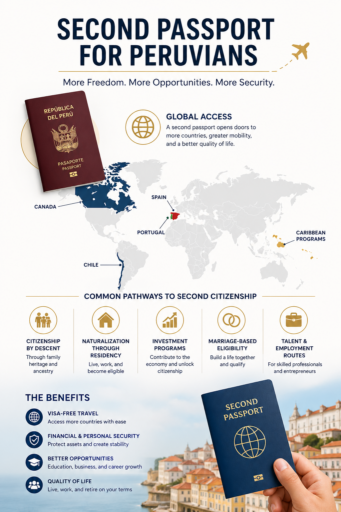
The most relevant second passport options for Peruvian citizens are Spain, Portugal, Canada, Chile, and Caribbean citizenship-by-investment programs such as Grenada and St. Lucia, chosen based on priorities like fast citizenship, EU mobility, work and education opportunities, or regional relocation.
Portugal (EU residency-to-citizenship route)
- Route: Residency → citizenship
- Stay requirement: 5 years legal residency
- Investment: Not required for citizenship, but some residency pathways (like investment funds or business options) may involve €250,000+ if choosing a Golden Visa-style route
- Why it suits Peruvians: Leads to EU citizenship with strong mobility rights across the Schengen Area, while offering flexible residency pathways that can be accessed through work, study, or other non-investment options.
Spain (heritage and naturalization route)
- Route: Residency or Latin American reduced naturalization pathway
- Stay requirement: 2 years for Latin American nationals (including Peruvians)
- Investment: No investment required for standard naturalization
- Why it suits Peruvians: One of the fastest EU citizenship routes for Peruvians, with easier integration supported by shared language and strong cultural ties.
Canada (work, study, and immigration pathways)
- Route: Express Entry, study permit → PR → citizenship
- Stay requirement: 3 years of physical presence as a permanent resident
- Investment: No direct citizenship investment, but requires skilled migration or study costs
- Why it suits Peruvians: Strong economy with high-quality education and healthcare systems, supported by clear immigration pathways and strong demand for skilled workers.
Chile (regional naturalization option)
- Route: Residency → citizenship
- Stay requirement: 5 years residency (varies by visa type)
- Investment: No citizenship investment requirement
- Why it suits Peruvians: Close geographic and economic ties with Peru, making it one of the easiest regional relocation options with strong labor mobility opportunities.
Grenada / St. Lucia (and other Caribbean CBI Programs)
- Route: Direct citizenship-by-investment
- Stay requirement: No residency required
- Investment: as low as USD 200,000+ donation or real estate investment (varies by program)
- Why it suits Peruvians: Fastest route to a second passport, often completed in months, offering immediate visa-free travel expansion and a reliable backup citizenship.
How powerful is a Peruvian passport?
The Peruvian passport provides access to around 140 visa-free or visa-on-arrival destinations, placing it in the mid-range globally in terms of travel freedom.
| Index | Ranking | Overall standing |
| Henley Passport Index | 29th | Moderate strength; Based purely on visa-free / visa-on-arrival access to global destinations |
| Arton Capital Passport Index | 20th | Mid-tier mobility; Measures travel mobility plus global score weighting of visa categories (visa-free, visa-on-arrival, eTA) |
| Nomad Capitalist Passport Index | 60th | Balanced but not high-tier passport; Evaluates broader factors such as taxation, global perception, dual citizenship friendliness, and personal freedom |
The Peruvian passport provides visa-free or visa-on-arrival access to parts of Latin America, several Asian destinations, and select African countries.
However, it has limited access to the Schengen Area and the United States, which are major global mobility hubs.
Because of this gap in high-value travel access, many Peruvians pursue a second passport to improve mobility, business flexibility, and long-term relocation options.
What are the benefits of second citizenship for Peruvians?
A second citizenship for Peru gives access to greater global positioning, stronger legal and financial frameworks abroad, and alternative residency rights outside Peru.
- Increased visa-free travel options, especially to high-access regions like the EU or Caribbean states
- Eligibility to live, work, or study in countries with stronger immigration systems
- Ability to structure assets or income across jurisdictions for greater financial flexibility
- Access to more stable healthcare, education, and public services in developed countries
- An additional nationality that can reduce dependence on a single country’s political or economic conditions
For many Peruvians, it serves as a long-term Plan B for global stability.
What are the negatives of dual citizenship?
Dual citizenship in Peru can create tax exposure, legal complexity, and administrative obligations across multiple countries, which may outweigh the benefits if not properly planned.
- Possible double taxation depending on countries involved and their tax residency rules
- Complicated legal and reporting requirements across two jurisdictions (banking, taxes, and compliance)
- Potential military service obligations in certain countries with mandatory conscription laws
- Increased administrative burden for renewing passports, maintaining records, and tracking residency status
- Restrictions or conflicts in eligibility for certain government, security, or public sector jobs
Tax Residency vs Citizenship: The Hidden Factor Peruvians Often Overlook
One of the most misunderstood aspects of obtaining a second passport is that citizenship and tax residency are separate systems, and moving abroad can change tax obligations even before citizenship is acquired elsewhere.
- Citizenship does not automatically determine taxation; tax status is usually based on where a person lives, works, and spends most of their time
- Becoming a tax resident abroad can trigger new obligations, especially in countries that tax worldwide income (depending on their tax system)
- Peru’s tax system is residency-based, meaning tax obligations depend more on where a person is considered resident rather than citizenship alone
- Some countries tax global income, while others are territorial, which can significantly affect long-term financial planning after migration
- Timing matters; when an individual leaves Peru and establishes residency elsewhere can influence whether overlapping tax exposure occurs
For more detailed guidance on structuring finances and managing cross-border tax exposure, consulting a financial advisor in Peru can provide additional clarity.
For Peruvians pursuing a second passport or relocation, understanding tax residency rules is just as important as choosing the destination country, since it can affect income, investments, and long-term financial structure.
Conclusion
For Peruvians, a second passport functions as a tool for increasing mobility options, reducing dependence on a single jurisdiction, and expanding long-term personal and financial flexibility.
The most important decision is not the passport itself, but the route taken to obtain it and the obligations that come with it over time.
Different pathways serve different objectives: Caribbean programs prioritize speed, Spain and Portugal focus on long-term EU access, and Canada emphasizes structured migration through skills and education.
Each route leads to a different balance between time, cost, and long-term settlement rights.
Many challenges arise when applicants focus only on visa-free travel while overlooking residency requirements, tax exposure, and the practical steps needed to maintain status in another country.
These factors often determine the real value of a second citizenship over the long term.
A more effective approach is to treat Peru second citizenship as part of a broader relocation and planning strategy, where residency, taxation, and lifestyle goals are considered together rather than in isolation.
FAQs
How many passports can you have in Peru?
Peru does not impose a strict limit on the number of citizenships a person can hold.
Peruvians may legally hold multiple passports, based on the laws of the other countries involved.
Is it hard to get Peruvian citizenship?
Peruvian citizenship is moderately accessible, typically requiring around 5 years of continuous legal residency for naturalization, or about 2 years if married to a Peruvian citizen, followed by an application and government approval process.
What are the new citizenship laws in Peru?
Recent updates to Peru’s nationality framework have changed the standard naturalization requirement from 2 years of legal residency to 5 years, as part of a broader reform of the citizenship system.
How can I get a second citizenship?
You can get a second citizenship through descent, residency-based naturalization, investment programs (where available), marriage, or work and talent-based immigration routes.
Pained by financial indecision?

Adam is an internationally recognised author on financial matters with over 830million answer views on Quora, a widely sold book on Amazon, and a contributor on Forbes.