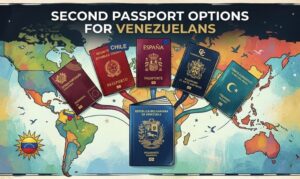
A second passport for Venezuela typically involves Venezuelans acquiring citizenship in countries such as Spain, Colombia, Peru, Chile, Brazil, or the United States while retaining their Venezuelan nationality.
These are among the most common destinations due to existing migration routes, legal pathways to residency, and established Venezuelan communities.
This article covers:
- Does Venezuela allow multiple citizenships?
- Why are so many people leaving Venezuela?
- What countries are Venezuelans fleeing to?
- What is the best second passport for Venezuelans?
- Is a Venezuelan passport powerful?
- What are the advantages and disadvantages of dual citizenship?
Key Takeaways:
- Venezuela allows dual citizenship, making second passports legally possible.
- Economic instability is the main driver of large-scale emigration in Venezuela.
- Latin America and Europe are the top destinations for Venezuelan migrants.
- A Venezuela second passport significantly improves mobility, security, and opportunity.
My contact details are hello@adamfayed.com and WhatsApp +44-7393-450-837 if you have any questions.
For digital nomad or residence visas that require income, assets, or qualifying investments, we can help structure suitable investment solutions that may align with those requirements, depending on your circumstances.
The information in this article is for general guidance only. It does not constitute financial, legal, or tax advice, and is not a recommendation or solicitation to invest. Some facts may have changed since the time of writing.

Can Venezuelans hold dual citizenship?
Yes, Venezuelans can hold dual citizenship.
The Venezuelan Constitution allows citizens to retain their nationality even if they acquire another passport.
This makes Venezuela one of the more flexible countries in Latin America regarding dual nationality.
However, dual citizens must still follow specific administrative rules, such as using Venezuelan documents when entering or exiting the country.
This requirement ensures that Venezuelan authorities recognize them as nationals during border control processes, even if they also hold a foreign passport.
Why are people migrating out of Venezuela?
People are leaving Venezuela mainly due to prolonged economic instability, hyperinflation, and limited access to basic services, jobs, and reliable income.
Years of economic contraction, currency devaluation, and shortages of essential goods have made everyday living increasingly difficult for many households.
This has developed into one of the world’s largest migration crises, with around 7.9 million Venezuelans having left the country, according to Aljazeera.
Many report that departure is driven by necessity rather than choice, particularly due to difficulties securing food, healthcare, and stable employment.
Political uncertainty and institutional instability have also contributed, with reduced confidence in long-term conditions under ongoing governance challenges.
At the same time, deteriorating public services and safety concerns have pushed professionals such as healthcare workers and skilled laborers to leave in search of better conditions abroad.
Where do migrants from Venezuela go?
Around 80–85% of Venezuelan migrants remain within Latin America and the Caribbean, with Colombia, Peru, Chile, Brazil, Ecuador, Spain, and the United States absorbing the largest shares of the Venezuelan diaspora.
Venezuelan migrants commonly relocate to nearby and accessible countries in Latin America and beyond.
These countries dominate migration flows due to geographic proximity, visa accessibility, language similarity (especially in Latin America and Spain), and the presence of large established Venezuelan communities that help newcomers integrate more easily.
Colombia alone hosts about 2.8 million Venezuelans, making it the single largest destination, followed by Peru with around 1.7 million, while Spain and the United States are the main non-regional destinations.
Which country is best for a second passport for Venezuelans?
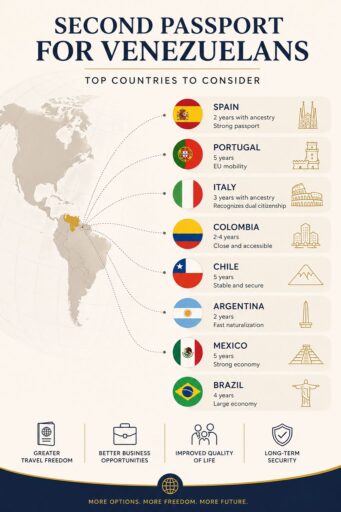
The most practical second passport options for Venezuelans are Spain, Portugal, Italy, Colombia, Chile, Argentina, Mexico, and Brazil, offering faster naturalization, ancestry pathways, and broader global mobility.
- Routes: Naturalization after residency, ancestry (limited cases), Sephardic Jewish heritage (historical route)
- Key requirements: Legal residency, integration, proof of ties to Spain
- Investment: No fixed investment (primarily living/residency costs)
- Timeline / years of stay: Typically 2 years for Venezuelans (shortened due to historical ties)
- What makes it stand out: Fast-track EU citizenship for Venezuelans, strong cultural and language alignment, full EU passport access, and a large established Venezuelan diaspora that supports integration.
- Routes: Naturalization through residency, Golden Visa (investment route), family reunification
- Key requirements: Legal residence, basic Portuguese language requirement
- Investment: Around €250,000+ (investment route, varies by program)
- Timeline / years of stay: Typically 5 years
- What makes it stand out: One of the most flexible EU citizenship programs for Venezuelans, low physical stay requirements, strong quality of life and stability, and growing popularity among professionals.
- Routes: Citizenship by descent (jure sanguinis), naturalization
- Key requirements: Proof of uninterrupted Italian lineage
- Investment: No investment required for ancestry route
- Timeline / years of stay: Ancestry route varies; naturalization usually 10 years
- What makes it stand out: One of the strongest ancestry-based citizenship systems for Venezuelans, full EU citizenship access, and deep historical Italian migration links that make eligibility relatively common among descendants.
- Routes: Naturalization through residency, marriage
- Key requirements: Legal residency and continuous stay
- Investment: None
- Timeline / years of stay: Typically 5 years (can be shorter for Latin Americans in some cases)
- What makes it stand out: Easiest integration due to proximity and shared culture, the largest Venezuelan diaspora globally, strong economic ties, and frequent use as an initial step toward long-term relocation.
Chile
- Routes: Naturalization through residency, permanent residency pathway
- Key requirements: Stable income, legal residence, clean criminal record
- Investment: None
- Timeline / years of stay: Typically 5 years
- What makes it stand out: One of the strongest passports in Latin America, higher economic stability than regional peers, a strong skilled labor market, and a key destination for Venezuelan professionals.
- Routes: Naturalization through residency
- Key requirements: Continuous legal residence
- Investment: None
- Timeline / years of stay: Can be as fast as 2 years of residency
- What makes it stand out: One of the fastest citizenship timelines globally, an accessible immigration system, a long history of openness to migrants, and strong appeal for Venezuelans seeking quick legal status.
- Routes: Naturalization through residency, marriage
- Key requirements: Permanent residency, language integration
- Investment: None
- Timeline / years of stay: Typically 5 years (can be shorter in some cases)
- What makes it stand out: Strong regional economic opportunities, a migrant-friendly environment, strategic access to North America, and a growing Venezuelan community.
- Routes: Naturalization through residency, marriage, children born in Brazil
- Key requirements: Legal residency and language ability
- Investment: None
- Timeline / years of stay: Typically 4 years (can be reduced to 1 year in some cases, e.g., marriage or Brazilian child)
- What makes it stand out: One of the fastest naturalization routes in South America, a large economy with multiple hubs, a strong Venezuelan migration corridor in the north, and relatively flexible citizenship rules by global standards.
Which country gives citizenship fastest?
The fastest citizenship routes for Venezuelans are Argentina, Brazil, and Colombia, with additional options available through Caribbean CBI programs, with timelines ranging from as little as 3–6 months to around 2 years based on the pathway.
Citizenship timelines vary widely, but the fastest pathways include:
- Argentina (can be as short as ~2 years of residency for naturalization eligibility)
- Brazil (around 4 years, reduced to as little as 1 year in special cases such as marriage or having a Brazilian child)
- Colombia (around 5 years, with potential reductions for Latin American nationals in certain scenarios)
- Caribbean CBI programs (Dominica, Grenada, St. Kitts and Nevis; as fast as 3–6 months through approved investment routes, without residency requirements in many cases)
Key limitations to consider:
- Argentina: Fastest legal pathway, but requires strong physical presence and residency continuity
- Brazil: Faster timelines only apply under specific personal conditions, not standard cases
- Colombia: Reductions exist but are discretionary and not guaranteed for all applicants
- Caribbean CBI programs: Fastest overall, but require significant financial investment and do not involve residency-based integration
Is Venezuela a strong passport?
The Venezuelan passport is considered moderate to weak globally, with around 120 visa-free or visa-on-arrival destinations, which is significantly lower than top-tier passports that offer 180+ destinations.
It provides some regional access across Latin America and limited entry into parts of Europe and Asia, but many countries still require visas or advance authorization.
| Index | Ranking | Key insights |
| Henley Passport Index | 43rd | Measures strict visa-free + visa-on-arrival access; Venezuela ranks mid-tier, reflecting declining mobility compared to global leaders like Singapore and Japan. |
| Arton Capital (Passport Index) | 38th | Uses a mobility score including visa-free, visa-on-arrival, and eTA; Venezuela shows moderate global access but weaker diplomatic reach than top-tier Latin American peers. |
| Nomad Capitalist Passport Index | 94th | Weighs mobility plus taxation, dual citizenship flexibility, and global perception; Venezuela ranks lower due to economic instability and limited tax/residency advantages. |
Are there any benefits of having dual citizenship for Venezuelans?
Yes, dual citizenship provides Venezuelans with significantly greater travel freedom and the ability to enter more countries without restrictive visa requirements.
It also allows individuals to live and work legally in more than one country, which expands long-term career and relocation options.
In addition, it improves access to education and healthcare systems abroad, while offering financial diversification and asset protection opportunities.
For Venezuelans in particular, dual citizenship is often viewed as a form of backup security during periods of political and economic instability.
Are there any negatives to dual citizenship?
Yes, dual citizenship in Venezuela can come with certain drawbacks, including potential tax obligations in more than one country, mandatory military service requirements in some jurisdictions, and added legal complexity when it comes to documentation and compliance.
It may also restrict eligibility for certain political or government positions depending on the countries involved.
In some cases, dual citizens can face conflicting legal obligations between two states, especially around taxation, residency rules, or national duties.
It is often recommended to consult a qualified financial advisor to understand cross-border tax exposure and legal implications before acquiring a second citizenship for Venezuela.
The Future of Venezuelan Mobility and Second Passports
Venezuelan mobility is expected to remain heavily shaped by economic conditions, regional migration frameworks, and access to dual citizenship pathways rather than any single policy change.
As global visa systems become more selective, second citizenships will continue to play a key role in expanding travel freedom for Venezuelans.
In Latin America, regional integration is likely to keep supporting easier movement between countries such as Colombia, Brazil, Peru, and Chile, which already host large Venezuelan populations.
At the same time, European pathways, especially Spain and Portugal, are expected to remain important long-term options due to language ties and established residency-to-citizenship systems.
Globally, demand for second passports is also increasing as more countries tighten immigration rules and prioritize skilled migration.
This trend reinforces the value of dual citizenship for Venezuelans looking for stability, mobility, and access to stronger legal and economic systems abroad.
Conclusion
Second citizenship for Venezuelans is increasingly shaped by practical constraints rather than preference, with legal access often determined by documentation, eligibility pathways, and administrative processes that vary widely across countries.
The most effective outcomes tend to come from understanding how these systems interact rather than treating each option in isolation.
One important consideration is how policy stability and institutional reliability influence long-term value after citizenship is obtained.
Some passports offer strong mobility but require ongoing compliance obligations, while others provide fewer restrictions but also more limited global reach.
In this context, the strategic value of a second passport lies in reducing dependence on a single legal and economic system, creating alternative routes for residence, work, and international movement when circumstances change.
FAQs
Is it easy to get Venezuelan citizenship?
Venezuelan citizenship is relatively easy to obtain for those born in the country or with Venezuelan parents.
For foreigners, it is more difficult and requires long-term legal residency and formal naturalization procedures.
Does Venezuela allow birthright citizenship?
Yes, Venezuela follows birthright citizenship principles, granting nationality to individuals born in the country, with additional provisions for children of Venezuelan parents abroad.
What are the 4 types of citizenship?
The four main types of citizenship are birthright citizenship, citizenship by descent, naturalization, and citizenship by investment.
Each type is determined by different legal requirements based on place of birth, ancestry, residency, or financial eligibility.
Has people leaving Venezuela affected the country?
Yes, large-scale emigration has significantly impacted Venezuela’s labor force, economy, and demographics.
Millions leaving the country has reduced workforce availability while also increasing reliance on remittances from abroad.
Pained by financial indecision?

Adam is an internationally recognised author on financial matters with over 830million answer views on Quora, a widely sold book on Amazon, and a contributor on Forbes.