A second passport for Cubans is most often pursued through countries like Spain, United States, and Canada to improve global mobility, access stronger economies, and reduce travel restrictions tied to a weak national passport.
However, Cuba has a more restrictive approach to nationality than many countries, particularly in how multiple citizenships are treated under domestic law and administrative practice.
As a result, second citizenship for Cubans is common in practice, but its recognition and legal effect inside Cuba can be limited.
This article covers:
- Does Cuba allow dual nationality?
- Which country is best for a second passport?
- What is the fastest second citizenship for Cubans?
- What countries are Cubans migrating to?
- Why are so many Cubans leaving Cuba?
- Is a Cuban passport powerful?
- What are some advantages of dual citizenship?
- What are the disadvantages of dual citizenship?
Key Takeaways:
- Cuba does not formally recognize dual citizenship, but many Cubans still obtain second passports abroad.
- Spain is one of the fastest and most accessible citizenship routes for Cubans.
- The Cuban passport has limited global mobility compared to most developed countries.
- A second passport for Cuba significantly improves travel access, security, and economic opportunity.
My contact details are hello@adamfayed.com and WhatsApp +44-7393-450-837 if you have any questions.
For digital nomad or residence visas that require income, assets, or qualifying investments, we can help structure suitable investment solutions that may align with those requirements, depending on your circumstances.
The information in this article is for general guidance only. It does not constitute financial, legal, or tax advice, and is not a recommendation or solicitation to invest. Some facts may have changed since the time of writing.

Does Cuba allow multiple citizenships?
Cuba does not formally recognize dual citizenship. Under Cuban law, a person is treated as exclusively Cuban while inside the country, regardless of any additional nationality they may hold.
Cuban citizens are also required to enter and exit Cuba using a Cuban passport, even if they possess another citizenship.
In practice, however, Cubans may acquire and hold a second citizenship abroad through naturalization or descent, and this is often tolerated as long as it does not interfere with obligations under Cuban law.
This means second citizenship for Cuba are commonly held but have limited legal effect within the country.
What is the best second passport for Cubans?
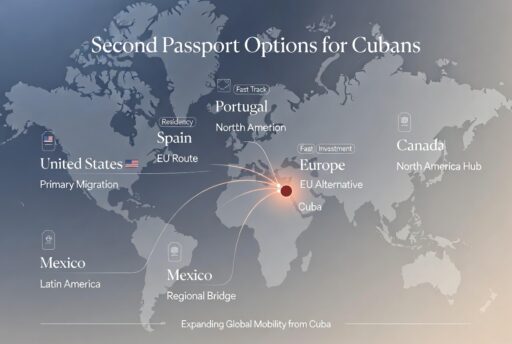
The most practical Cuba second passports usually come from residency-to-citizenship routes in Spain, the United States, and Canada, with additional EU options like Portugal and regional pathways like Mexico.
- Routes: Legal residency (work, family reunification, or long-term stay) leading to citizenship
- Key requirements: Fast-track eligibility (minimal years) for Cubans and other Latin Americans (under Spain’s simplified naturalization rule)
- Investment: No mandatory investment for standard routes
- Timeline: 2 years of legal residency + processing up to 12 months
- Why it stands out for Cubans: Fastest EU citizenship pathway with strong language and cultural alignment
United States
- Routes: Family sponsorship, humanitarian programs, asylum pathways
- Key requirements: Strongly dependent on family ties or qualifying protection status
- Investment: Low for asylum/family routes; legal and relocation costs vary
- Timeline: Often 5–10 years depending on immigration path
- Why it stands out for Cubans: Largest Cuban diaspora and historically established migration route
- Routes: Skilled migration (Express Entry), study-to-residency, family sponsorship
- Key requirements: Points-based system (education, language ability, work experience)
- Investment: Moderate (proof of funds and settlement costs required)
- Timeline: 3–5 years to citizenship after permanent residency
- Why it stands out for Cubans: High acceptance potential for skilled applicants and strong quality-of-life outcomes
- Routes: Residency visas (work, study, or investment) leading to citizenship
- Key requirements: Legal residency + basic language requirement
- Investment: No mandatory investment for standard residency routes. Investment-based options such as the Golden Visa require a qualifying investment starting from around €250,000.
- Timeline: 5+ years to citizenship
- Why it stands out for Cubans: Flexible EU immigration system and relatively accessible long-term residency path
- Routes: Temporary residency → permanent residency → citizenship
- Key requirements: Proof of income, family ties, or long-term stay
- Investment: Low (no mandatory citizenship-by-investment requirement)
- Timeline: 5 years to citizenship
- Why it stands out for Cubans: Geographic proximity and easier cultural integration
Citizenship by Investment (CBI) programs
CBI programs are offered mainly by Caribbean countries such as Dominica, St. Kitts and Nevis, Grenada, and Antigua and Barbuda, granting citizenship in exchange for a qualifying financial investment.
- Routes: Direct investment (donation or real estate) with no residency requirement
- Key requirements: Proof of funds, due diligence checks, clean background
- Investment: High (typically starts from around US$200,000 for government donation options or for approved real estate investment routes, depending on the country and program structure)
- Timeline: 3–6 months on average
- Reality for Cubans: While not legally prohibited, strict financial documentation and banking requirements can make access difficult for many applicants
Which country gives the quickest citizenship?
For Cubans, the quickest citizenship options are typically found in Spain and Argentina, where eligibility can begin in as little as around 2 years of residency.
A few more countries offer similar timelines but with more variability in practice.
- Argentina – Citizenship possible after about 2 years of residency
- Reality: Often one of the fastest in practice, as courts can grant citizenship with relatively flexible interpretation of residency requirements
- Spain – Fast-track eligibility after 2 years of legal residency for Cubans and other Latin Americans
- Reality: One of the most structured and predictable fast-track systems, though processing time still applies after eligibility
- Dominican Republic – Fast-track naturalization possible after about 2 years
- Reality: Available in law, but timelines and administrative consistency can vary in practice
- Brazil – Typically 4 years, with shorter timelines under special conditions
- Reality: Can be reduced significantly through marriage or having a Brazilian child, but not a standard fast-track
- Portugal – Citizenship after 5 years of legal residency
- Reality: Not a fast-track system, but one of the most predictable and widely used EU pathways
Where do most Cubans move to?
Most Cubans today relocate primarily to the United States, followed by Spain and an increasing number of destinations across Latin America such as Mexico and Brazil, reflecting a broader geographic spread since 2021.
- United States – Main destination
- Over 860,000 arrivals between 2021 and mid-2024 according to CiberCuba
- Largest Cuban population abroad, concentrated in Florida
- Spain – Leading European destination
- Strong inflows driven by language and legal pathways
- One of the largest Cuban communities in Europe
- Mexico – Transit and settlement role
- Rising asylum applications in recent years
- Used both as a stopover and longer-term base
- Brazil – Growing destination
- Increasing asylum requests and long-term stays
- Now among the larger Cuban communities outside North America
- Canada and others
- Smaller but steady inflows across Latin America and Europe
Overall, while the United States remains dominant, recent patterns show a wider distribution across multiple regions rather than concentration in a single destination.
Why are so many Cubans leaving Cuba?
Many Cubans are leaving Cuba due to a combination of ongoing economic crisis, shortages of basic goods, and limited income opportunities, with recent migration waves reflecting one of the largest outflows in decades.
- Limited economic opportunities and low wages
- Restricted private sector growth
- Inflation and shortages of essential goods
- Desire for political and personal freedom
- Family reunification abroad, especially in the United States
These factors have contributed to one of the largest Cuban diasporas in history.
How strong is Cuba’s passport?
The passport of Cuba is considered relatively weak globally, with access to roughly 50–70 visa-free or visa-on-arrival destinations, limiting mobility compared to most countries in the Americas, Europe, and Asia.
| Index | Ranking | Key insight |
| Henley Passport Index | 77th | Measures visa-free access; Cuba ranks low due to limited entry agreements, especially with Europe and North America |
| Arton Capital Passport Index | 64th | Focuses on mobility score; Cuba performs weakly because of restricted visa-free travel across major economic regions |
| Nomad Capitalist Passport Index | 161st | Weighs taxation, perception, and freedom; Cuba ranks low due to economic restrictions and limited global integration |
Access to the Schengen Area (Europe), the United States, Canada, and most advanced economies requires a visa, which significantly reduces travel flexibility.
Why is it good to have two passports?
For Cubans, having two passports provides greater travel access, more relocation options, and a practical safeguard against the limitations of the passport of Cuba.
At the same time, it is not without trade-offs that should be considered.
Advantages
- Greater travel freedom – access to more countries visa-free
- Security backup – protection during political or economic instability
- Work and study options – easier access to global opportunities
- Tax and financial flexibility – depending on jurisdictions
- Family mobility – simplified relocation options for dependents
Potential drawbacks
- Legal complexity – Cuba does not formally recognize dual citizenship in practice, which can create complications inside the country
- Administrative burden – maintaining compliance across two nationality systems can be complex
- Tax and reporting obligations – some countries require worldwide income reporting depending on residency status
- Cost – acquiring and maintaining a second citizenship can be expensive depending on the route
Real barriers Cubans face when applying for a second passport
For many applicants from Cuba, the main challenges are not eligibility itself but proving financial capacity, meeting documentation standards, and navigating strict compliance checks across different immigration systems.
- Banking and source-of-funds verification – Many programs require detailed proof of income, savings history, or legal fund transfers, which can be difficult depending on financial documentation available in Cuba
- Limited access to international banking systems – Cross-border transactions and account history verification can create delays or rejections in applications
- Document availability and legalization – Civil records, translations, and apostilles often require extra processing time and coordination
- Visa and administrative scrutiny – Applicants from Cuba may face additional background checks depending on the destination country
- Financial planning complexity – Proper structuring of income, savings, and residency pathways often requires professional guidance
For this reason, many applicants work with professional advisors or consult a financial advisor to help structure documentation and improve approval chances for residency or citizenship applications.
Conclusion
Cuba second citizenship functions as a structural shift in mobility and opportunity, addressing the limitations imposed by the passport of Cuba in areas such as travel access, financial systems, and long-term relocation planning.
Across all available pathways, the key differentiator is practical feasibility over time, whether a route can realistically be maintained through legal residency, documentation standards, and compliance requirements until citizenship is granted.
This is why residency-based systems such as Spain’s fast-track framework and Canada’s skilled migration model remain widely used, while investment-based programs depend more heavily on financial transparency and eligibility strength.
The most durable outcomes come from pathways where legal residence, income stability, and documentation consistency are aligned from the outset, rather than treated as separate steps.
FAQs
What are the 4 types of citizenship?
The four main types of citizenship are by birth (jus soli), by descent (jus sanguinis), by naturalization, and by investment.
Is Cuba considered 3rd world?
Yes. Cuba is often classified as a developing country due to its economic structure, limited market access, and lower income levels compared to developed nations.
What countries can a Cuban passport go to?
A Cuban passport allows visa-free, visa-on-arrival, or eVisa access to countries such as Dominica, Grenada, Saint Lucia, Russia, Malaysia, Singapore, Qatar, Kenya, Botswana, and Seychelles.
Most of Europe (Schengen Area), the United States, and Canada require visas.
What are the top 10 strongest passports?
The strongest passports globally, based on leading mobility indices, typically include Singapore, Japan, South Korea, the United Arab Emirates, Spain, Italy, France, Germany, Finland, and the United States.
These rankings shift annually depending on visa agreements and global mobility changes.
Pained by financial indecision?

Adam is an internationally recognised author on financial matters with over 830million answer views on Quora, a widely sold book on Amazon, and a contributor on Forbes.