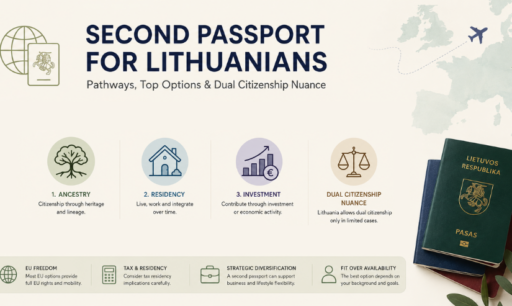
A second passport for Lithuanians most commonly points to options like Ireland, Germany, Spain, and the Nordic countries for work mobility, lifestyle migration, and broader EU access.
While Lithuania generally prohibits dual citizenship, it allows it in specific exceptions such as citizenship by descent, exile-related cases, or where renunciation of another nationality is not legally possible.
It is not one of the easiest citizenships to get, but it is highly valuable due to full EU citizenship rights.
This article covers:
- Can Lithuanians hold two passports?
- What is the easiest country to get a second passport in?
- What countries have the most Lithuanians?
- Why are people emigrating from Lithuania?
- How powerful is a Lithuanian passport?
- What are the advantages and disadvantages of dual citizenship?
Key Takeaways:
- Lithuanian citizenship is mainly accessible through ancestry or limited legal exceptions.
- Dual citizenship for Lithuanians is restricted but allowed in specific cases.
- A Lithuanian passport offers strong EU-wide mobility and travel access.
- The hardest part for a second citizenship for Lithuania is eligibility; not the benefits, which are EU-level and highly valuable.
My contact details are hello@adamfayed.com and WhatsApp +44-7393-450-837 if you have any questions.
For digital nomad or residence visas that require income, assets, or qualifying investments, we can help structure suitable investment solutions that may align with those requirements, depending on your circumstances.
The information in this article is for general guidance only. It does not constitute financial, legal, or tax advice, and is not a recommendation or solicitation to invest. Some facts may have changed since the time of writing.

Does Lithuania allow multiple citizenships?
Lithuania generally does not allow dual or multiple citizenship under its nationality framework, but it permits it in clearly defined exceptional cases.
The governing rule is based on Lithuania’s Citizenship Law (as amended, especially after 1990 restoration of independence and subsequent constitutional court interpretations), which maintains the principle of single citizenship while carving out specific legal exemptions.
Multiple citizenship is permitted only in limited situations, such as:
- Those who regained citizenship through descent (e.g., descendants of Lithuanians who left before 1990)
- Individuals who were exiled during occupation periods
- Cases where renouncing another citizenship is legally or practically impossible
- Certain special approvals granted by the Lithuanian government
Outside these statutory exceptions, Lithuanian law typically requires applicants to renounce their previous nationality in order to acquire or retain citizenship.
Which country is best for a second passport for Lithuanians?
For Lithuanians, the best second passport options are typically Ireland, Germany, Spain, Portugal, and select Nordic countries, based on faster naturalization routes, stronger global mobility, or easier relocation within the EU.
Each option works differently based on eligibility, timeline, and route:
- Route: Ancestry or naturalization through residency
- Key requirement/qualification: Irish descent or legal residence
- Investment: None for citizenship (residency requires standard living costs)
- Timeline: Fast via ancestry (2–12 months for registration and passport issuance depending on eligibility); 5+ years via residency
- Why ideal for Lithuanians: Strong EU + English-speaking environment and historical migration links
- Route: Naturalization through long-term residency
- Key requirement/qualification: Years of residence, language proficiency, integration
- Investment: None (employment or stable income required)
- Timeline: Medium-term (typically 5 years)
- Why ideal for Lithuanians: Strong labor market and high-income opportunities within the EU
- Route: Residency-based naturalization
- Key requirement/qualification: Residency years (reduced for some Latin American nationals, not Lithuanians)
- Investment: Optional investment visa routes exist
- Timeline: Long-term (10 years standard)
- Why ideal for Lithuanians: Lifestyle migration, climate, and EU mobility benefits
- Route: Residency or investment-based pathways
- Key requirement/qualification: 5 years legal residence
- Investment: Available through qualifying investment programs, typically starting from around €250,000
- Timeline: Relatively fast (5 years)
- Why ideal for Lithuanians: One of the most flexible EU residency-to-citizenship routes
Nordic countries (Sweden, Norway, Finland, Denmark)
- Route: Long-term residency and integration
- Key requirement/qualification: Residency, language, and stable income
- Investment: None
- Timeline: Medium to long-term
- Sweden (5–8 years)
- Norway (7–8 years)
- Finland (8 years)
- Denmark (9 years)
- Why ideal for Lithuanians: High quality of life, strong social systems, and labor mobility opportunities
What is the easiest 2nd passport to get?
The easiest second passport options for Lithuanians are typically Ireland and Italy through ancestry routes, along with Caribbean citizenship-by-investment programs like Dominica and St. Kitts & Nevis.
Easiest generally refers to minimal residency requirements, faster processing time, or qualification through ancestry or investment rather than long-term naturalization.
- Fastest residency-to-citizenship options: Argentina (~2 years), Dominican Republic (~3–5 years total including residency process), and Portugal (~5 years residency)
- Simplest ancestry-based routes: Ireland (grandparent-based citizenship eligibility) and Italy (broad jus sanguinis ancestry rules with no generational limit in many cases)
- Fastest investment citizenship programs: Dominica and St. Kitts & Nevis (Caribbean citizenship-by-investment programs with processing timelines typically around 3–6 months)
Where do most Lithuanians emigrate to?
Most Lithuanians who emigrate abroad primarily move to Germany, Norway, Spain, Ireland, and the United Kingdom, based on recent OECD migration flow data covering Lithuanian citizens relocating to other OECD member countries.
These destinations consistently appear across European migration statistics due to established labor mobility patterns and long-term migration networks.
Germany and Norway are currently among the leading destinations, while Spain, Ireland, and the UK remain important secondary hubs.
Overall, these countries reflect the main direction of Lithuanian outward migration within Europe and other OECD economies.
Why are so many people leaving Lithuania?
Lithuanians have historically left the country due to higher wages and stronger job opportunities in Western Europe, supported by EU free movement since 2004, which made relocation significantly easier.
OECD research continues to identify income gaps and employment prospects as key drivers of outward migration, especially among younger and working-age groups.
However, the narrative has shifted significantly as of 2026, with Lithuania experiencing stronger wage growth, improved living standards, and sustained return migration, which has reduced net emigration.
As a result, current migration trends are more balanced than in the past, with mobility now driven more by career progression and lifestyle choices rather than purely economic necessity.
Is Lithuanian a strong passport?
The Lithuanian passport is considered strong globally, offering visa-free or visa-on-arrival access to around 170-180 countries, along with full EU citizenship rights and unrestricted mobility across the Schengen Area.
| Index | Ranking | Key insights |
| Henley Passport Index | 9th | Ranked primarily on visa-free/visa-on-arrival travel access; strong performance due to broad EU and Schengen mobility rights |
| Arton Capital Passport Index | 6th | Measures global mobility plus factors like investment access and perception of openness; Lithuania scores strongly due to EU integration and travel freedom |
| Nomad Capitalist Passport Index | 31st | Evaluates five factors: visa-free travel, taxation, global perception, dual citizenship flexibility, and personal freedom; Lithuania scores well overall but is slightly limited by stricter dual citizenship rules |
What benefits do I get if I have dual citizenship?
Dual citizenship for Lithuanians can create additional legal and lifestyle flexibility by combining Lithuanian EU rights with another country’s nationality benefits, where such arrangements are permitted under Lithuanian law.
Dual citizenship (when allowed) can offer:
- Access to two passports, widening international travel options
- Legal ability to reside and work in two different countries
- Eligibility for public services such as healthcare and education in both systems
- Greater flexibility for cross-border business, banking, and asset structuring
- A backup nationality during periods of political or economic uncertainty
What is the downside of dual citizenship?
For Lithuanians, dual citizenship can be restrictive because Lithuania generally limits it under nationality law, meaning not all second citizenships can be legally retained alongside a Lithuanian passport.
Common disadvantages include:
- Possible loss of original citizenship depending on the other country’s rules
- Tax obligations across multiple jurisdictions
- Military service obligations in one or both countries, depending on nationality rules
- Legal complexity when navigating two different legal systems
- Administrative limitations in passport renewal or cross-border documentation
In Lithuania’s case, strict legal exceptions around dual citizenship also mean eligibility can be narrow and case-specific, adding an extra layer of complexity compared to more permissive countries.
Should a second passport be pursued as a Lithuanian?
A second passport for Lithuania is only worthwhile when it serves a clear long-term purpose, since Lithuania citizenship already provides strong EU-based residence and work rights.
A practical way to assess this is through a few key considerations:
- Whether long-term relocation outside the EU is a realistic need
- If eligibility through ancestry is available, which can significantly simplify the process
- Whether multiyear residency requirements in another country are feasible
- Whether the goal is lifestyle diversification, career expansion, or legal flexibility
When these conditions align, a second passport can meaningfully expand long-term options and mobility choices; when they do not, it may simply be a lower-priority administrative pathway rather than a necessity.
Conclusion
Interest in second citizenship for Lithuanians is shaped by access gaps rather than broad mobility goals, since Lithuania already sits within a highly integrated EU framework.
What actually drives decisions is not the passport itself, but specific friction points such as eligibility inheritance rules, tax residency exposure, or the need for jurisdictional diversification in certain life or business scenarios.
Across most pathways, the key constraint is not availability but fit: ancestry is historically fixed, residency is time-dependent, and investment routes are capital-driven.
This creates a system where outcomes are predetermined by background rather than intention.
As a result, second citizenship planning tends to function more like legal structuring than migration planning, often intersecting with broader financial planning considerations, including working with a financial advisor in Lithuania.
FAQs
Who qualifies for a Lithuanian passport?
You may qualify for a Lithuanian passport if you can prove Lithuanian ancestry, were born in Lithuania or to Lithuanian citizens, or meet standard naturalization requirements through long-term residence, language ability, and integration.
What is the easiest dual citizenship in Europe?
The easiest dual citizenships in Europe are usually obtained through ancestry in countries like Italy and Ireland, or through residency-based naturalization in Portugal.
Additional simplified routes may be available in countries like Romania or Poland for eligible descendants under specific legal provisions.
Can I be a dual citizen of the US and Lithuania?
Dual citizenship between the US and Lithuania is only possible if the applicant qualifies under Lithuania’s limited legal exceptions, such as citizenship by descent (e.g., proving Lithuanian ancestry).
The US permits dual citizenship but Lithuania restricts it.
Is it easy to get PR in Lithuania?
It is moderately easy for EU citizens but more structured and time-bound for non-EU nationals, as it requires around 5 years of legal residence plus basic integration requirements in some cases.
Pained by financial indecision?

Adam is an internationally recognised author on financial matters with over 830million answer views on Quora, a widely sold book on Amazon, and a contributor on Forbes.