India’s five-year tax holiday can exempt qualifying overseas income for eligible individuals who come to India to work under Central Government-notified schemes. It does not make every foreign national’s salary, investments or business income tax-free.
The key checks are your previous Indian tax-residence status, the scheme connected to your work, where your income arises, and the relevant five-year window.
Indian work income and taxes in another country require separate analysis.
Key Takeaways
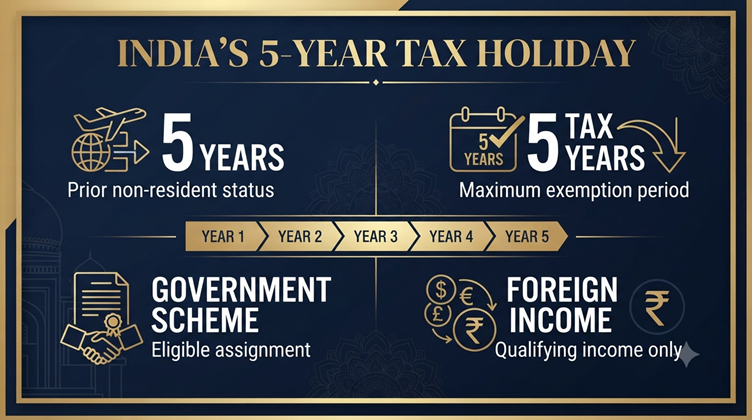
- Five prior non-resident years and work under a notified government scheme are required.
- Only qualifying overseas income is exempt. Indian work income generally remains taxable.
- The arrival tax year counts and relief lasts up to five consecutive tax years.
- Overseas taxes may still apply. India’s exemption does not cancel another country’s tax obligations.
I can connect you with expert tax support for your specific situation. Email hello@adamfayed.com if you have any questions.
The information in this article is not tax advice and may have changed since the time of writing.
Does a foreigner have to pay income tax in India?
Yes, a foreigner can owe Indian income tax. The result depends primarily on tax residence, income source and applicable exemptions or treaty provisions.
Citizenship and immigration permission are different from income tax residence. A visa does not establish whether all, some or none of your overseas income is taxable.
Broadly, the ordinary rules distinguish:
|
Indian status |
General scope of taxable income |
|
Non-resident |
Income received or deemed received in India, and income arising or deemed arising in India |
|
Resident but not ordinarily resident |
Similar coverage, plus certain foreign income from an India-controlled business or India-established profession |
|
Resident and ordinarily resident |
Worldwide income, subject to available relief |
Section 5 sets out this framework.
Under section 6, the general residence tests include 182 days in India during the tax year, or 60 days during that year plus 365 days over the preceding four years. Special rules affect certain Indian citizens and people of Indian origin.
Do not rely on “stay below 183 days” as a universal rule. Track travel and assess the applicable test each year.
How much tax do foreigners pay in India?
Foreigners in India generally pay individual income tax at progressive rates ranging from 0% to 30% under the default tax regime for 2026–27.
Taxable income up to ₹4 lakh is exempt, while income exceeding ₹24 lakh falls within the highest standard tax band.
The default individual regime under section 202 uses these bands:
|
Taxable income band |
Rate on that band |
|
Up to ₹4 lakh |
Nil |
|
Above ₹4 lakh to ₹8 lakh |
5% |
|
Above ₹8 lakh to ₹12 lakh |
10% |
|
Above ₹12 lakh to ₹16 lakh |
15% |
|
Above ₹16 lakh to ₹20 lakh |
20% |
|
Above ₹20 lakh to ₹24 lakh |
25% |
|
Above ₹24 lakh |
30% |
These are marginal rates. The highest band you reach does not apply to every rupee.
Health and Education Cess is generally 4% of income tax plus applicable surcharge. High-income taxpayers may also face surcharge. Regime choice, deductions and special-rate income can change the calculation.
The rebate commonly associated with income up to ₹12 lakh is restricted to qualifying resident individuals.
Foreign citizenship alone does not determine whether the residence condition is satisfied.
What is the 5-year tax holiday for foreign nationals in India?
India’s five-year year tax holiday is a conditional exemption for income arising outside India that is not legally treated as arising in India.
An ordinary job offer, foreign passport or overseas bank account does not establish entitlement. Readers must distinguish the law creating the exemption from the notifications and conditions needed to use it.
The provision sits in Schedule IV, entry 13B, of the Income-tax Act, 2025, and was inserted by the Finance Act, 2026, with effect from 1 April 2026.
What is the meaning of a 5-year tax holiday?
A five-year tax holiday removes specified income from the Indian tax calculation for a limited period, provided the conditions are met. It does not suspend every tax or reporting obligation.
For this provision, the relief concerns eligible foreign-source income. It does not automatically cover GST, taxes connected with property transactions, or an employer’s obligations.
Someone may qualify personally but still receive taxable income. Equally, someone who fails the scheme conditions may have foreign income outside India’s tax net under the ordinary residence rules.
How is India's five-year tax holiday period calculated?
The five-year tax holiday is calculated using five consecutive tax years, beginning with the first tax year of the relevant scheme-related visit. It is not necessarily five full years from your arrival date.
India’s tax year runs from 1 April to 31 March. Consider this sample timeline:
- First qualifying visit: January 2027.
- First tax year in the window: 2026–27.
- Fifth tax year: 2030–31.
- Following year: 2031–32.
The arrival year counts even though the person arrived near its end. Annual conditions must still be satisfied.
Taking a break between assignments does not necessarily extend the exemption period. Individuals with previous scheme-related visits should establish when their five-year period began.
Once the tax holiday ends, the taxation of foreign-source income will depend on the individual's tax residency status and India's ordinary income tax rules. Worldwide income does not automatically become taxable in the sixth year.
Your tax exemption lasts five years. What about your investments?
Build an investment strategy that accounts for your changing tax residency, overseas assets and financial objectives beyond the exemption period.
Discuss Your Investment OptionsWho is eligible for the 5-year tax exemption in India?
The statutory eligibility starts with an individual who was non-resident in India for the five consecutive tax years immediately before the relevant first visit for scheme-related services.
The framework also requires the individual to:
- Visit India to render services connected with a Central Government-notified scheme.
- Render services in India connected with such a scheme during the relevant claim year.
- Remain within the five-consecutive-tax-year limit.
- Meet any further prescribed conditions.
This is a cumulative test. Five years abroad alone is insufficient. So is working on a project that an employer informally describes as government-supported.
Before accepting an assignment, ask the sponsor to identify the notification that brings the work within entry 13B. Keep the notification number, date and evidence connecting your role to that scheme.
Are NRI professionals visiting India to get 5-year tax exemption on overseas income?
Some NRI professionals may be eligible for five-year relief on qualifying overseas income, but a visit to India is insufficient. The work must connect to a notified scheme, alongside the required residence history and other conditions.
Budget-era headlines often shorten these requirements. That can leave readers believing the exemption applies to all returning professionals or all income earned through foreign clients.
A useful decision sequence is:
- Establish your Indian residence status for each preceding year.
- Identify the legal scheme supporting the Indian assignment.
- Classify each income stream by source.
- Test home-country taxation separately.
- Calculate the actual benefit after compliance costs.
The last step matters. An exemption may provide little additional saving if the same overseas income was already outside India’s tax net because you remained non-resident.
The value may be different if a longer assignment changes your Indian residence status. Compare the position with and without the exemption before making relocation decisions.
What types of income are tax-exempt under India’s tax holiday?
Income that accrues or arises outside India and is not deemed to accrue or arise in India may qualify for exemption under the tax holiday. Receiving income in a foreign bank account does not automatically make it tax-exempt.
Potential examples, subject to individual source analysis, include:
|
Income |
What needs checking |
|
Interest from an overseas bank |
Whether it genuinely arises outside India |
|
Dividends from foreign investments |
The payer, investment and applicable source rules |
|
Rent from overseas property |
The property location and ownership arrangement |
|
Gains on overseas assets |
Whether Indian deemed-source rules apply |
|
Salary paid abroad for Indian work |
Indian services can make the salary India-source |
Salary for services performed in India is generally treated as arising in India under section 9. Paying it into a foreign account does not convert it into exempt overseas income.
For example, an eligible professional might have Indian assignment pay and rent from a home abroad. Those income streams need separate treatment. The assignment pay does not inherit the rental income’s possible exemption.
Share awards, deferred bonuses, pension payments and consultancy fees need closer review. Their source can depend on service periods, contractual terms and specific legal rules.
Will I still pay tax in my home country during India's tax holiday?
Possibly. India can exempt income under Indian law, but it cannot cancel another country’s taxing rights.
Your home country may continue taxing you because you remain resident there. It may also tax income sourced there, such as local property rent, even after you become non-resident.
US citizens and US resident aliens generally face US tax rules on worldwide income. Moving to India does not remove US filing or tax obligations. Available exclusions and credits have their own eligibility rules.
Before moving, review:
- The departure rules in your current country.
- Whether keeping a home or family there affects residence.
- Source-country tax on rent, dividends and pensions.
- Tax-return and foreign-account reporting duties.
- Any continuing citizenship-based obligations.
How does India's tax holiday affect double taxation?
India's five-year tax holiday may prevent double taxation on qualifying foreign-source income by exempting it from Indian tax. However, it does not automatically provide treaty relief or foreign tax credits.
A Double Taxation Avoidance Agreement, or DTAA, may allocate taxing rights or provide relief when two countries tax the same income. Results depend on the treaty, residence position and income category.
Distinguish these mechanisms:
- Exemption: Qualifying income is excluded from tax in one jurisdiction.
- Foreign tax credit: Eligible tax paid elsewhere reduces a tax liability, within limits.
- Treaty relief: The agreement may restrict taxation or prescribe how overlapping claims are resolved.
An Indian exemption does not normally create foreign tax paid that you can credit abroad. For US purposes, for example, foreign tax credits generally require qualifying foreign taxes paid or accrued.
Calculate the combined tax across countries. A reduction in India may partly shift the remaining liability elsewhere rather than produce an equal worldwide saving.
How to apply for the 5-year tax holiday in India?
Start by verifying eligibility under the actual notified scheme and obtaining advice on the prescribed claim requirements. There is no verified universal application process.
A sensible preparation sequence is:
- Obtain the applicable scheme notification from the assignment sponsor.
- Ask a tax professional to assess your five-year residence history.
- Review each overseas income stream and any Indian connection.
- Confirm whether approval, certification or a prescribed filing is required.
- Arrange PAN registration and tax-return compliance where applicable.
- Review withholding and claims with payroll before the relevant deadlines.
Treat these as preparation steps, not a government-issued application checklist.
An employment contract promising tax-free income cannot establish a statutory exemption. Clarify who bears additional tax, interest and professional fees if the assumed treatment is rejected.
What documents are needed to claim the India tax exemption?
The mandatory documents vary based on the notified scheme and prescribed conditions. The following is a practical evidence file, not a verified official document list:
- Passport, visa and immigration records.
- Travel calendar and supporting arrival or departure evidence.
- Residence calculations for the five preceding tax years.
- Previous returns and foreign residence certificates, where relevant.
- Scheme notification and assignment or appointment documents.
- Evidence of services performed during each claim year.
- Overseas bank, investment, rental and pension statements.
- Contracts explaining bonuses, share awards or consulting income.
- PAN details and records of Indian tax deducted.
Keep a year-by-year file showing both eligibility and income classification. This helps when an employer changes, an assignment ends or a tax authority asks why a particular receipt was excluded.
Also check any foreign asset disclosures required for your residence category. Exempt income should not be assumed to eliminate every reporting duty.
Is India's tax holiday a good financial opportunity for you?
Evaluate the potential financial benefits of relocating to India alongside your existing investments, retirement plans and international financial commitments.
Speak to an AdviserHow does India's tax holiday compare to UAE or Singapore for expats?
India’s scheme-specific relief is narrower than the UAE’s general absence of personal income tax. Singapore generally exempts overseas income received by individuals, subject to exceptions, while taxing local work income.
|
Factor |
India |
UAE |
Singapore |
|
Basis |
Conditional relief under notified schemes |
No general personal income tax |
Source-based individual tax rules |
|
Local employment pay |
Generally taxable |
No personal income tax on wages |
Generally taxable |
|
Overseas income |
Entry 13B requires eligibility and source tests |
Check business rules and foreign-country taxes |
Generally exempt, with exceptions |
|
Duration |
Five consecutive tax years maximum |
No equivalent five-year personal limit |
No equivalent general five-year limit |
The UAE can tax qualifying business activities conducted by individuals. Its corporate tax rules distinguish business income from wages and qualifying personal investment income.
Singapore taxes work performed there even where the employer is abroad. Some overseas income, including income received through Singapore partnerships, can also be taxable. Resident individual rates reach 24%.
Compare your actual earnings, residence rights, housing costs and home country liabilities. A country with lower local tax is not automatically the best financial choice.
Conclusion
The value of India’s five-year tax holiday depends largely on how much overseas income would otherwise become taxable during an assignment in India.
For someone whose foreign income is already outside the Indian tax net under ordinary residence rules, the exemption may offer little additional benefit.
For professionals with substantial overseas investments, rental income or other foreign earnings, the exemption could have greater financial significance.
The five-year window may also influence the timing of investment disposals, retirement withdrawals and the duration of an Indian assignment.
FAQs
Does India's five-year tax holiday extend to spouses and dependants?
No automatic exemption extends to family members. A spouse seeking relief on their own overseas income must independently satisfy the statutory eligibility requirements.
Is there a limit on how much overseas income can be exempt under India's tax holiday?
Entry 13B does not expressly specify a monetary cap on qualifying foreign-source income. However, any additional prescribed conditions must also be considered.
Can I change employers during India's tax holiday?
Changing employers does not necessarily end the exemption. Continued eligibility depends on whether the new assignment involves services under a qualifying notified scheme and meets the applicable conditions.
Related Articles
- How Are NRIs Taxed in India?
- Best Countries for Second Residency for NRIs
- Cross-Border Investing for Expats: A Global Guide
- Top Tax-Efficient Investments for NRIs
- Indian Expat Investment Options: From NRI Accounts to Offshore Trusts
- Financial Planning for NRIs: Key Money Decisions to Review
- What Happens to Tax-Efficient Investments When Expats Change Country?