Business accounting and tax in Hong Kong involve HKFRS-based financial reporting, statutory audits, seven-year record retention, and Profits Tax on profits arising in or derived from Hong Kong.
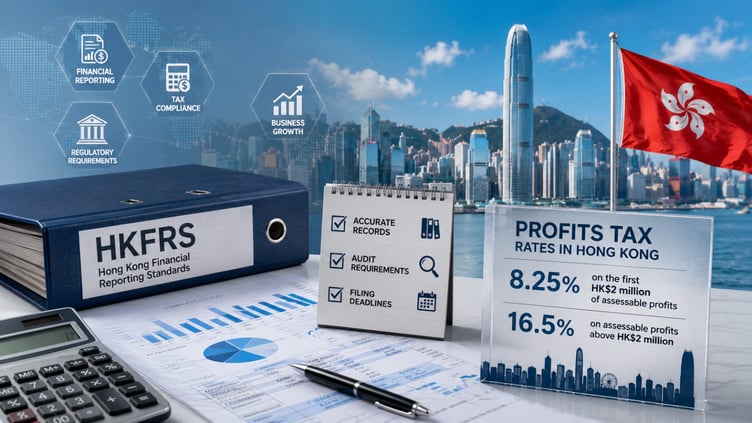
Corporations generally face a 16.5% Profits Tax rate, while qualifying entities benefit from a lower 8.25% rate on their first HK$2 million of assessable profits under the two-tiered regime.
Key Takeaways
- HKFRS is the main accounting framework, with alternative frameworks available to eligible private companies.
- Most Hong Kong companies must be audited, with dormant companies generally being the key exception.
- Business records must generally be kept for at least seven years.
- Corporate Profits Tax is generally 16.5%, or 8.25% on the first HK$2 million for qualifying businesses.
My contact details are hello@adamfayed.com and WhatsApp +44-7393-450-837 if you have any questions.
The information in this article is not tax advice and may have changed since the time of writing. I can connect you with expert tax support for your specific situation.
What accounting standards are used in Hong Kong?
Hong Kong-incorporated companies generally prepare financial statements using accounting standards issued by the Hong Kong Institute of Certified Public Accountants (HKICPA).
The main frameworks are HKFRS, HKFRS for Private Entities, and the SME-FRF & SME-FRS framework for eligible entities.
HKFRS, or Hong Kong Financial Reporting Standards, is closely aligned with International Financial Reporting Standards (IFRS).
This means that financial statements prepared under HKFRS are broadly familiar to international investors and businesses.
Eligible private companies may instead use HKFRS for Private Entities or the SME-FRF & SME-FRS, subject to the relevant eligibility requirements.
A company should use one appropriate financial reporting framework consistently when preparing its financial statements.
Businesses should also be aware of upcoming accounting changes.
The revised HKFRS for Private Entities is effective for annual periods beginning on or after January 1, 2027, with early application permitted.
HKFRS 18, which replaces HKAS 1 and introduces new presentation and disclosure requirements, is also effective for annual periods beginning on or after January 1, 2027, with early application permitted.
Do all Hong Kong companies need to be audited?
Generally, yes. Under Hong Kong's Companies Ordinance, companies are required to have their financial statements audited, including companies that qualify for the reporting exemption.
An eligible private company may be permitted to prepare simplified financial statements and directors' reports, but it generally still needs an audit.
The audit must be conducted by an appropriately qualified auditor, and the resulting audited financial statements form an important part of the company's annual compliance process.
Which companies are exempted from audit?
A Hong Kong company is generally exempt from the statutory audit requirement only when it qualifies as a dormant company under section 447 of the Companies Ordinance.
A dormant company is broadly one that has no accounting transactions during its dormant period, other than transactions specifically excluded under the Companies Ordinance.
If it enters into an accounting transaction, it ceases to be dormant from that point.
This should not be confused with the reporting exemption available to certain private and guarantee companies.
For example, a small private company can qualify for simplified reporting when it satisfies at least two of these three criteria for a financial year:
- Revenue of no more than HK$100 million
- Total assets of no more than HK$100 million
- No more than 100 employees
How many years of accounting records to keep in Hong Kong?
Businesses carrying on a trade, profession or business in Hong Kong generally need to retain their accounting and business records for at least seven years.
This requirement applies to records needed to establish the business's assessable profits.
The seven-year period is particularly important for businesses that may face an IRD enquiry or tax investigation because the records provide evidence supporting reported income, expenses and tax calculations.
Failure to maintain the required records without a reasonable excuse can result in a fine of up to HK$100,000.
What types of records should be kept?
Hong Kong businesses should keep detailed financial and supporting records that allow the IRD to verify their income, expenses, assets, liabilities and assessable profits.
Key records include:
- Books of accounts: Entries showing daily business transactions, including receipts, payments, income and expenditure.
- Sales and purchase documentation: Invoices, receipts and credit notes supporting goods or services bought and sold.
- Banking records: Bank statements and other documents reconciling business income and payments.
- Asset and liability records: Details of business assets, liabilities and relevant transactions involving them.
- Cash transaction records: Documentation of money received and spent outside the business's bank accounts.
- Payroll records: Details of salaries, wages and other payments made to employees.
- Contracts and agreements: Documents supporting major business transactions, services, purchases, leases and other obligations.
- Other supporting documents: Any records needed to substantiate transactions, income or expenses reported for tax purposes.
Keeping these records also helps businesses substantiate tax deductions by demonstrating that claimed expenses were incurred in producing taxable profits.
Is Hong Kong tax free for business?
No. Hong Kong is not completely tax free for businesses.
Businesses carrying on a trade, profession or business in Hong Kong can be subject to Profits Tax on profits arising in or derived from Hong Kong.
What makes Hong Kong attractive from a business tax perspective is its relatively low tax rates and territorial approach to taxation.
Hong Kong also does not have a general value-added tax (VAT) or sales tax.
However, businesses can still encounter other taxes and government charges depending on their activities, assets, employees and transactions.
How much tax do you have to pay on your business?
A Hong Kong corporation generally pays 16.5% Profits Tax, while qualifying businesses can benefit from the two-tiered Profits Tax regime, which applies a lower 8.25% rate to the first HK$2 million of assessable profits.
Profits above HK$2 million are generally taxed at 16.5%.
For unincorporated businesses, such as sole proprietorships and partnerships, the standard Profits Tax rate is 15%, with a reduced 7.5% rate applying to the first HK$2 million of qualifying assessable profits under the two-tiered regime.
The two-tiered regime generally applies to qualifying entities, but connected entities must generally nominate one entity to benefit from the two-tiered rates.
Certain businesses subject to specific concessionary tax regimes may also be excluded.
How to calculate Profits Tax in Hong Kong?
Businesses in Hong Kong generally calculate their Profits Tax by adjusting accounting profit to arrive at assessable profits, then applying the applicable Profits Tax rate.
A simplified calculation is:
Accounting profit
± tax adjustments
− additional allowable deductions
− applicable allowances
= assessable profits
Tax adjustments may include adding back non-deductible expenses and excluding income that is exempt or not chargeable to Hong Kong Profits Tax. Additional deductions and allowances may then be applied where relevant.
The applicable Profits Tax rate is then applied to the resulting assessable profits.
For example, suppose a Hong Kong company has HK$3 million of qualifying assessable profits and can use the two-tiered regime.
The first HK$2 million would generally be taxed at 8.25%, while the remaining HK$1 million would be taxed at 16.5%.
This produces a simplified Profits Tax calculation of:
- HK$2 million × 8.25% = HK$165,000
- HK$1 million × 16.5% = HK$165,000
- Total Profits Tax = HK$330,000
Actual tax computations can be more complicated because businesses may have tax adjustments, depreciation allowances, losses, exempt or non-chargeable income, and other items that affect assessable profits.
Hong Kong also uses a provisional tax system, under which Provisional Profits Tax is generally based on the previous year's assessed profits and credited against the final Profits Tax liability for the relevant year.
Which expenses can be claimed as a deduction from business?
Generally, an expense can be deducted when it is incurred in producing profits chargeable to Hong Kong Profits Tax.
The IRD's rules do not allow businesses to deduct every expense appearing in their financial accounts.
Common examples of potentially deductible business expenses include:
- Employee salaries and related business costs
- Office rent and business premises expenses
- Professional and accounting fees
- Business insurance
- Advertising and marketing costs
- Certain interest expenses
- Utilities and other operating expenses
- Certain repairs and maintenance costs
Expenses that are generally not deductible include private or domestic expenses, capital expenditure, expenses unrelated to producing chargeable profits, and certain taxes and other specifically prohibited items.
For mixed-use expenses, only the portion attributable to the production of chargeable profits may be deductible in appropriate circumstances.
Businesses should therefore keep invoices and supporting documentation rather than relying solely on accounting entries when claiming deductions.
What are the tax deadlines in Hong Kong?
Hong Kong businesses generally have one month from the date the IRD issues their Profits Tax Return to file it, although tax representatives may obtain extensions under the Block Extension Scheme.
For the 2025/26 year of assessment, the IRD began issuing Profits Tax Returns on April 1, 2026.
The actual deadline shown on the return applies to the individual business.
Businesses should also keep track of:
- Profits Tax filing deadline: Generally one month from the return's issue date unless an extension applies.
- Block Extension Scheme: Businesses represented by tax representatives may qualify for an extended filing deadline.
- Final Profits Tax payment: The payment date stated in the relevant IRD notice.
- Provisional Profits Tax payment: Payment dates may differ from the final tax liability.
- Employer reporting: Additional filing deadlines apply to businesses with employees.
- Business Registration: Businesses must also meet applicable Business Registration renewal and payment requirements.
From April 1, 2026, mandatory electronic filing of Profits Tax Returns began in phases for specified entities, including certain in-scope multinational enterprise groups.
Because deadlines can vary according to the taxpayer and accounting-period code, businesses should follow the filing and payment dates stated in their IRD notices rather than relying on a single general deadline.
Conclusion
Hong Kong’s appeal for businesses is not simply its relatively low tax burden, but the clarity and predictability of its overall business tax environment.
That can make it easier for businesses to plan around their expected tax costs and make informed decisions as they grow.
For international business owners, however, the important question is not just how much tax Hong Kong charges, but whether the business’s activities and structure genuinely fit within Hong Kong’s tax framework.
Getting that distinction right can matter far more than focusing on the headline tax rate alone.
FAQs
What are the different types of taxes in Hong Kong?
The main taxes relevant to businesses and business owners are Profits Tax, Salaries Tax, Property Tax, Stamp Duty, and Business Registration fees and levies, along with certain sector-specific taxes and duties.
Hong Kong does not impose a general VAT or sales tax, making Profits Tax the primary direct tax for most operating businesses.
Does Hong Kong report CRS?
Yes. Hong Kong participates in the Common Reporting Standard (CRS) and exchanges reportable financial account information with relevant tax authorities under its AEOI regime.
Does Hong Kong use IFRS?
Yes. Hong Kong uses HKFRS, which is closely aligned with IFRS and issued by the HKICPA.
Eligible companies may also use alternative frameworks such as HKFRS for Private Entities or the SME-FRF & SME-FRS.
Related Articles