Bridging loan notes provide short-term financing for property transactions, business acquisitions and other funding needs that require capital before longer-term finance becomes available.
These arrangements can help borrowers complete time-sensitive transactions, while loan notes may also allow investors to provide capital in exchange for interest payments.
Key Takeaways
- Companies may issue bridging loan notes to raise private debt without selling equity.
- Repayment typically relies on a property sale, refinancing or another funding event.
- Investors face credit, security-ranking and capital-loss risks.
- Borrowers should assess total financing costs, including interest, fees and extension or default charges.
My contact details are hello@adamfayed.com and WhatsApp +44-7393-450-837 if you have any questions.
The information in this article is for general guidance only. It does not constitute financial, legal, or tax advice, and is not a recommendation or solicitation to invest. Some facts may have changed since the time of writing.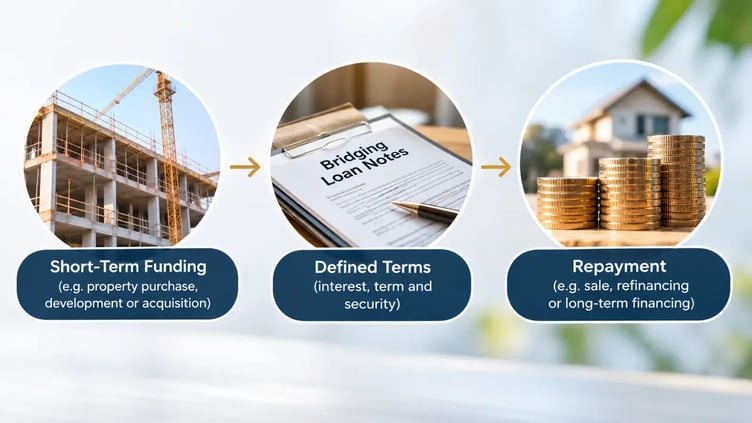
What exactly is a bridging loan note?
A bridging loan note is a debt instrument associated with short-term financing, usually involving a temporary funding requirement before a longer-term source of capital becomes available.
The term combines two related financial concepts: bridging finance and loan notes.
A bridging loan is a short-term loan used to cover a temporary funding gap.
A loan note, meanwhile, is a written debt instrument that records the borrower's obligation to repay a specified amount to the lender or noteholder under agreed terms.
For instance, a property investment company may issue loan notes to investors to raise funds for acquiring or refinancing a property.
The company becomes the issuer and owes repayment to the noteholders. The capital raised may then support a bridging loan to a property borrower.
Alternatively, a borrower may obtain a conventional bridging loan directly from a lender, with the loan agreement setting out the repayment obligations.
These structures should not be treated as interchangeable.
A borrower taking out a bridging loan has a debt obligation to the lender, while an investor purchasing a loan note is exposed to the issuer's ability to repay the investment.
How are bridging loan notes structured?
Bridging loan notes are structured around the amount borrowed or invested, the repayment period, the interest terms, the security arrangements and the contractual obligations of the parties involved.
The precise structure varies between transactions, but the following components are commonly relevant.
Principal Amount
The principal is the amount of capital provided to the borrower or issuer.
For a conventional bridging loan, the principal is the amount advanced by the lender.
For a loan note investment, it is the amount subscribed by the investor and owed by the issuing company.
The principal amount may be limited by the value of the underlying asset, the borrower's financial position or the issuer's ability to meet its obligations.
Interest Rates and Returns
Interest represents the cost of borrowing for the borrower and the potential return for a noteholder.
Bridging loans commonly use monthly interest rates, while loan notes may offer fixed interest payments, periodic distributions or interest payable at maturity.
Some arrangements use rolled-up interest, meaning the interest is added to the outstanding balance rather than paid monthly.
The effective borrowing cost can be significantly higher once arrangement fees, legal expenses, valuation charges and exit fees are included.
For investors, the stated interest rate on a loan note should not be treated as a guaranteed return.
Payment remains subject to the issuer's financial position and the terms of the instrument.
Loan Terms and Maturity Dates
The maturity date is the date on which the outstanding principal and any amounts due must be repaid.
Bridging finance is generally short-term, with many property bridging facilities lasting several months to around a year.
A loan note may have a fixed maturity date, an early repayment provision or an extension mechanism.
These terms should be reviewed carefully because an extension may involve additional interest, fees or investor consent.
Security and Collateral
Security determines which assets may be used to recover the outstanding debt if the borrower or issuer defaults.
A bridging loan may be secured against residential property, commercial property, land or other eligible assets.
A loan note may also be secured or unsecured.
For secured arrangements, the documentation should identify the collateral, the priority of the security and the circumstances in which enforcement is permitted.
A first-ranking charge generally gives the secured creditor priority over creditors holding lower-ranking security over the same asset, subject to applicable law and other claims.
However, collateral does not eliminate investment risk.
The asset may be difficult to sell, its value may decline, or enforcement costs may reduce the amount recovered.
Repayment and Exit Strategies
An exit strategy identifies the source of funds expected to repay the bridging finance at maturity.
Common repayment sources include:
- Sale of the property or another asset.
- Refinancing through a mortgage or long-term loan.
- Proceeds from a business acquisition or disposal.
- Completion of an equity raise or bond issuance.
- Cash flow generated by the underlying business.
A closed bridging loan generally has a fixed repayment date, while an open bridging loan may not have a fixed date but still requires a credible repayment plan.
The exit strategy is one of the most important elements of the arrangement.
A transaction may be commercially attractive at the outset but become financially unsustainable if the expected sale, refinancing or funding event fails to materialize.
When would you need a bridging loan note?
A bridging loan note may be considered when short-term capital is required to complete a transaction before the proceeds from a sale, refinancing or another funding source become available.
Conventional mortgages, long-term business loans or equity financing may take longer to arrange, potentially preventing a transaction from proceeding on schedule.
The following situations illustrate common applications of bridging finance.
Bridging Property Purchases
Bridging finance can help property buyers complete an acquisition before the proceeds from an existing property sale or long-term mortgage become available.
A common example involves purchasing a new home before selling the current one.
A bridging loan can cover the purchase price or the funding shortfall, with repayment expected from the eventual sale proceeds.
Property investors may also use bridging finance to secure properties at auction, where completion deadlines are often short.
For international property buyers, bridging finance may also support a transaction involving a property in another country.
However, cross-border borrowing introduces additional considerations, including currency exposure, local property laws, lender eligibility requirements and the enforceability of security.
Funding Property Development
Bridging finance can fund property acquisitions or early stage development work before a project qualifies for longer-term development financing.
Property developers may use short-term funding to purchase land, acquire a building requiring refurbishment or cover initial construction expenses.
The financing can allow a project to progress while planning approvals, development finance or other funding arrangements are completed.
For example, an investor may acquire a residential property requiring substantial renovation.
A bridging loan could fund the acquisition and refurbishment, with repayment planned through a sale or refinancing once the property has been improved.
Financing Business Acquisitions
Bridging finance can provide temporary capital for a business acquisition before permanent financing or additional investment is secured.
A buyer may use a bridge loan to complete an acquisition while waiting for a bank loan, private equity investment or proceeds from another transaction.
This can be particularly useful when the acquisition has a strict completion deadline.
For example, an investor acquiring a privately owned company may arrange short-term financing to complete the purchase before a longer-term financing package is finalized.
In corporate transactions, bridging loans can also provide temporary funding before a bond issuance, equity raise or term loan becomes available.
These arrangements are commonly referred to as bridge-to-bond or bridge-to-term financing.
However, business acquisition financing requires careful consideration of the target company's financial position, cash flow and ability to support future debt repayments.
Bridging loan notes vs other short-term financing options
Bridging loan notes allow companies to raise debt from investors, while traditional bridging loans involve direct lending and revolving credit facilities let borrowers draw and repay funds as needed.
The main differences lie in how each option provides capital, structures repayment and accommodates the borrower's financing requirements.
|
Financing Option |
How It Works |
Main Advantage |
Main Limitation |
|
Bridging loan notes |
Companies issue debt instruments to investors to raise capital under agreed repayment terms. |
Provides access to private investor funding without issuing ordinary shares. |
Investors face issuer default risk and may have limited liquidity. |
|
Traditional bridging loans |
A lender advances a lump sum directly to a borrower, usually against property or other collateral. |
Can facilitate time-sensitive property purchases and acquisitions. |
Typically carries higher interest rates and fees than long-term borrowing. |
|
Business term loans |
A lender provides a fixed amount that is repaid over an agreed schedule. |
Offers predictable repayments and a defined financing period. |
Approval may involve more extensive underwriting and documentation. |
|
Revolving credit facilities |
Borrowers draw, repay and redraw funds up to an agreed credit limit. |
Provides flexibility for recurring working capital requirements. |
Interest rates, fees and credit conditions may change or restrict access. |
|
Mezzanine financing |
A company obtains debt that ranks below senior loans, sometimes with equity-linked features. |
Can provide additional capital when senior debt is insufficient. |
Usually involves higher financing costs and greater repayment complexity. |
|
Equity financing |
A company raises capital by selling ownership interests to investors. |
Does not create the same contractual debt repayment obligation. |
Dilutes existing shareholders' ownership and potential returns. |
What are the pros and cons of a bridge loan note?
A bridge loan note can provide rapid access to capital for time-sensitive transactions, but high financing costs, short repayment periods and the risk of default can make it a costly borrowing option or a high-risk investment.
Pros of Bridging Loan Notes
- Faster access to capital: Can help borrowers complete property purchases, acquisitions or other transactions before conventional financing becomes available.
- Flexible financing terms: Interest arrangements, maturity dates and security provisions can be structured around the transaction.
- Access to alternative funding: Companies can raise debt capital from private investors without issuing ordinary shares.
- Potential investment income: Noteholders may receive contractual interest payments, subject to the issuer's ability to meet its obligations.
Cons of Bridging Loan Notes
- High financing costs: Interest rates, arrangement fees and other charges can make bridging finance more expensive than conventional borrowing.
- Short repayment periods: Borrowers must repay the debt within a limited timeframe, often relying on a property sale or refinancing.
- Default and capital loss risk: Borrowers may face enforcement against secured assets, while investors may lose some or all of their capital if the issuer defaults.
- Limited liquidity: Loan note investors may be unable to sell their holdings before maturity, particularly when no active secondary market exists.
- Complex legal structures: Multiple parties or layers of security can make it difficult to determine repayment priority and investor rights.
Conclusion
The value of bridging finance lies in whether it solves a temporary funding gap without creating a larger repayment problem.
A transaction’s potential returns matter, but the strength of its exit strategy matters just as much.
For borrowers, the key is to secure a realistic route to repayment; for loan note investors, it is to assess the issuer’s ability to pay and the protections available if the plan fails.
FAQs
What happens if you don't pay back a bridging loan?
Failure to repay a bridging loan can lead to default interest, additional fees and legal action.
For secured loans, the lender may repossess and sell the collateral, while the borrower may remain liable for any shortfall.
Is bridge financing risky?
Yes. Bridge financing carries risks from short repayment periods, high costs and reliance on a property sale or refinancing.
Loan note investors may also face issuer default, limited liquidity and the loss of some or all of their investment.
How much equity do you need for a bridging loan?
Borrowers typically need equity of around 20% to 40% of the property's value, although some lenders offer higher loan-to-value ratios.
The required equity varies with the property, borrower profile, loan purpose and lender criteria.
Related Articles