Buy, Borrow, Die can be used as a wealth strategy in Singapore, but its tax rationale is weaker than in countries where selling appreciated investments routinely triggers capital gains tax.
Singapore generally does not tax gains from shares and other financial instruments held as personal investments, and estate duty has been abolished for deaths.
Borrowing against investments can still help wealthy investors obtain liquidity without selling assets, but the decision is more about financing, portfolio continuity and estate planning than avoiding a general Singapore capital gains or inheritance tax.
Key Takeaways
- Singapore generally does not tax capital gains, reducing the tax benefit of borrowing.
- Wealth lending allows investors to access cash while keeping eligible investments intact.
- Borrowing makes more sense when keeping the assets is worth the financing cost.
- Foreign tax rules can make the strategy more relevant for expats and internationally mobile HNWIs.
My contact details are hello@adamfayed.com and WhatsApp +44-7393-450-837 if you have any questions.
The information in this article is for general guidance only. It does not constitute financial, legal, or tax advice, and is not a recommendation or solicitation to invest. Some facts may have changed since the time of writing.
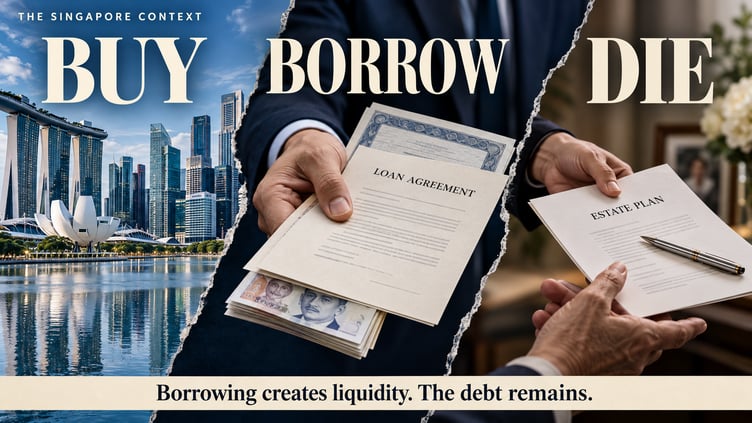
What is the Buy, Borrow, Die strategy?
Buy, Borrow, Die is a wealth strategy in which investors accumulate appreciating assets, borrow against them instead of selling them for cash, and retain the assets throughout their lifetime.
The strategy is commonly described in three stages:
-
Buy: Build wealth through assets expected to appreciate over the long term, such as shares, investment funds, businesses or property.
-
Borrow: Use those assets as collateral for loans, creating liquidity without selling them.
-
Die: Continue holding the assets until death, when they pass according to the owner's estate and succession arrangements.
The strategy became particularly associated with wealthy US investors because selling appreciated assets can create capital gains tax, while borrowing does not itself constitute a sale.
Singapore changes that equation considerably.
Does Buy, Borrow, Die work in Singapore?
The mechanics work in Singapore, but the traditional tax argument for Buy, Borrow, Die is substantially weaker because personal investment gains are generally not taxed as capital gains.
IRAS states that gains from selling shares and other financial instruments are generally considered gains from personal investments and are not taxable.
Gains from Singapore property are also generally capital gains, although profits can become taxable where the activity amounts to trading.
A Singapore investor therefore does not necessarily need to borrow simply to avoid triggering tax on an appreciated investment.
Borrowing may still make sense when an investor wants liquidity without reducing market exposure, disrupting a long-term portfolio or selling an asset they expect to continue appreciating.
That makes the Singapore version of the strategy more dependent on the economics of leverage than on a capital gains tax advantage.
How does the Buy part work in Singapore?
The Buy stage involves accumulating assets capable of generating income, capital appreciation or both over a long investment horizon.
For individual investors, Singapore's tax system can already be relatively favorable to long-term investing.
Gains on shares and financial instruments held as personal investments are generally not taxable.
Singapore one-tier corporate dividends are generally tax-exempt for individual shareholders, while foreign dividends received in Singapore by resident individuals are generally not taxable unless specific exceptions apply.
Interest from deposits with approved Singapore banks and qualifying debt securities is also generally non-taxable for individuals.
The distinction between investing and trading remains important. IRAS can treat gains as taxable income where activities have the characteristics of a trade rather than personal investment.
How can wealthy investors borrow against investments in Singapore?
Investors can use portfolio or Lombard lending to borrow against eligible investments without selling them.
Singapore private banks and wealth managers offer lending facilities secured against assets such as equities, bonds, unit trusts and deposits.
An investor with a substantial portfolio could pledge eligible investments and draw cash for purposes such as personal spending, property purchases or further investments, subject to the lender's terms.
The original investments remain exposed to the market while they are pledged.
Is borrowing against investments tax-free in Singapore?
Receiving loan proceeds does not amount to selling the pledged investments, but borrowing should not be confused with receiving tax-free investment income.
The investor receives borrowed capital and incurs a corresponding debt to the lender.
The bigger question in Singapore is whether borrowing is economically preferable to selling.
If selling a personal investment would not create Singapore capital gains tax in the first place, interest and lending costs can make borrowing more expensive than simply realizing part of the portfolio.
Is interest on Buy, Borrow, Die loans tax-deductible in Singapore?
Investors should not assume that interest on a personal portfolio-backed loan creates a Singapore tax deduction.
The treatment of interest expenses depends on what the borrowed money is used for and the tax status of the relevant income or activity.
Singapore's rules allow deductions in defined circumstances for expenses incurred in producing taxable income, but that does not create a general deduction for borrowing against investments to fund personal expenditure.
This matters to Buy, Borrow, Die because interest costs can accumulate over many years.
Without a corresponding tax deduction, the investment portfolio needs to produce sufficient returns to justify those financing costs.
What are the risks of borrowing against investments in Singapore?
The main risk is that the debt remains fixed while the collateral can fall in value.
Portfolio lending normally assigns different advance ratios to different investments. If the collateral falls sufficiently, the investor may need to provide additional assets, repay part of the loan or face the sale of pledged investments.
Interest-rate risk also matters. Variable borrowing costs can rise even when portfolio returns are weak.
Concentration risk becomes more significant where much of someone's wealth consists of one company, fund or asset.
Currency risk can arise when the loan and collateral are denominated in different currencies.
The strategy is consequently much more fragile when investors borrow aggressively against volatile assets.
What happens to the debt when the investor dies in Singapore?
Death does not make a portfolio-backed loan disappear; outstanding debts must still be addressed as part of administering the deceased's assets and liabilities.
This is an important distinction between the popular phrase Buy, Borrow, Die and actual estate planning.
The estate may need sufficient liquidity to repay debts, or arrangements may need to be made for refinancing or disposing of assets.
The consequences will also depend on the loan agreement, ownership structure and assets involved.
The Die stage requires advance planning rather than simply leaving the debt outstanding indefinitely.
Does Singapore have inheritance or estate tax?
No. Singapore does not currently impose inheritance tax or estate duty. Estate duty was abolished for deaths occurring on or after 15 February 2008.
IRAS confirms that estate duty was removed from that date.
This makes Singapore fundamentally different from jurisdictions where estate tax is a major component of Buy, Borrow, Die planning.
It does not, however, mean that every asset owned by a Singapore resident escapes tax at death worldwide.
Does Buy, Borrow, Die work for expats in Singapore?
Expats can use the investment and borrowing mechanics of Buy, Borrow, Die, but their nationality, domicile, assets and future residence can create tax exposure outside Singapore.
Singapore generally does not tax overseas income received by individuals, subject to specified exceptions. But an investor can simultaneously have obligations in another country.
This becomes especially important for HNWIs holding foreign property, companies or securities.
An expat may face estate, inheritance, capital gains or reporting rules imposed by another jurisdiction even when Singapore itself imposes no equivalent tax.
For internationally mobile investors, Buy, Borrow, Die has to be assessed across the jurisdictions connected to both the investor and the assets, not from Singapore's tax rules alone.
Is Buy, Borrow, Die more useful for Singapore residents with overseas assets?
Potentially, because foreign tax exposure can restore some of the tax considerations that are largely absent from a purely Singapore portfolio.
Suppose an investor owns appreciated assets subject to capital gains tax in another country. Selling those investments could have different consequences from selling Singapore personal investments.
Foreign assets can also create succession or estate tax exposure where the asset is located, regardless of the owner's Singapore residence.
In those circumstances, borrowing rather than selling can become more relevant, but the rules of the foreign jurisdiction determine whether the strategy actually produces a tax advantage.
Is Buy, Borrow, Die better than selling investments in Singapore?
Borrowing is most defensible when retaining the investment has a stronger financial or strategic rationale than selling it, rather than simply because the investor wants to avoid tax.
For a Singapore investor whose sale would produce a non-taxable capital gain, the decision can be reduced to a relatively straightforward economic comparison.
If expected portfolio returns comfortably exceed borrowing costs and the investor can tolerate leverage, retaining the investment may be attractive.
If the loan is expensive, collateral is volatile or the investor already has excessive market exposure, selling assets may be more efficient.
Borrowing also preserves downside exposure. Someone who sells S$1 million of shares no longer bears market risk on that S$1 million. Someone who borrows S$1 million against the shares keeps the market exposure and adds a liability.
What are the pros and cons of Buy, Borrow, Die in Singapore?
Buy, Borrow, Die can preserve investments and provide flexible liquidity, but Singapore's lack of a general capital gains tax makes its principal tax advantage less compelling.
Pros
- Access liquidity without selling investments
- Maintain exposure to appreciating assets
- Avoid disrupting long-term portfolios
- Flexible portfolio-backed borrowing is available
- Can support liquidity planning for HNWIs
- May be relevant where foreign assets face different tax rules
Cons
- Interest reduces the strategy's return
- Falling collateral can trigger margin calls
- Leverage magnifies financial risk
- Selling personal investments may already be tax-free
- Variable rates can increase borrowing costs
- Cross-border tax and estate rules add complexity
Who might consider Buy, Borrow, Die in Singapore?
The strategy is most relevant to HNWIs with substantial liquid portfolios, low borrowing needs relative to their assets and a strong reason to retain their investments.
It can be particularly relevant to business owners or investors whose wealth is concentrated in assets they do not want to sell, as well as internationally mobile families managing assets across several jurisdictions.
It is considerably less compelling where borrowing costs are high, the portfolio is volatile, liquidity needs are persistent or selling investments would have little tax consequence.
The amount borrowed also matters. A modest credit facility against a diversified portfolio creates a very different risk profile from using the maximum lending capacity available.
Bottom Line
Singapore removes two tax pressures that made Buy, Borrow, Die famous elsewhere because personal investment gains are generally not subject to capital gains tax and estate duty has been abolished.
That changes the economics of the strategy. Borrowing against a portfolio can preserve investments, provide liquidity and avoid an unwanted sale, but the cost of the debt still needs to be justified.
Paying years of interest solely to avoid selling becomes harder to justify when the sale itself may generate no Singapore capital gains tax.
The stronger reason to borrow is usually that retaining the asset serves a financial purpose worth the financing cost.
For internationally mobile HNWIs, foreign assets and tax systems can alter that calculation. An investor living in Singapore may still hold assets exposed to capital gains, estate or inheritance taxes elsewhere.
In Singapore, Buy, Borrow, Die ultimately comes down to whether keeping an asset justifies the cost and risk of borrowing against it.
FAQs
Is Buy, Borrow, Die legal in Singapore?
Yes. Buying investments and borrowing against eligible assets are ordinary financial activities in Singapore.
Tax treatment still depends on the nature of the investments, transactions and individual circumstances.
Can I borrow against shares in Singapore?
Yes. Some Singapore banks offer portfolio-backed and Lombard lending against eligible shares and other financial assets. The amount available depends on the lender, collateral and applicable advance ratio.
Do you need to be ultra-wealthy to use Buy, Borrow, Die in Singapore?
There is no legal wealth threshold for using the strategy, but portfolio-backed lending typically becomes more practical with substantial investable assets.
Banks set their own eligibility requirements, collateral rules and minimum lending amounts.
Can property be used for Buy, Borrow, Die in Singapore?
Yes, property can form part of a borrowing-based wealth strategy, although the financing works differently from Lombard lending against securities.
Property-backed borrowing is subject to Singapore's mortgage and lending rules, so investors cannot assume the same borrowing limits or flexibility available against an investment portfolio.
Related Articles
- Borrowing Against Your Assets: What It Means and How It Works
- Why the Wealthy Borrow Money: The Financial Strategy Behind Using Debt
- How to Invest as an Expat: A Practical Framework for Building a Global Portfolio
- Investing in SGX (Singapore Exchange) as a Foreigner
- Singapore Expat Investment Options: Best Investments for Singaporeans Abroad
- Wealth Management for Singapore Expats: How to Grow and Protect Global Assets