Foreigners can buy certain types of property in the Philippines through a company, but they generally cannot own land through a foreign-owned company because of constitutional ownership restrictions.
Philippine corporations that are at least 60% Filipino-owned may own land, while foreign companies are generally limited to alternatives such as qualifying condominium ownership and long-term land leases.
This article covers:
- Can a corporation own a property in the Philippines?
- What is the tax on buying property and land under corporation in the Philippines?
- Are foreign corporations allowed to own land in the Philippines?
- What to check before buying land in the Philippines?
- What are the benefits and risks of buying company and land through a company?
Key Takeaways:
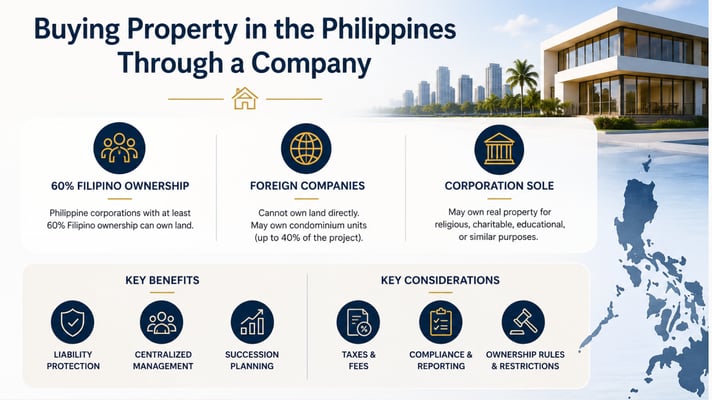
- Philippine corporations that are at least 60% Filipino-owned can generally own land in the Philippines.
- Foreign companies cannot directly own Philippine land but may own qualifying condominium units.
- Buying property through a company can provide liability protection, centralized management, and succession planning benefits.
- Corporate property ownership involves additional compliance requirements, taxes, and regulatory considerations.
My contact details are hello@adamfayed.com and WhatsApp +44-7393-450-837 if you have any questions
The information in this article is for general guidance only. It does not constitute financial, legal, or tax advice, and is not a recommendation or solicitation to invest. Some facts may have changed since the time of writing.

Can a Corporation Buy Land and Property in the Philippines?
Yes, a corporation can buy property in the Philippines, but its ability to own land is based on its ownership structure.
A Philippine corporation that is at least 60% Filipino-owned is considered a Philippine national and may generally own private land.
By contrast, a foreign company incorporated outside the Philippines cannot directly own land. Likewise, a Philippine corporation that is majority foreign-owned generally cannot own land, even if it is incorporated locally.
Qualified Philippine corporations may purchase various types of real estate, including commercial properties, office buildings, industrial facilities, residential developments, hotels, investment properties, and land.
Foreign businesses that require land typically use alternatives such as:
- Long-term land leases
- Joint ventures with qualified Philippine entities
- Investing through a Philippine corporation that meets the 60% Filipino ownership requirement
- Purchasing condominium units where permitted by law
Before acquiring property or land, investors should verify the company's ownership eligibility, the property's land classification, applicable zoning regulations, and any restrictions affecting its intended use.
The constitutional restriction applies to both residential and commercial land.
Can a Foreign Company Own Condominiums in the Philippines?
Yes, a foreign company may own condominium units in the Philippines, subject to condominium ownership restrictions.
The Condominium Act allows foreign individuals and foreign corporations to own condominium units provided that foreign ownership within the condominium project does not exceed 40% of the total units.
However, ownership generally extends only to the condominium unit and the proportionate interest allowed under condominium laws, not direct ownership of the underlying land.
Can a Corporation Sole Own Real Property in the Philippines?
Yes, a corporation sole can own real property in the Philippines for religious, charitable, educational, or similar institutional purposes.
A corporation sole is a special legal entity commonly used by churches and religious organizations to hold and administer assets.
It may acquire and own real estate necessary for carrying out its lawful functions, subject to applicable laws and regulatory requirements.
The rules governing a corporation sole differ from those applicable to ordinary stock corporations, including foreign corporations and foreign-owned Philippine corporations.
What documents does a company need to buy property in the Philippines?
When buying property in the Philippines through a company, the purchaser typically needs corporate, tax, authorization, and property ownership documents.
Common requirements include:
Corporate Documents
- Certificate of Incorporation
- Articles of Incorporation
- By-laws
- General Information Sheet (GIS)
- Latest SEC filings
Corporate Authority
- Board Resolution authorizing the purchase
- Secretary's Certificate
- Authorized signatory documents
Tax and Registration Documents
- Tax Identification Number (TIN)
- BIR registration records
- Proof of tax compliance where required
Property Documents
- Certified true copy of title
- Tax Declaration
- Real Property Tax receipts
- Survey plans and technical descriptions
- Deed of Sale
Additional requirements may apply depending on the property's classification, ownership structure, and transaction details.
How Much Land Can a Corporation Own?
A qualified Philippine corporation is not subject to a single maximum landholding limit for all types of land.
The amount of land it may own depends on the property's classification and the applicable constitutional, statutory, and regulatory restrictions.
The practical limit is usually determined by:
- The property's classification (residential, commercial, industrial, or agricultural)
- The corporation's business purpose
- Zoning regulations
- Environmental regulations
- Agricultural land laws
- Industry-specific restrictions
- Regulatory approvals where required
Agricultural land is subject to additional constitutional and agrarian reform rules that may impose ownership and land-use limitations beyond those applicable to residential, commercial, or industrial land.
How Much Agricultural Land Can a Corporation Own in the Philippines?
A qualified Philippine corporation may generally acquire up to five hectares of private agricultural land, subject to the Comprehensive Agrarian Reform Law and other applicable land-use regulations.
The actual extent of ownership may also depend on the land's classification, agrarian reform coverage, and any other applicable statutory or regulatory restrictions.
Before completing the acquisition, companies should verify the land's classification, zoning, title status, agrarian reform coverage, and any approvals or restrictions that may affect ownership, development, or future use.
What to Know Before Buying Land in the Philippines?
Before buying land in the Philippines, investors should verify the property's ownership, title status, zoning classification, land-use restrictions, and eligibility for corporate ownership.
- Verify Ownership and Title: Confirm that the seller has legal ownership and authority to transfer the property.
- Check for Liens and Encumbrances: Review mortgages, adverse claims, easements, and other title annotations.
- Review Zoning and Land Use: Confirm that the intended use aligns with local zoning regulations.
- Assess Access and Infrastructure: Verify road access, utilities, drainage, and development potential.
- Check Environmental Restrictions: Certain areas may be subject to environmental protection or development limitations.
- Confirm Corporate Ownership Eligibility: Ensure the purchasing company complies with Philippine ownership requirements where land ownership is involved.
Early due diligence can help prevent costly legal, regulatory, and development issues after acquisition.
What Taxes Do Companies Pay When Buying Property and Land in the Philippines?
Companies buying property or land in the Philippines may incur transfer taxes, registration fees, Documentary Stamp Tax (DST), and ongoing property-related taxes.
Transaction costs commonly total around 2% to 8% of the property's value, based on the transaction structure, the type of property or land being acquired, and the applicable taxes and fees.
Common taxes and fees include:
| Tax or Fee | Typical Application |
|---|---|
| Documentary Stamp Tax (DST) | Transfer documents |
| Transfer Tax | Local government transfer tax |
| Registration Fees | Registry of Deeds registration |
| Notarial Fees | Execution of legal documents |
| Value-Added Tax (VAT) | Certain property and land transactions |
| Capital Gains Tax (CGT) | Usually paid by the seller |
| Real Property Tax (RPT) | Ongoing annual property tax |
Companies acquiring land should also consider whether the property's classification such as residential, commercial, industrial, or agricultural, affects the taxes, regulatory requirements, or approvals applicable to the transaction.
Corporate owners may also face:
- Corporate income tax on rental income
- Tax obligations arising from property sales
- Withholding tax requirements in certain transactions
Professional tax advice is recommended before acquiring significant real estate or land holdings, particularly where agricultural land, commercial developments, or cross-border ownership structures are involved.
Who Is Exempt From Paying Property Taxes in the Philippines?
Certain properties used exclusively for religious, charitable, educational, or governmental purposes may qualify for exemptions from real property tax.
Examples may include:
- Churches and religious institutions
- Charitable organizations
- Educational institutions
- Government-owned properties
Exemptions are subject to constitutional provisions, local government regulations, and actual property use requirements.
Commercially used properties generally remain taxable.
What Are the Benefits of Buying Property in the Philippines Through a Company?
Buying property in the Philippines through a company can simplify family ownership, succession planning, property management, and commercial real estate operations.
Liability Separation
Corporate ownership separates business assets from personal assets, helping reduce personal exposure to certain liabilities.
Easier Multi-Owner Management
Companies provide a structured framework for multiple shareholders to own and manage property collectively, which can be particularly useful for family-owned assets and joint ventures.
Succession Planning
Ownership transfers can often be achieved through share transfers rather than repeated transfers of the underlying property, helping simplify long-term family succession planning.
Asset Consolidation
Businesses and families with multiple properties can centralize ownership, management, accounting, and reporting under a single entity.
Greater Flexibility for Commercial Activities
A corporate structure may be more suitable for leasing, property development, commercial operations, and other income-generating real estate activities.
Easier Admission of Future Investors
New investors or family members can often be added through share ownership without changing the property's title, providing greater flexibility for future ownership changes.
What Are the Risks of Buying Property in the Philippines Through a Company?
Buying property in the Philippines through a company can increase compliance obligations, administrative costs, and regulatory complexity, particularly for foreign investors and family-owned structures.
Ongoing Compliance Requirements
Companies must maintain SEC filings, accounting records, tax registrations, and other corporate governance obligations even when the property itself is not actively generating income.
Additional Administrative Burden
Major decisions involving the property may require board resolutions, shareholder approvals, and other corporate authorizations.
Tax Complexity
Corporate ownership may create different tax consequences from personal ownership, affecting rental income, property sales, and overall investment returns.
Foreign Ownership Restrictions
Foreign investors must carefully navigate constitutional restrictions on land ownership and ensure that any ownership structure complies with Philippine law.
Costs of Maintaining the Company
Beyond property-related expenses, corporations may incur ongoing legal, accounting, filing, and compliance costs.
Regulatory Scrutiny
Companies holding real estate remain subject to ongoing obligations with the SEC, BIR, local government units, and other relevant authorities.
Buying Property in the Philippines Through a Company vs Buying Personally
Personal ownership is often simpler for a primary residence or a single investment property, while company ownership may be more suitable for commercial activities, multiple properties, and long-term succession planning.
| Factor | Company Ownership | Personal Ownership |
| Liability | Separate legal entity | Direct personal ownership |
| Succession Planning | Transfer through shares | Transfer of the property itself |
| Multiple Owners | Easier to accommodate | More complex co-ownership |
| Compliance | Ongoing corporate filings | Fewer administrative requirements |
| Costs | Higher maintenance costs | Generally lower costs |
| Commercial Use | Often more suitable | Commonly used for personal ownership |
Conclusion
Real estate often remains in families, businesses, and investment portfolios for decades.
The ownership structure chosen at acquisition can influence future financing opportunities, ownership changes, and strategic decisions long after the purchase is completed.
A company structure is therefore best viewed as part of a broader asset-holding strategy rather than merely a method of acquiring property.
FAQs
What Is the 60/40 Ownership Rule in the Philippines?
The 60/40 ownership rule requires at least 60% Filipino ownership and no more than 40% foreign ownership in a corporation that wishes to own land in the Philippines.
How to Split the Title of a Property in the Philippines?
Property titles are commonly split through a subdivision process approved by the relevant government agencies and registered with the Registry of Deeds.
Where multiple owners or heirs are involved, title splitting may also occur through partition or estate settlement procedures.
How to Avoid Capital Gains Tax on Real Estate in the Philippines?
Capital gains tax generally applies to taxable real estate sales in the Philippines and cannot simply be avoided.
Certain exemptions or tax-efficient structures may be available under Philippine law if the applicable requirements are met.
What Is the Best Type of Corporation for Real Estate?
A domestic stock corporation is commonly used for real estate ownership and investment because it provides separate legal personality, centralized management, and flexibility for multiple shareholders.
Related Articles