Carbon credit investments provide exposure to a growing market where emissions reductions and removals are assigned financial value.
Investors can gain exposure by purchasing credits directly, backing carbon projects, or investing in businesses and funds linked to carbon markets.
Key Takeaways
- Carbon credit investors can gain exposure through credits, projects, companies and funds.
- Credit quality, project type, eligibility and demand can significantly affect prices.
- Returns can come from rising credit prices or revenue generated by carbon projects.
- Carbon credit investments carry liquidity, price, regulatory and project risks.
My contact details are hello@adamfayed.com and WhatsApp +44-7393-450-837 if you have any questions.
The information in this article is for general guidance only. It does not constitute financial, legal, or tax advice, and is not a recommendation or solicitation to invest. Some facts may have changed since the time of writing.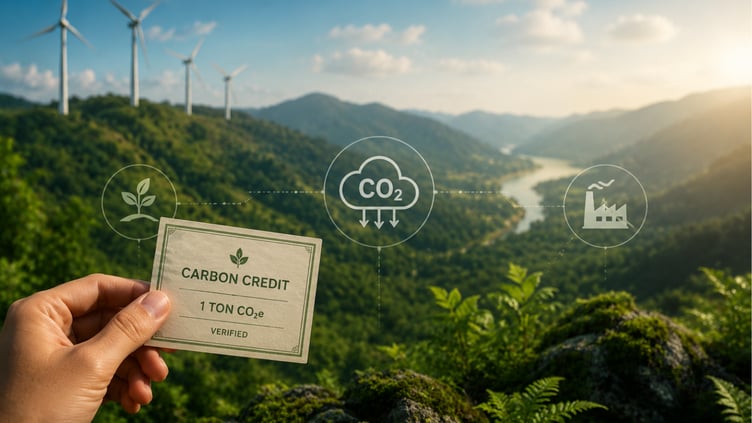
What is carbon credit investing and how does it work?
Carbon credit investing involves purchasing carbon credits or investing in assets connected to the generation, trading or retirement of those credits with the expectation of obtaining financial value from them.
A carbon credit generally represents one metric tonne of carbon dioxide equivalent (tCO2e) that has been reduced, avoided or removed through a qualifying project.
For example, a project may prevent deforestation, capture methane from a landfill, improve energy efficiency or remove carbon from the atmosphere.
Once the resulting emissions reduction has been measured and independently verified under an applicable standard or mechanism, credits can be issued.
The investment process can therefore involve several stages:
- A project reduces, avoids or removes greenhouse gas emissions.
- The emissions reduction is measured against an appropriate baseline.
- The project undergoes monitoring, reporting and verification.
- Eligible carbon credits are issued.
- Credits can be transferred or sold to buyers.
- A buyer may eventually retire the credit to make a claim associated with the emissions reduction.
Measurement, reporting and verification, or MRV, is particularly important because it is intended to demonstrate that the claimed emissions reduction actually occurred.
For investors, the potential return comes from the difference between the acquisition and eventual sale price, or from participation in a project or financial vehicle whose value is linked to carbon markets.
This is different from simply purchasing a carbon credit to offset or compensate for emissions.
How are carbon credits produced?
Carbon credits are produced when an eligible activity generates a measurable reduction, avoidance or removal of greenhouse gas emissions.
The process generally begins by establishing a methodology and baseline for determining what emissions would have occurred without the project.
The project's actual emissions impact is then measured and reported.
Independent verification is an important part of the process.
Under carbon-crediting systems, third parties may assess whether the project meets the applicable requirements before credits are issued.
Once issued, credits are recorded in a registry and can be transferred, sold or ultimately retired.
Retiring a credit removes it from further circulation and prevents it from being resold or used again.
The quality of the underlying project is critical.
Concepts such as additionality, permanence, leakage and accurate measurement are therefore central to evaluating carbon credits.
How can I invest in carbon credits?
You can invest in carbon credits by buying credits directly, investing in carbon projects, gaining exposure through carbon-related companies or funds, or trading carbon allowances in regulated markets.
Each approach offers a different combination of potential returns, liquidity, risk and exposure to the carbon market.
Directly buying carbon credits
An investor can purchase credits through carbon-market platforms, brokers or other market intermediaries.
The credits may subsequently be sold if there is a willing buyer and an appropriate market.
However, buying a credit does not automatically mean it will appreciate.
Carbon credits can vary significantly in quality, project type, vintage, location and market eligibility, which can produce large differences in price.
Investing in carbon projects
Another approach is to invest in projects that generate carbon credits.
These can include forestry, reforestation, methane capture, renewable energy, waste management, clean cooking and carbon-removal projects.
In this structure, the investor's potential return can come from the project's underlying economics and the sale of the credits it generates.
Investing in carbon-related companies or funds
Investors can also obtain indirect exposure through companies involved in carbon markets, emissions management, carbon removal or related technologies.
Depending on the structure, this can provide broader diversification than owning individual credits.
Trading carbon allowances
A related but distinct approach is trading allowances in regulated emissions trading systems.
These instruments should not automatically be treated as the same thing as voluntary carbon credits.
The distinction matters because regulated carbon markets operate under government-established rules, while many voluntary carbon credits are generated by independent crediting programs.
Carbon markets are becoming increasingly significant.
The World Bank's 2026 State and Trends of Carbon Pricing report says carbon pricing now covers nearly 30% of global greenhouse gas emissions, while carbon credit issuances increased 8% from 2024 to 2025.
| Route | What investor owns | Liquidity | Main risk |
|---|---|---|---|
| Direct credits | Individual carbon credits | Often low | Quality/resale risk |
| Carbon projects | Project/economic interest | Low | Project and issuance risk |
| Funds/securities | Fund or listed security | Usually higher | Market/manager risk |
| Carbon allowances | Compliance-market instruments/exposure | Market-dependent | Regulatory/policy risk |
Is carbon credit a good investment?
Carbon credits can be a good investment for investors seeking exposure to the growing carbon market, but their volatile prices, limited liquidity and varying credit quality make them a higher-risk investment than traditional assets.
One potential attraction is the possibility of increasing demand.
Governments are expanding carbon-pricing systems, while companies are facing greater pressure to measure and reduce emissions.
In 2025, more than 80% of retired carbon credits were used for voluntary purposes, according to the World Bank, while future carbon-credit demand was also supported by around US$12 billion in offtake agreements signed during the year.
Another potential attraction is diversification.
Carbon markets can be influenced by environmental regulation, corporate demand, project supply and climate policy rather than only the traditional factors affecting stocks and bonds.
However, carbon credits have important limitations.
Prices can be volatile, the market is fragmented, and liquidity can be limited for specific projects or credit types.
The value of a credit can also depend heavily on its environmental integrity and eligibility under particular market rules.
Recent market data illustrates the variation. MSCI reported that its global carbon credit price index averaged US$3.50 per tCO2e in 2025, down from US$4.30 in 2024.
However, higher-rated credits averaged US$6.80 in 2025, demonstrating the substantial price difference between credits of different perceived quality.
Therefore, carbon credits may have a role within a diversified portfolio for investors who understand the market, but they should not be treated as a guaranteed source of returns.
How much money do you get from carbon credits?
Investors can make money from carbon credits when the value of their credits or carbon market investments rises above their acquisition and transaction costs. Project investors can also earn returns from financing projects that generate credits for future sale.
There is no fixed yield or standard rate of return attached to a carbon credit. Unlike a bond that pays interest or a stock that may distribute dividends, a carbon credit held directly generally produces a return through price appreciation and resale.
For example, an investor who buys 10,000 credits at US$5 each has an initial position worth US$50,000.
If those credits can later be sold at US$8 each, the gross gain would be US$30,000 before brokerage, platform, tax and other transaction costs.
If their market price falls to US$3, the position would instead have a gross loss of US$20,000.
The potential return can be very different when investing directly in a carbon project. In that case, returns may come from the sale of credits generated by the project, but the investor also takes on development, verification, issuance and project-performance risks.
How much can I sell my carbon credits for?
Carbon credits can sell for anywhere from around US$1 to more than US$20 per tCO₂e.
It can vary according to the project's type, location, vintage, verification standard, environmental attributes, market eligibility and perceived quality.
There is no standard price, and individual credits can trade at significantly different levels.
For example, the World Bank reported that exchange-traded avoided-deforestation credits were around US$5.30 per tCO₂e on April 1, 2025, while nature-based removal credits were around US$15.50 per tCO₂e.
Its 2026 report also found that most credit types traded between roughly US$1 and US$14 per tCO₂e, while CORSIA-eligible credits traded at approximately US$15 to US$22 per tCO₂e from September 2025.
These figures are market indicators rather than guaranteed resale prices.
A specific credit may sell for considerably more or less depending on its characteristics and available buyers.
Who buys carbon credits?
Carbon credits are purchased by a range of participants, including companies, financial institutions, governments, intermediaries and, in some markets, individuals.
Companies may purchase credits to meet voluntary climate commitments, support emissions-reduction projects or satisfy specific regulatory requirements where credits are eligible.
Governments and regulated entities can also participate in compliance carbon markets.
In a cap-and-trade system, for example, companies that need additional units to meet their obligations can purchase eligible emissions units from other participants.
Other buyers include brokers, retailers and wholesalers that purchase credits for resale.
Individuals can also purchase certain voluntary carbon credits, although access and available products vary by market.
Demand is particularly important to investors because a carbon credit only has a market value if there are buyers willing to purchase it.
Which countries are major carbon credit markets?
India, Brazil, Colombia, Indonesia and other emerging markets are important sources of carbon-credit projects.
Meanwhile, major compliance and buyer markets are concentrated in jurisdictions including the European Union, China, California and other economies with established carbon-pricing systems.
However, the largest carbon-credit producers are not necessarily the most attractive places to invest.
Investors need to distinguish between:
- countries that generate credits,
- jurisdictions that create demand for them, and
- regulated emissions markets where different instruments such as allowances are traded.
Which countries generate the most carbon credits?
India ranked first by project location for voluntary carbon offsets issued between 2004 and 2025, with approximately 405 million tonnes of offsets, according to data from the Berkeley Carbon Trading Project cited by the US Congressional Research Service.
India was the largest carbon-credit issuer on the Verra Registry in 2024, with approximately 28 million carbon credits, according to UN Trade and Development.
Colombia is a major source of nature-based and REDD+ carbon credits, with around 142 million tonnes of nature-based carbon credits issued since the market's inception as of September 2024.
Why does a carbon credit's country matter to investors?
Project location can affect a carbon credit's price, regulatory eligibility, political risk, project economics and the pool of buyers willing to purchase it.
credit is not economically interchangeable with every other credit merely because each represents one tCO₂e.
MSCI identifies region alongside project type, quality and vintage as an important pricing factor and has observed substantial regional price differences for otherwise comparable project categories.
Country exposure can also become important where credits interact with domestic carbon market rules or international mechanisms.
Investors need to evaluate the host country's carbon market framework alongside the underlying project.
What are the disadvantages of carbon credit investment?
The main disadvantage is that carbon credits do not behave like a conventional asset with a straightforward valuation model.
Price volatility: Carbon credit prices can move sharply as regulations, corporate demand, supply and perceptions of project quality change.
Quality risk: Not every carbon credit carries the same environmental value.
Investors need to consider whether emissions reductions are measurable, additional, permanent where relevant and independently verified.
Liquidity risk: Some credits trade relatively infrequently, making them more difficult to sell quickly at a desired price.
Regulatory risk: Carbon markets are heavily influenced by government policy and international agreements.
Changes in eligibility rules can affect demand for particular credits.
Project risk: A project may fail to deliver its expected emissions reductions because of operational, environmental, political or financial problems.
Market fragmentation: Carbon credits can be issued under different standards and mechanisms, making direct comparisons difficult.
Reputation risk: Concerns about the environmental integrity of certain credits can reduce their market value or make them less attractive to buyers.
The World Bank reported that carbon credit prices generally declined slightly across 2025, while higher-rated and internationally eligible credits continued to command premiums.
This highlights why simply buying the cheapest available credit may not produce the best investment outcome.
Conclusion
The most important question in carbon credit investing is not how much the carbon market grows, but which credits capture that growth.
Two credits can represent the same tonne of CO₂e yet have very different investment prospects because buyers may place a premium on stronger verification, greater permanence, removal rather than avoidance, or eligibility in particular markets.
That makes carbon credits an unusually selection-driven investment: market growth can create opportunity, but it does not lift all credits equally.
For investors, the ability to distinguish durable demand from temporary pricing trends may ultimately matter more than simply getting exposure to carbon markets.
FAQs
How much is 1 carbon credit in dollars?
One carbon credit averaged about US$3.50 per tCO₂e in 2025, although prices varied significantly by credit quality.
Higher-rated credits averaged US$6.80 per tCO₂e during the same year, according to MSCI.
Can a regular person buy carbon credits?
Yes, individuals can buy certain voluntary carbon credits, although the purchase route and requirements vary by platform and crediting program.
Individuals may be able to purchase credits through retail platforms or intermediaries.
What are the two types of carbon markets?
The two main types of carbon markets are compliance carbon markets and voluntary carbon markets.
Compliance markets operate under government regulations, while voluntary markets allow companies, organizations and individuals to purchase carbon credits voluntarily for climate-related purposes.
What is the only country that is carbon negative?
Bhutan is widely recognized as the world's first carbon-negative country, with its forests absorbing more carbon dioxide than the country emits.
Bhutan's 2026 Resource Mobilization Plan reports that forests cover more than 69.7% of the country's land area and identifies Bhutan as the world's first carbon-negative country.
Related Articles
- Green Finance: How to Invest, Key Examples, and Risk Considerations
- ESG Investing Strategies: How to Invest Responsibly from ESG Funds
- Ethical Investing vs Greenwashing: Are ESG investments legit?
- Sustainable investing: What is it and why you should consider it
- Top Investments for Expats: A Guide to Expat Investing Abroad