A STAR trust is a specialised trust under Cayman Islands law that can be created for named beneficiaries, specific purposes, or a combination of both.
Unlike many traditional trusts, a STAR trust is enforced by an appointed enforcer rather than beneficiaries, making it a flexible tool for succession planning, family businesses, and long-term wealth preservation.
Key Takeaways
- STAR trusts may continue indefinitely, making them suitable for long-term ownership and governance arrangements.
- They are governed by the Cayman Islands Trusts Act and require an appointed enforcer.
- STAR trusts are commonly used for succession planning, family businesses, and international wealth structures.
- While generally tax-neutral in the Cayman Islands, tax obligations may still apply in other jurisdictions.
We offer bespoke trust & wealth structuring solutions tailored to your situation.
My contact details are hello@adamfayed.com and WhatsApp +44 7393 450 837 if you have any questions.
How does a STAR trust work?
A STAR (Special Trusts Alternative Regime) trust works by transferring assets from a settlor to a Cayman Islands trustee, who manages and administers those assets according to the terms of the trust deed.
Unlike a traditional trust, a STAR trust may be established to benefit individuals, fulfill specific purposes, or achieve both objectives within a single structure.
Another key difference from many traditional trusts is how the trust is enforced.
Instead of beneficiaries having the automatic legal right to enforce the trust, a STAR trust requires one or more enforcers who are responsible for ensuring the trustee administers the trust according to the settlor's instructions.
A typical STAR trust involves the following parties:
- Settlor: Establishes the trust and transfers assets into it.
- Trustee: Holds legal title to the trust assets and manages them according to the trust deed.
- Enforcer: Has the legal authority to oversee the trustee and enforce the terms of the trust.
- Beneficiaries (if any): Individuals or organizations that may receive benefits from the trust.
What is the Cayman STAR trust law?
The Cayman STAR trust is governed by Part VIII of the Cayman Islands Trusts Act, formerly known as the Special Trusts (Alternative Regime) Law introduced in 1997.
The legislation was designed to modernize Cayman trust law by allowing trusts that could exist for purposes beyond simply benefiting individuals.
Key features of the law include:
- Trusts may benefit persons, purposes, or both.
- Purposes do not have to be charitable.
- An enforcer, rather than beneficiaries, has legal standing to oversee the trustee.
- Trusts can be drafted with significant flexibility regarding governance and succession.
- Cayman Islands licensed trustees must generally act as trustee.
The legislation has made the Cayman Islands one of the world's leading jurisdictions for sophisticated trust planning.
What is a STAR trust best used for?
A STAR trust is best used for long-term wealth planning, family business ownership, succession planning, and other arrangements that require flexible governance or specific trust purposes.
Family Wealth Preservation
Families can establish long-term structures that preserve assets across multiple generations while maintaining centralized management.
Succession Planning
A STAR trust can help ensure family businesses, investment portfolios, or other significant assets continue according to the settlor's wishes after death.
Family Business Ownership
Many privately owned businesses use STAR trusts to hold company shares while establishing governance rules that reduce succession disputes.
Private Trust Companies
STAR trusts frequently own shares of private trust companies (PTCs), allowing families to maintain greater involvement in trust administration.
Charitable and Philanthropic Projects
Unlike many traditional trusts, STAR trusts can exist solely for charitable or non-charitable purposes, making them suitable for foundations, research initiatives, and philanthropic activities.
Investment Holding Structures
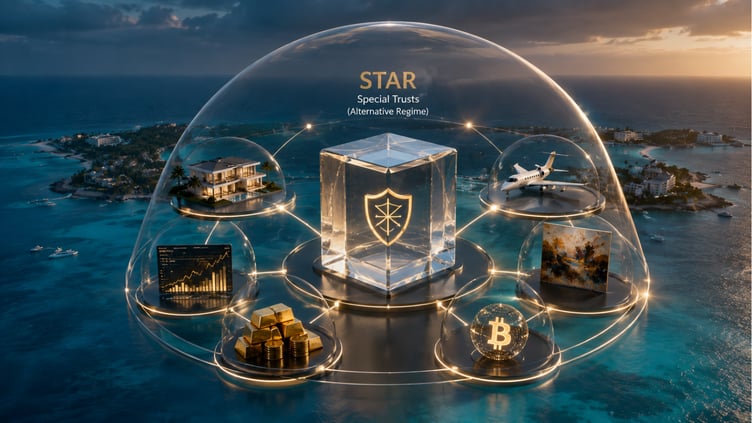
They may hold:
- Global investment portfolios
- Real estate
- Private equity interests
- Intellectual property
- Digital assets
- Cryptocurrency
Special Purpose Transactions
Financial institutions sometimes use STAR trusts in structured finance transactions where assets need to be held independently for a defined purpose.
What are the advantages and disadvantages of a STAR trust?
STAR trusts offer greater flexibility than many traditional trusts, but they also involve higher costs, more complex administration, and specialized legal requirements.
Advantages
- Can combine beneficiaries and specific purposes within a single trust, providing greater planning flexibility than many traditional trust structures.
- Non-charitable purposes are permitted under Cayman Islands law.
- An independent enforcer oversees compliance with the trust deed, adding an additional layer of accountability.
- Can be customized with tailored governance, succession, and distribution provisions.
- Benefits from the Cayman Islands' well-established trust law and legal framework.
- Suitable for holding complex assets and ownership interests under a single trust structure.
Disadvantages
- Generally more expensive to establish and administer than conventional trusts.
- Requires ongoing administration by qualified professional trustees and legal advisers.
- Governance and compliance can be more complex than standard trust arrangements.
- A qualified Cayman Islands trustee is generally required.
- May be unnecessarily sophisticated for individuals with relatively simple estate planning needs.
How to set up a STAR trust?
Creating a STAR trust involves defining the trust's objectives, appointing a qualified Cayman trustee and an enforcer, drafting the trust deed, transferring assets into the trust, and administering it in accordance with Cayman Islands law.
1. Determine Your Objectives
Identify whether the trust will benefit family members, achieve specific purposes, own business interests, or accomplish multiple goals.
2. Select a Cayman Trustee
The trust generally requires a qualified Cayman Islands trustee authorized under local law.
3. Draft the Trust Deed
The trust deed establishes:
- Trust purposes
- Beneficiaries
- Trustee powers
- Investment authority
- Distribution rules
- Governance provisions
4. Appoint an Enforcer
Every STAR trust requires one or more enforcers responsible for ensuring trustees carry out the trust's objectives.
5. Transfer Assets
Assets may include:
- Cash
- Investment accounts
- Company shares
- Real estate
- Intellectual property
- Cryptocurrency
- Alternative investments
6. Ongoing Administration
Trustees manage investments, maintain records, comply with Cayman regulations, and administer the trust according to its governing document.
What is the minimum needed to start a STAR trust?
There is no statutory minimum asset requirement to establish a STAR trust in the Cayman Islands. In theory, a trust may be settled with a nominal amount, such as US$100.
However, practical considerations often make larger asset values more appropriate.
Because STAR trusts involve legal drafting, licensed trustees, and ongoing administration, they are generally used for larger estates or complex ownership structures where the benefits outweigh the costs.
Many professional service providers work with clients whose trust assets are worth several million dollars, although minimum engagement thresholds vary by trustee and law firm.
Are STAR trusts tax-free in Cayman Islands?
Yes, STAR trusts generally benefit from the Cayman Islands' tax-neutral regime, where there is no personal income tax, capital gains tax, estate tax, wealth tax, or inheritance tax.
However, this favorable tax treatment applies within the Cayman Islands and does not automatically exempt the trust, the settlor, or the beneficiaries from taxes in other jurisdictions.
The overall tax treatment of a STAR trust depends on factors such as:
- The settlor's tax residency
- The beneficiaries' tax residency
- The location of the trust assets
- Applicable foreign tax laws
- Reporting obligations under regimes such as CRS and FATCA
STAR trust vs other types of trusts
A STAR trust differs from other types of trusts by allowing a single trust to benefit individuals, fulfill specific purposes, or combine both objectives, while also requiring an appointed enforcer rather than relying on beneficiaries to enforce the trust.
| Feature | STAR Trust | Discretionary Trust | Fixed Trust | Purpose Trust |
|---|---|---|---|---|
| Can benefit individuals | ✔ | ✔ | ✔ | Usually no |
| Can exist for specific purposes | ✔ | No | No | ✔ |
| Non-charitable purposes allowed | ✔ | No | No | Jurisdiction-dependent |
| Requires identifiable beneficiaries | No | Yes | Yes | No |
| Enforcer required | ✔ | No | No | Usually |
| Can combine beneficiaries and purposes | ✔ | No | No | No |
| Commonly used for long-term governance | ✔ | Sometimes | Sometimes | ✔ |
Conclusion
STAR trusts are designed for situations where conventional trust structures may not provide sufficient flexibility.
Their ability to combine beneficiaries with specific purposes and operate under a dedicated enforcement framework makes them a distinctive option for sophisticated ownership and governance arrangements.
That said, a STAR trust is not a one-size-fits-all solution. Selecting the appropriate trust structure is based on the planning objectives, the nature of the assets involved, the jurisdictions concerned, and the applicable legal and tax considerations.
Careful planning and professional advice can help determine whether a STAR trust is the most suitable structure for a particular situation.
FAQs
What are the different types of trusts in the Cayman Islands?
The Cayman Islands recognizes several types of trusts, including STAR trusts, discretionary trusts, fixed trusts, life interest trusts, charitable trusts, purpose trusts, reserved powers trusts, exempted trusts, and unit trusts.
Each trust is designed to meet different estate planning, asset holding, investment, commercial, or succession planning objectives.
Are STAR trusts recognized internationally?
Yes. STAR trusts are widely recognized in international private wealth planning and cross-border asset structuring.
They are frequently used by international families, private trust companies, investment managers, and multinational business owners.
Can foreigners establish a STAR trust?
Yes. Foreign nationals can establish a STAR trust in the Cayman Islands without becoming Cayman residents or citizens.
The trust must generally be administered by a qualified Cayman trustee and comply with Cayman trust legislation.
Related Articles