A child born after a parent receives citizenship by investment may acquire citizenship at birth or become eligible for registration later. The process, deadline and fees are determined by the country’s nationality law and post-approval rules.
Getting a family CBI passport creates a lasting benefit for your family, but adding new children later may mean following strict rules, meeting deadlines, and paying extra fees.
Key Takeaways
- Children born after CBI approval may acquire citizenship automatically or require separate registration.
- Post-approval additions can involve separate documentation, processing and passport fees.
- Processing speed should be weighed against dependent eligibility and post-approval family rules.
- Family CBI costs can increase when spouses, children or other eligible dependents are added to the application or registered after approval.
For second residencies that require income, assets, or qualifying investments, we can help structure suitable investment solutions that may align with those requirements, depending on your circumstances.
My contact details are hello@adamfayed.com and WhatsApp +44-7393-450-837 if you have any questions.
The information in this article is for general guidance only, does not constitute financial, legal, or tax advice, and may have changed since the time of writing.
How does post-approval citizenship pass down to newborns?
Post-approval newborns inherit status through citizenship by descent or through post-citizenship dependent registration based on the host nation's legal framework.
- Citizenship by Descent (Jus Sanguinis): Under this mechanism, a child born to a naturalized CBI parent automatically becomes a citizen at birth as a legal right. Parents complete the process by submitting a local birth certificate, filing a birth registration form, and applying for a passport through a national consulate or government department.
- Post-Citizenship Dependent Registration: Popular CBI jurisdictions usually classify primary investors as naturalized citizens rather than citizens by birth. Even when citizenship passes automatically at birth, parents usually need to register the birth and apply separately for the child’s citizenship documents and passport.
Can you add children after getting citizenship by investment?
Yes, you can add children after getting Citizenship by Investment, provided you follow the jurisdiction's specific eligibility rules, registration deadlines, and fee schedules.
Eligibility for Post-Approval Addition:
Most CBI programs allow primary applicants to add newborns, newly adopted children, or newly wed spouses after initial approval.
However, adding existing adult children who were omitted from the main application is generally restricted unless they qualify as new dependents under specific program updates.
Registration Timelines & Deadlines:
Some CBI programs impose specific deadlines or procedures for registering children born after citizenship is granted.
The applicable window varies by jurisdiction, so parents should confirm the deadline, required documents and consequences of late registration before relying on a post-approval route.
Post-Addition Fee Structures:
Adding a child post-approval incurs separate government processing, background check, certificate of naturalization, and biometric passport fees.
While including a newborn shortly after birth typically costs between $2,000 and $10,000, post-approval addition fees for older dependents can be significantly higher.
Post-Approval Family Additions
For children born or spouses married after initial citizenship approval, program policies allow secondary registration under specific processing fee tiers:
|
Add-On Dependent Category |
Average Government Fee |
Due Diligence Fee |
|
Newborn / Child (Ages 0–5) |
$5,000 – $10,000 |
Excluded ($0) |
|
Child (Ages 6–17) |
$20,000 – $25,000 |
$0 – $2,000 |
|
Adult Dependent (18+) |
$50,000 |
$4,000 – $7,500 |
Key factors to consider when selecting a CBI program for future family planning
Evaluating a CBI program for family planning requires knowing how each jurisdiction handles dependent age thresholds, post-approval additions, residency requirements, and generational rights over time.
- Spouses and existing dependents
Check the age limit for adult children and any requirements concerning financial dependence, marriage or education. Also check whether dependent parents or grandparents can join the initial application. - Adding family members after approval
Check whether future spouses and children can be added years after citizenship is granted, including the applicable deadlines and fees. - Physical presence requirements
Check whether family members must visit or reside in the country, when any requirement applies, and whether children qualify for exemptions. - Citizenship for future generations
Check whether children and grandchildren born abroad can acquire citizenship, including any registration requirements or limits on transmission.
Which citizenship by investment programs are best for families?
Antigua & Barbuda, St. Kitts & Nevis, Grenada, Dominica, St. Lucia, and Turkey, provide clear operational pathways for adding dependents and managing multi-generational family expansion.
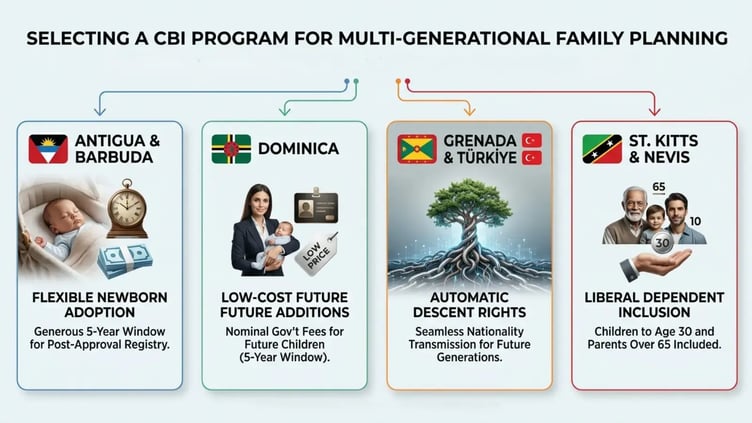
- Antigua & Barbuda: Offers the most cost-effective option for large families via the University of the West Indies (UWI) Fund route worth $260,000 for a family of 6+, inclusive of processing fees. Post-approval newborns under age five can be added for a fixed government processing fee of $10,000 plus a $300 passport issuance fee, and citizenship automatically passes down to future generations by descent.
- St. Kitts & Nevis: Allows primary applicants to add newborns born post-approval upon submission of a birth certificate and standard administrative fees of about $10,000 post-approval fee plus processing within 12 months. Unmarried dependent adult children are covered up to age 30 provided they are financially supported by the main applicant.
- Grenada: Features generous family inclusion rules, permitting unmarried siblings, dependent parents, and dependent adult children up to age 30 on the main application. Newborns born post-approval can be registered as citizens by descent within 12 months of birth for a fixed government processing fee.
- Dominica & St. Lucia: Both island nations feature dedicated, time-sensitive channels for post-approval additions. Dominica permits parents to add a newborn born post-approval for a low government processing fee of $2,000. St. Lucia allows post-approval newborn additions within the first 12 months of birth for a fixed government contribution fee of $5,000, plus standard processing and passport fees.
- Turkey: Grants direct citizenship to the main applicant, spouse, and dependent children under age 18 through a single real estate investment, with a minimum of $400,000. Children born after the parents acquire citizenship inherit Turkish nationality automatically by descent without additional investment requirements.
Which countries give citizenship to babies born there?
Canada, the United States, Mexico, Brazil, Argentina, and select Caribbean CBI nations grant unconditional birthright citizenship (jus soli) to any child born within their territorial borders.
- The Americas: Canada and the United States maintain strict, unconditional birthright citizenship laws regardless of parental status.
- Latin America: Brazil, Argentina, Costa Rica, Panama, and Mexico automatically confer nationality on all children born on their soil.
- CBI Nations with Jus Soli: Caribbean CBI nations including St. Kitts & Nevis, Antigua & Barbuda, St. Lucia, Grenada, and Dominica, enforce constitutional jus soli. If a CBI passport holder physically travels to these islands to deliver their baby, the child obtains birthright citizenship automatically by birthplace rather than through a post-approval CBI application.
Which country gives fastest citizenship by investment?
St. Kitts & Nevis and Grenada are among the fastest established citizenship-by-investment options for families, with published processing periods of three to six months and three to four months, respectively.
These figures refer to the program's processing stage rather than necessarily the full period from preparing documents to receiving passports.
For families, processing speed should be assessed alongside dependent eligibility, family fees and the rules for children born after citizenship is granted.
A program with a short initial processing window may not offer the same advantages when future family additions are considered.
Parents should compare the initial application timeline with the rules for adding newborns, the treatment of dependent children and the costs that apply after approval.
Processing times can also vary based on document completeness, due diligence and the individual application.
Citizenship by birthplace vs Investment
Citizenship by birthplace grants immediate legal status based on physical location of delivery, whereas citizenship by investment grants status via legal contribution and administrative post-approval registration.
|
Feature |
Birthplace Citizenship (Jus Soli) |
CBI Post-Approval Registration (Jus Sanguinis / Administrative) |
|
Primary Requirement |
Physical delivery within the country's borders |
Naturalized parent status and formal application |
|
Application Method |
Automatic local birth certificate registration |
Post-approval dependent filing through a government agency |
|
Travel Expectation |
Expectant mother must physically travel to deliver |
Fully processed remotely via consular services |
|
Standard Cost Structure |
Medical delivery, travel, and lodging expenses |
$2,000 – $15,000+ in state processing & passport fees |
|
Registration Window |
Immediate upon birth |
Often time-sensitive (e.g., must apply within 12 months) |
|
Next-Generation Status |
Child becomes a citizen by birth |
Child becomes a citizen by descent/naturalization |
What happens when a child ages out during a CBI application?
A child who exceeds a program’s dependent age limit while an application is pending may lose eligibility under that category.
The key issue is whether the program assesses age at submission, approval or another specified stage, and whether it preserves eligibility established when the application was filed.
Marriage, leaving education or becoming financially independent during processing may also affect a child’s eligibility where the program imposes those conditions.
For a child approaching the limit, ask the authorized agent to confirm in writing whether a birthday during processing would affect inclusion and what options remain if the child no longer qualifies.
Do not assume that submitting the application freezes the child’s age.
Conclusion
Family expansion within Citizenship by Investment (CBI) programs is fundamentally an exercise in risk management and generational asset protection.
While securing a secondary nationality offers immediate security, its true long-term value depends on how effectively the primary investor navigates administrative deadlines, shifting legislative landscapes, and multi-generational transmission rules.
Investors who treat CBI not as a static, one-time transaction, but as an ongoing family governance framework are far better positioned to preserve international mobility, optimize tax residence, and protect their descendants' global access for decades to come.
FAQs
Do children automatically become citizens when their parents are naturalized?
For existing children, citizenship is never automatic; they must be formally included as dependents on the primary application at the outset.
For children born after approval, rules vary. Some jurisdictions grant automatic citizenship by descent, while others require a separate post-approval registration process and fee.
What is proof of citizenship for a newborn?
Proof of citizenship for a newborn registered under a CBI program is primarily established by an official Certificate of Naturalization or Registration issued in the child's name, along with a valid national passport.
Secondary proof includes an official Consular Birth Record or state-issued birth certificate.
Do children automatically get dual citizenship?
Children acquire dual citizenship automatically only if birth laws or parental nationalities confer it at birth; acquiring it through a parent's CBI program is never automatic.
Which is the toughest citizenship to get?
Vatican City, Qatar, Liechtenstein, Kuwait, and Japan maintain the world's strictest citizenship requirements, often mandating decades of continuous physical residence, deep language fluency, and complete renunciation of foreign nationality.
Related Articles
- Caribbean Second Passport: Which Citizenship Is Fastest to Get?
- Popular Citizenship by Investment Programs for NRIs
- Is Moving Abroad with a Family Worth It?
- Financial Planning for Cross-Border Wealth for Expats
- Cross-Border Tax Planning: What to Review Before & After Moving
- Citizenship by Birth Countries: Where to Get Birthright Citizenship