A cross-border financial planner helps individuals and families manage investments, taxes, retirement plans, and wealth across multiple countries.
Cross-border financial planning focuses on coordinating financial decisions between different jurisdictions to reduce risks and support long-term financial goals.
Key Takeaways
- A cross-border financial planner helps coordinate finances across multiple countries.
- International tax, regulatory, and currency risks can complicate financial decisions.
- A qualified cross-border financial planner should have relevant credentials and international experience.
- Professional planning often becomes more valuable as financial situations become more complex.
My contact details are hello@adamfayed.com and WhatsApp +44-7393-450-837 if you have any questions.
The information in this article is for general guidance only. It does not constitute financial, legal, or tax advice, and is not a recommendation or solicitation to invest. Some facts may have changed since the time of writing.
What does a cross-border financial planner do?
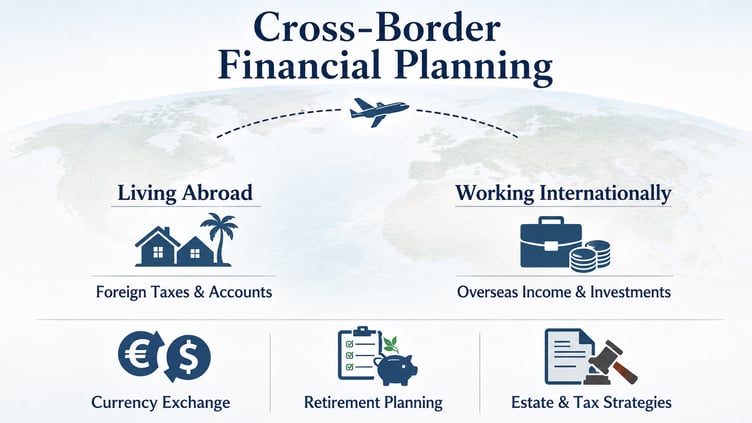
A cross-border financial planner helps coordinate finances when assets, income, investments, or tax obligations span multiple countries.
Depending on the client’s circumstances, a cross-border financial planner may advise on:
- International tax considerations
- Retirement and pension planning
- Investment portfolio management
- Estate and inheritance planning
- Currency management
- International insurance solutions
- Education funding strategies
- Relocation planning
Cross-border financial planning brings these areas together into an integrated financial strategy rather than treating each country’s financial considerations separately.
How to choose a good cross-border financial planner?
A good cross-border financial planner should have relevant international experience, recognized professional credentials, expertise in the countries involved, and a transparent fee structure.
Look for Relevant International Experience
A planner who regularly works with expatriates, dual citizens, international executives, or globally mobile families may be better positioned to understand the challenges associated with managing finances across multiple jurisdictions.
Experience with situations similar to your own can help ensure recommendations account for both local and international considerations.
Verify Professional Credentials
Look for recognized qualifications and professional designations that demonstrate expertise and adherence to professional standards.
Credentials such as CFP, CFA, ChFC, or CPA may indicate specialized knowledge in financial planning, investments, or taxation.
While credentials alone do not guarantee quality advice, they can provide evidence of formal training and professional commitment.
Understand Geographic Specialization
Cross-border financial planning often involves country-specific rules and regulations.
Some planners focus on particular country combinations, such as:
- United States and United Kingdom
- United States and Canada
- United Kingdom and Europe
- Australia and Asia
- Middle East and Europe
A planner who understands the tax systems, retirement structures, reporting requirements, and investment regulations of the relevant jurisdictions may be better equipped to identify potential planning opportunities and challenges.
Evaluate the Fee Structure
Some planners charge hourly fees, while others use fixed planning fees, retainer arrangements, or asset-based fees.
Knowing how compensation works can help clients evaluate costs and understand whether recommendations may be influenced by particular business models.
Ask About Coordination with Other Professionals
Cross-border planning rarely exists in isolation.
Tax specialists, accountants, estate planning attorneys, and immigration professionals may all play important roles in a comprehensive financial strategy.
A planner who regularly collaborates with other professionals may be able to provide a more coordinated approach to complex international financial situations.
Confirm Regulatory Status
Financial planning regulations vary by jurisdiction.
Verify that the planner holds the necessary licenses, registrations, or authorizations required to provide services in the relevant locations.
Regulatory oversight can provide an additional layer of accountability and professional standards.
Discuss Communication and Ongoing Support
Financial planning is often an ongoing process rather than a one-time event.
Before engaging a planner, it may be helpful to understand how frequently reviews are conducted, how communication is handled, and whether ongoing monitoring of the financial plan is included.
A good cross-border financial planner should also be transparent about their expertise, limitations, compensation structure, and the specific jurisdictions they serve.
What qualifications do you need to be a financial planner?
Financial planners typically need professional credentials such as the Certified Financial Planner (CFP) designation, relevant regulatory licenses, and, in some cases, specialized qualifications in investment management, taxation, or wealth planning.
Common credentials include:
Certified Financial Planner (CFP)
The CFP designation is one of the most widely recognized financial planning credentials globally.
It generally requires education, examinations, professional experience, and adherence to ethical standards.
Chartered Financial Consultant (ChFC)
This designation focuses on comprehensive financial planning and wealth management.
Chartered Financial Analyst (CFA)
The CFA credential is highly regarded in investment management and portfolio analysis.
Certified Public Accountant (CPA)
CPAs often specialize in accounting and taxation, which can be particularly relevant in cross-border situations.
Local Regulatory Licenses
Financial professionals may also need licenses or registrations required by regulators in their jurisdiction.
When evaluating a cross-border financial planner, qualifications should be considered alongside practical experience and international expertise.
What is the typical cost of a cross-border financial planner?
A cross-border financial planner typically costs anywhere from $200 to $500+ per hour, $2,000 to $10,000+ for a comprehensive financial plan, or around 0.5% to 1.5% of assets under management annually, based on the complexity of the client's situation.
Common fee models include:
Hourly Fees
Planners may charge hourly rates for consultations or specific projects.
Fixed Planning Fees
A comprehensive financial plan may be offered for a predetermined fee.
Assets Under Management (AUM)
Some advisors charge a percentage of assets managed on behalf of clients.
Ongoing Retainer Fees
Clients with complex financial situations may engage planners through recurring monthly or annual retainers.
Cross-border planning often costs more than traditional financial planning because it typically involves additional research, regulatory considerations, and coordination across multiple jurisdictions.
The focus should not be solely on financial planner cost but also on the value provided through tax efficiency, risk management, and long-term planning outcomes.
When should you start working with a cross-border financial planner?
A cross-border financial planner should ideally be engaged before major financial decisions, especially those involving international moves, significant investments, retirement planning, or cross-border assets.
Situations where it may be beneficial to start working with a financial planner include:
- Before relocating to another country
- Before accepting an overseas job assignment
- Before retiring abroad
- Before purchasing foreign property
- Before receiving a large inheritance
- Before selling a business
- When managing substantial investment assets
- When financial obligations span multiple countries
Starting early may provide more planning opportunities than attempting to address issues after they arise.
For individuals with international financial interests, proactive planning can help reduce tax inefficiencies, reporting challenges, and long-term financial risks.
What is better, a financial planner or advisor?
A financial planner is generally better for comprehensive financial planning, while a financial advisor may be better suited for investment management and wealth management services.
A financial advisor is a broad term that can encompass professionals who provide investment advice, wealth management services, or financial guidance.
Many professionals perform both roles.
For individuals facing international financial challenges, a cross-border financial planner may offer a more comprehensive approach than an advisor focused primarily on investment management.
The most important factor is whether the professional's expertise aligns with the client's needs rather than the title they use.
Common mistakes in cross-border financial planning
Cross-border financial planning can become complicated when financial decisions are made without considering the rules and implications of multiple jurisdictions.
Ignoring Tax Obligations in Multiple Countries
Income, investments, and assets may create tax obligations in more than one country.
Failing to understand these obligations can lead to unexpected liabilities or penalties.
Overlooking Foreign Reporting Requirements
Many jurisdictions require the disclosure of foreign bank accounts, investments, and other overseas assets.
Missing reporting deadlines can result in significant consequences.
Failing to Update Estate Plans
Wills and estate plans prepared in one country may not fully address assets located in another.
Cross-border families should periodically review their estate planning arrangements.
Holding Unsuitable Investment Products
Some investment products may have unfavorable tax treatment or regulatory restrictions for individuals with cross-border financial ties.
Investment suitability should be evaluated within the context of all relevant jurisdictions.
Neglecting Currency Exposure
Exchange rate fluctuations can affect investment returns, retirement income, and the value of international assets. Ignoring currency risk may impact long-term financial outcomes.
Conclusion
As international mobility continues to increase, financial decisions are becoming more complex for many individuals and families.
Different tax systems, reporting requirements, investment regulations, and legal frameworks can interact in ways that create both opportunities and unintended consequences, making it increasingly important to take a coordinated approach.
Rather than treating each country's financial obligations separately, effective cross-border financial planning brings them together within a single strategy.
For internationally mobile individuals and families, this can help improve financial efficiency, support long-term goals, and provide greater confidence when navigating an increasingly interconnected world.
FAQs
Can you have two financial planners?
Yes. Some individuals, especially high-net-worth investors, work with multiple financial planners, particularly when financial matters span different jurisdictions or specialties.
Coordination between advisors is important to avoid conflicting recommendations.
What are the two types of financial planners?
Financial planners are often categorized as fee-only planners and commission-based planners.
Fee-only planners are compensated directly by clients, while commission-based planners may receive compensation from financial products they recommend.
Do you have to be rich to have a financial planner?
No. Financial planning can benefit individuals at various income and asset levels.
While high-net-worth individuals often use financial planners, many professionals, families, and retirees also seek financial guidance.
Is a CFP better than a CPA?
No, a CFP and a CPA serve different roles.
A CFP specializes in financial planning, while a CPA specializes in accounting and taxation, making both valuable depending on an individual's needs.
Related Articles
- Basic Financial Terms Glossary: Financial Planning, Retirement, and Insurance
- Expat Wealth Planners: Why International Expertise Matters
- International Financial Planning: Key Insights on Global Wealth Optimization
- Financial Planning for Life Events
- Best Financial Planning 101 for HNWI Families
- Financial Planning and Pensions for Expat Teachers
- Financial Planner vs Wealth Manager
- Top Wealth Managers for Expats