Employer health insurance can cover employees abroad, but many plans only pay for emergency treatment or provide limited overseas benefits.
The scope of coverage depends on the employer's policy, destination country, and whether the employee is traveling for business or relocating on a long-term international assignment.
This article covers:
- Does employer health insurance cover overseas?
- What is the difference between assignment and business trip coverage?
- How does international insurance work?
- Why is international health insurance necessary for most expats?
- Can you rely on employer health insurance abroad?
Key Takeaways:
- Employer health insurance does not always provide comprehensive overseas coverage.
- International benefits vary significantly between employers and insurance plans.
- Business trips and long-term expatriate assignments often have different levels of coverage.
- Reviewing your policy before moving abroad helps avoid costly coverage gaps.
My contact details are hello@adamfayed.com and WhatsApp +44-7393-450-837 if you have any questions.
The information in this article is for general guidance only. It does not constitute financial, legal, or tax advice, and is not a recommendation or solicitation to invest. Some facts may have changed since the time of writing.
Do I need insurance to work abroad?
Yes. Health insurance is often required to work abroad, either as a condition of obtaining a work visa, meeting local legal requirements, or satisfying an employer's overseas assignment policy.
Even where it is not legally required, health insurance protects employees from potentially significant medical expenses while living or working overseas.
Employees working abroad should confirm whether adequate health insurance is in place before relocating, particularly for long-term international assignments.
Does my employer health insurance cover overseas travel?
Sometimes, but not always. Employer-sponsored health insurance does not automatically provide comprehensive medical coverage overseas.
While some multinational employers offer international health insurance for employees on overseas assignments, many domestic employer plans only cover emergency treatment abroad or provide no overseas benefits at all.
Coverage generally falls into one of these categories:
| Type of Employer Plan | Overseas Coverage |
| Domestic health insurance | Usually emergency care only or no coverage |
| International employer health plan | Comprehensive worldwide coverage |
| Expat assignment plan | Comprehensive coverage in the host country and often globally |
| Business travel insurance | Emergency medical care during short work trips |
Even when overseas healthcare is covered, provider networks, reimbursement rules, annual limits, and covered services may differ from those available in the employee's home country.
How do I know if my insurance works internationally?
The only way to confirm international coverage is to review the employer's health insurance policy or obtain written confirmation from the employer, insurer, or HR department.
Before working abroad, verify:
- Which countries are covered
- Whether treatment is cashless or reimbursement-based
- Which hospitals and clinics are in the provider network
- Whether emergency medical evacuation is covered
- Whether spouses and dependent children are eligible
- Whether pre-existing conditions remain covered
- Whether annual benefit limits or exclusions apply
Confirming these details before departure helps prevent unexpected medical expenses and coverage gaps while abroad.
How does health insurance work in another country?
Employer-sponsored health insurance typically works abroad through either a global healthcare network or a reimbursement system.
Depending on the policy, employees may receive cashless treatment at approved medical facilities or pay for healthcare upfront and submit a claim for reimbursement afterward.
The claims process generally involves the following:
Finding a healthcare provider
Many international employer health plans have approved hospital networks where employees can receive cashless treatment.
Receiving care outside the network may result in higher out-of-pocket costs or reduced reimbursement.
Pre-authorization for certain treatments
Hospital admissions, surgeries, and other high-cost treatments often require prior approval from the insurer before coverage is confirmed.
Emergency assistance and medical evacuation
Many international employer plans provide 24-hour emergency assistance to help coordinate medical care, hospital admissions, and medical evacuation when appropriate.
Claims and supporting documents
For reimbursement-based plans, employees typically need to submit medical invoices, receipts, claim forms, and clinical records within the insurer's specified timeframe to receive reimbursement.
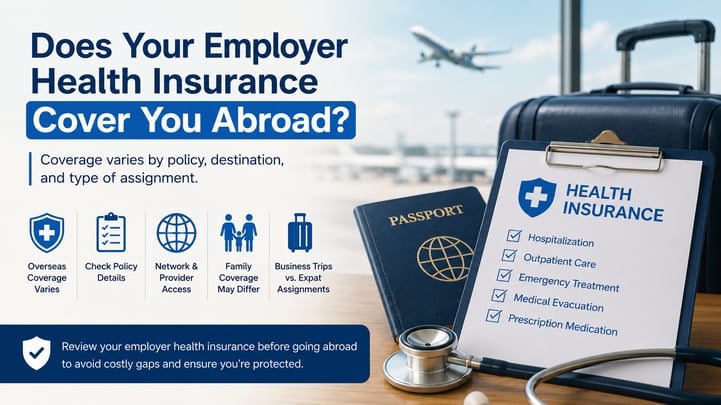
What Does Employer Health Insurance Not Cover Abroad?
Employer health insurance usually does not cover cosmetic procedures, non-essential elective treatments, medical tourism, and certain high-risk or non-approved medical services overseas.
At the same time, many international employer health plans commonly cover medically necessary healthcare, including:
- Inpatient hospitalization
- Outpatient treatment
- Emergency medical treatment
- Prescription medication
- Medical evacuation (on many international plans)
- Preventive healthcare (on some higher-tier plans)
Common exclusions include:
- Cosmetic procedures
- Experimental or unapproved treatments
- Medical tourism
- Non-essential elective procedures
- Routine dental care
- Routine vision care
- Alternative therapies (depending on the policy)
- High-risk sports injuries
- Treatment received outside approved provider networks
- Certain pre-existing conditions (depending on the plan)
Some domestic employer health insurance plans also limit overseas coverage to emergency treatment only, excluding routine or non-emergency healthcare received abroad.
If your employer's health insurance does not provide sufficient international coverage, insurance.adamfayed.com can help you compare international health insurance plans and evaluate alternative coverage options.
Does Your Employer Health Insurance Cover Your Family Abroad?
Employer health policy may cover spouses and dependent children abroad, but family coverage is not automatically included in every employer-sponsored plan.
Some employers include dependents under their international health insurance, while others require separate enrollment or an additional premium for family members.
Family coverage often mirrors the employee's medical benefits and may include:
- Hospitalization
- Outpatient care
- Pregnancy and maternity benefits (if included)
- Pediatric care
- Emergency treatment
- Prescription medication
Before an overseas assignment, confirm which family members are eligible for coverage, whether separate enrollment is required, and whether any additional premiums or coverage limits apply.
Business Trip vs Expat Assignment Insurance Coverage: What's the difference?
Employer health insurance for business trips typically provides limited short-term medical coverage, while expat assignments usually include more comprehensive international health insurance.
The level and duration of coverage generally reflect the nature and length of the overseas assignment.
| Business Trips | Expat Assignments |
| Short-term travel | Long-term relocation |
| Emergency medical care often included | Comprehensive healthcare usually provided |
| Limited duration | Ongoing annual coverage |
| Often paired with travel insurance | Often includes international health insurance |
| May exclude routine care | Often includes routine and preventive care |
Why is insurance important to employees?
For employees working abroad, health insurance provides access to medical care while reducing the financial impact of illness or injury in another country.
Employer health insurance can provide:
- Access to quality healthcare overseas
- Financial protection against expensive medical bills
- Faster treatment through private healthcare networks
- Medical evacuation if local facilities are inadequate
- Greater peace of mind while living and working abroad
Strong international health coverage also supports employee wellbeing, productivity, and confidence during overseas assignments.
Should You Rely Solely on Employer Health Insurance Abroad?
You cannot always just rely on medical insurance from an employer.
Employer-sponsored health insurance may be sufficient for some international assignments, but supplemental international health insurance may be appropriate when employer coverage leaves significant gaps.
Understanding the scope of employer health insurance before an overseas assignment helps employees determine whether additional coverage is necessary.
Conclusion
Employer health insurance is ultimately designed as an employee benefit, not a universal healthcare solution.
As careers become increasingly international, the value of a health plan lies not simply in having coverage, but in whether it remains effective across borders, healthcare systems, and changing personal circumstances.
Viewing international health protection as part of long-term financial and career planning—not merely an HR benefit—can lead to more informed decisions and greater resilience abroad.
FAQs
Does health insurance cover thyroid?
Usually yes.
Most health insurance plans cover medically necessary diagnosis and treatment for thyroid conditions, although coverage for pre-existing conditions, specialist consultations, and medications is based on the specific policy.
Is Parkinson's disease covered by health insurance?
Generally yes.
Employer health insurance often covers medically necessary treatment for Parkinson's disease, including consultations, hospitalization, and prescription medications.
Is pancreatitis covered in health insurance?
Yes, in most cases. Acute and chronic pancreatitis are generally covered when treatment is medically necessary, though benefits vary by insurer and policy.
What are the 7 most important principles of insurance?
The seven fundamental principles of insurance are utmost good faith, insurable interest, indemnity, contribution, subrogation, proximate cause, and loss minimization.
These principles form the legal and operational foundation of most insurance policies worldwide.
Related Articles: