Before a first retirement withdrawal as an expat, key checks include tax residence, withdrawal taxation, applicable treaty relief and the expected after-tax amount.
Lump-sum versus regular payments, withdrawal timing and required tax paperwork should also be reviewed before the funds are released.
Key Takeaways
- Tax residence and pension source determine which country can tax a withdrawal.
- Lump sums can create a larger taxable amount in one year, while regular payments spread taxable income across multiple years.
- Tax treaties can reduce source-country withholding or shift taxing rights to the country of residence.
- Tax withheld at source may differ from the final tax liability after credits and other relief.
My contact details are hello@adamfayed.com and WhatsApp +44-7393-450-837 if you have any questions.
The information in this article is for general guidance only. It does not constitute financial, legal, or tax advice, and is not a recommendation or solicitation to invest. Some facts may have changed since the time of writing.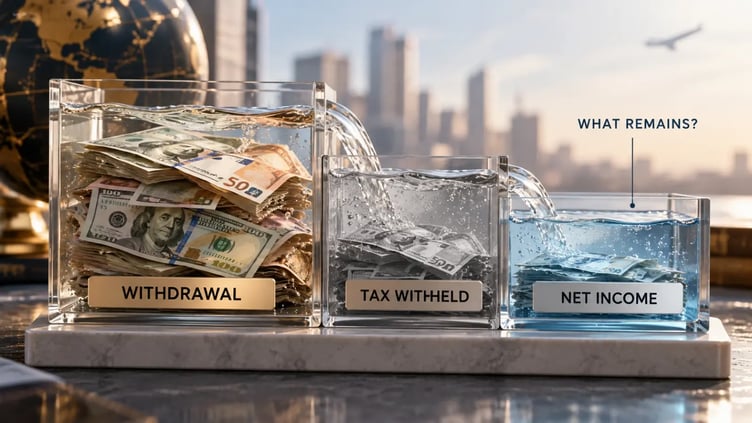
What is expat retirement income tax planning?
Retirement income tax planning for expats is the process of checking how retirement income will be taxed when you live in one country but receive a pension or retirement distribution connected to another country.
Before your first withdrawal, you should establish which country considers you tax resident, where the pension is sourced, and which country has the right to tax the payment under its domestic rules and any applicable tax treaty.
The first withdrawal is particularly important because the tax treatment can differ from subsequent regular payments.
A pension provider may also apply withholding tax before you receive the funds, meaning the amount deposited into your account may be lower than the gross withdrawal.
The relevant rules can also vary according to the type of retirement arrangement, the nature of the payment and your age at withdrawal.
How much tax is taken from a retirement withdrawal?
Tax on a retirement withdrawal is generally calculated on the taxable portion of the amount you withdraw, using the applicable tax rate in the country that has the right to tax the payment.
For example:
United States: A nonperiodic retirement distribution generally has a 10% federal withholding rate, while an eligible rollover distribution is generally subject to 20% withholding.
The final federal income tax can be higher or lower because it is determined based on the taxpayer's taxable income and circumstances.
An additional 10% early distribution tax may also apply in certain cases.
United Kingdom: Pension income is generally taxed as income at the individual's applicable rate.
Up to 25% of eligible pension savings can generally be taken tax-free, subject to the applicable lump-sum allowances, while the remaining taxable pension income is generally subject to the individual's marginal income tax rate.
Australia: The tax treatment of a retirement withdrawal varies according to factors including age and the type of superannuation benefit.
For example, certain benefits paid from age 60 can be tax-free under Australian domestic rules, while withdrawals made earlier can receive different treatment.
Your actual liability can change further if you live in another country when you make the withdrawal or if a tax treaty gives your country of residence or the pension's source country taxing rights.
There are two amounts to distinguish:
Tax withheld at source: This is deducted by the pension provider or financial institution before the money reaches you.
Final tax liability: This is the amount you ultimately owe after applying the tax rules in your country of residence, deductions, allowances, credits and any foreign tax relief.
These amounts do not necessarily match.
For example, a pension provider could withhold tax when making a payment to a non-resident, while the country where you live may subsequently give you a foreign tax credit for some or all of that amount.
Alternatively, you may have to file a tax return to reclaim excess withholding.
Before making the withdrawal, check:
- The gross amount you intend to withdraw.
- Which portion is taxable.
- The expected withholding rate.
- Whether your country of residence also taxes the payment.
- Whether a tax treaty changes the withholding treatment.
- Whether foreign tax credits are available.
- Your estimated final after-tax amount.
What are some tax-efficient strategies for retirement withdrawals?
Tax-efficient retirement withdrawals generally involve choosing a withdrawal amount and timing that fit your tax position, while using any available allowances, treaty relief and other applicable tax benefits.
Before your first withdrawal, check these points:
- Timing: Whether taking the withdrawal in a different tax year could change your taxable income.
- Withdrawal type: Whether a lump sum or regular payments receive different tax treatment.
- Tax relief: Whether you can use available allowances, deductions or pension-specific exemptions.
- Treaty relief: Whether a tax treaty can reduce source-country withholding.
Is it better to take tax-free lump sum from pension?
A tax-free lump sum can be more tax-efficient than regular pension withdrawals when the lump sum remains tax-free in both countries and regular payments would be taxable.
Regular pension payments spread taxable income across multiple years, while a lump sum can concentrate a larger amount into a single tax year.
For expats, the outcome can change if the country of residence taxes the lump sum or if regular payments benefit from lower marginal tax rates.
Before taking a tax-free lump sum, check:
- Whether the lump sum is tax-free under the pension country's rules
- Whether the country of residence also exempts it
- Whether regular pension payments would be taxed as income
- Whether the tax treaty treats lump sums and regular payments differently
- Whether the lump sum creates a higher taxable income in the withdrawal year
- Whether withholding applies despite the tax-free treatment
The relevant comparison is therefore the total tax on the lump sum versus the cumulative tax on regular withdrawals, rather than the tax treatment in the pension country alone.
How does the early withdrawal penalty affect taxes?
An early withdrawal penalty reduces the amount you receive and can be charged in addition to the income tax due on the retirement withdrawal.
The penalty and the tax on the withdrawal are separate issues.
If you withdraw $50,000 and a $5,000 early withdrawal penalty applies, the penalty reduces the amount you receive, while the $50,000 withdrawal may still be subject to applicable income tax.
Check:
- The minimum withdrawal age for your retirement account
- Whether your circumstances qualify for an exception
- Whether the penalty is a fixed amount or percentage
- Whether the penalty is deductible for tax purposes
- Whether your country of residence recognizes the treatment
- Whether the withdrawal itself remains taxable
What are the benefits of having a tax treaty in the first withdrawal?
A tax treaty can reduce the tax withheld from your first pension withdrawal and determine whether the pension country or your country of residence has the primary right to tax it.
This can be particularly important for your first withdrawal because the pension provider may otherwise apply its standard non-resident withholding rate.
A treaty may provide mechanisms for avoiding double taxation, such as foreign tax credits.
However, having a tax treaty does not automatically mean that your withdrawal will be tax-free. You still need to establish:
- Whether the treaty applies to your specific pension
- Whether you are a tax resident of the treaty country
- Which treaty article covers the payment
- Whether the treaty treats lump sums differently from periodic pensions
- What paperwork the pension provider requires
- Whether you need to claim relief through a tax return
Do you have to report retirement in both countries?
You may have to report a retirement withdrawal in both countries, although the exact reporting requirements are based on the countries involved and the type of pension payment.
Reporting the income does not necessarily mean you will pay tax twice.
Before your first withdrawal, check whether you need to:
- Report the gross pension payment
- Report tax already withheld
- Submit a foreign income schedule
- Claim a foreign tax credit
- Report the pension account itself separately from the withdrawal
- Provide proof of foreign tax paid
Keep copies of the withdrawal statement and tax documents so that the amounts reported in each country can be reconciled.
What documents should you keep after your first withdrawal?
Keep withdrawal statements, tax records, treaty documents and proof of tax residence after the first retirement withdrawal.
At a minimum, retain:
- Pension or retirement account statement
- Withdrawal confirmation showing gross and net amounts
- Record of tax withheld at source
- Proof of tax residence
- Tax treaty relief forms and related correspondence
- Pension provider correspondence
- Tax return and foreign tax credit records
- Exchange rate used to report the withdrawal in local currency
These records can substantiate the withdrawal amount, tax paid and treaty relief claimed if the payment later needs to be reconciled on a tax return or supported with a foreign tax credit.
Conclusion
The first retirement withdrawal can set the tax pattern for future pension income, making the decision about when and how to access the money as important as the amount withdrawn.
Expats should note whether the withdrawal is being made under the most appropriate tax treatment across the countries involved.
A withdrawal that looks tax-efficient at source can still produce a different result after residence-country taxation, treaty rules and reporting requirements are applied.
Establishing the position before the first payment therefore gives greater clarity over the actual retirement income available and reduces the risk of correcting avoidable tax issues later.
FAQs
Does a retirement withdrawal count as income?
A retirement withdrawal can count as taxable income, although the treatment is based on the type of pension, withdrawal and applicable tax rules.
Some withdrawals or portions may be tax-free or receive preferential treatment.
Can I withdraw my pension if I move abroad?
Yes, in many cases, a pension can still be withdrawn after moving abroad, but the withdrawal remains subject to the pension's rules and the tax laws of the new country of residence.
What are the requirements for applying for tax treaty Relief (TTRA)?
TTRA generally requires proof of tax residence and the relevant treaty-relief form, with some countries or pension providers also requiring pension or income documentation.
The requirements should be confirmed before the withdrawal is processed to avoid unnecessary withholding.
What is the 3 year rule for pensions?
The 3-year rule is a South African retirement-fund rule requiring certain former tax residents to remain non-resident for an uninterrupted three years before accessing specified retirement benefits before retirement.
The rule applies to particular types of retirement funds and circumstances, so the applicable fund and cessation-of-residence rules must be checked.
Related Articles
- Can I withdraw money from SRS account as an expat?
- Best Expat Podcasts for Pension Planning
- Pensions for Expats Explained
- Expat Annuities: Tax Rules, Options, and Retirement Planning
- Retirement Planning 2026: How Much You Need, Best Strategies, and What to Expect
- How Can I Withdraw From My 401(k) Early Without Penalty?