I have been advising expats and high-net-worth individuals on investments and retirement planning for close to a decade and a half, and have written about it for Forbes and other publications.
In that time, the most frequent questions I get are: “How can I ensure that I don’t run out of money” and “How can I withdraw more money in retirement safely”.
This article will look at two cases:
- Those who retire at standard retirement ages (60s and 70s)
- Those who want to retire early
Worried about your retirement income?
Discover strategies that can help you create more income, enjoy greater financial freedom, and spend more confidently throughout retirement.
Adam is an internationally recognised author on financial matters with over 830 million answer views on Quora, a widely sold book on Amazon, and a contributor on Forbes.
As featured in

Firstly, a word of caution:
What got you here, probably won’t get you there.
You are either reading this article because you know that you haven’t invested enough for retirement. In that case, it is easy to know what to do — invest more to begin with and then look at drawdown strategies.
However, if you have already saved a lot for retirement, it is likely that you fall into a number of categories:
- The money is in cash. So, you are a good saver.
- The money is in an aggressive portfolio. So, mainly in stock options, ETFs, and investment funds linked to the stock market.
Those strategies aren’t always ultra high-risk when you are working. If stocks fall, you can buy more. History tells us that they will recover, and you will benefit.
If you are losing money to inflation in the bank that isn’t optimal, but you are still adding more money to your retirement pot yearly.
In comparison, as soon as you retire, any falls in the value of stocks or the currency relative to inflation are more problematic, because you are withdrawing money from a pot which is getting smaller.
Let’s backtest some portfolios for somebody who retires in their 60s or early 70s
Let’s start with a premise. We can’t know, for certain, when stock markets will rise and when they will fall.
All we know is that whilst stock markets historically have always risen very strongly, they have some bad periods as well as good periods.
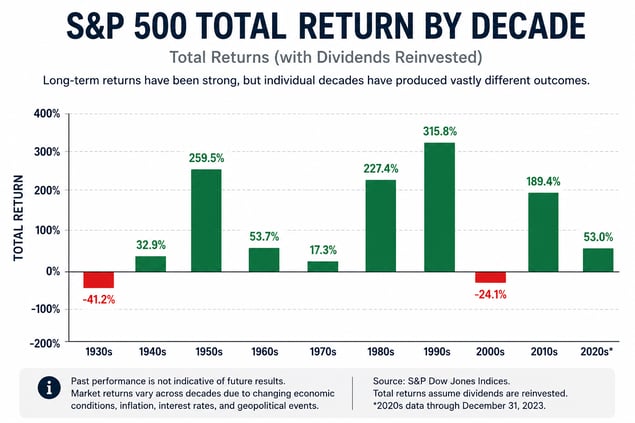
But it is better to prepare for the worst, so let’s backtest starting from the year 2000. That was days before the 2000 stock market crash, and eight years before 2008/2009.
If a portfolio can survive until now, twenty-six years later, that is a good sign!
Here is how 100% in stocks performed:
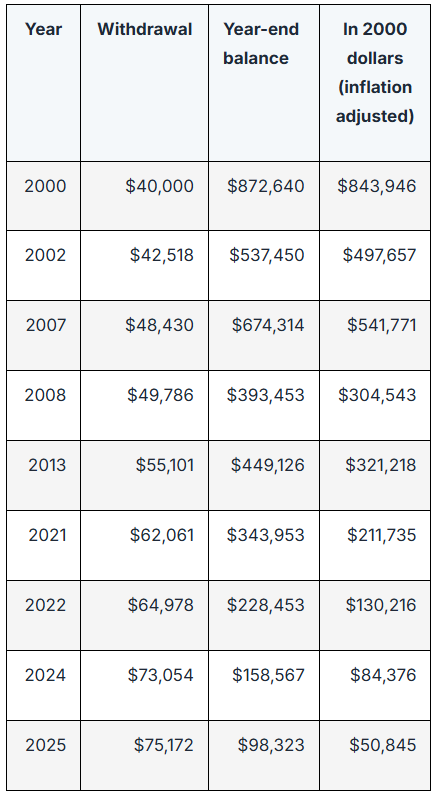
As you can see you would now be struggling to not run out of money.
Being 100% in cash would have done even worse.
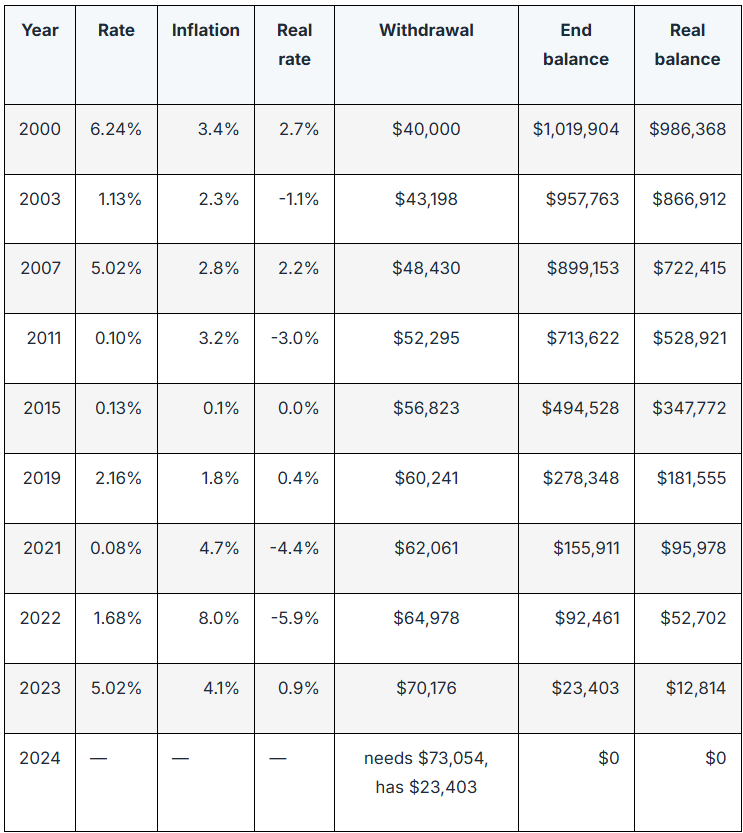
In comparison, 50% in bonds and 50% in stocks did far better.
What did even better was broader diversification.
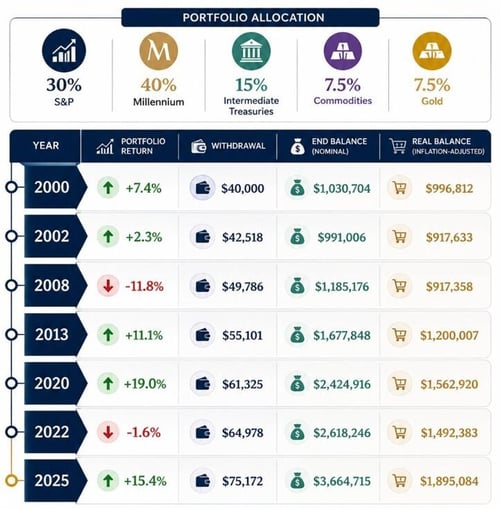
Here is how Ray Dalio’s All Weather Portfolio did, which is a combination of stocks, bonds, gold, and commodities:
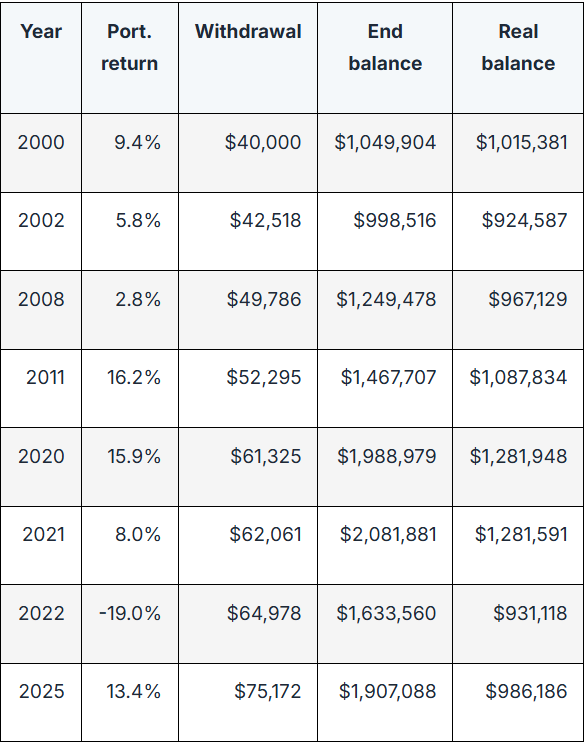
In comparison, here is how a portfolio which swaps out Dalio’s long-term bonds for a hedge fund did:
 How about longer retirements if you retire early?
The previous section looked at the reality that being more diversified was better for preserving your wealth during bad periods for the stock market.
This point is even more important for those planning for longer retirements.
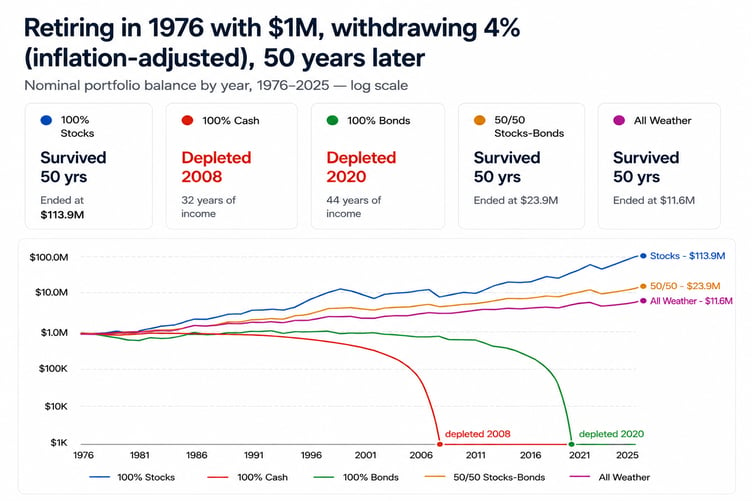
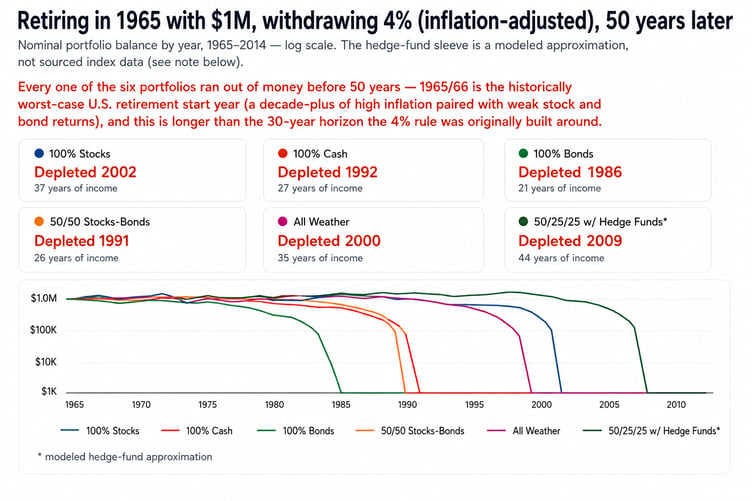
Let’s now compare two different time periods to illustrate the point: 1976, which wasn’t a bad year to retire as the stock market performed excellently in the 1980s and 1990s, and 1965, which was a bad year to retire as markets performed poorly for about fifteen years after that point.
Here is how the portfolio would have performed since 1976:
In comparison, here is how the portfolios would have performed if somebody had retired in 1965:
What’s the bottom line?
The main points are:
1. How markets perform in the early years of retirement has a disproportionate impact on how long a portfolio will last. Being 100% in stocks will perform well if you retire during a moment like 1976, but not if you retired in 1965 or 2000.
2. As we can’t know if we will retire during a good, or bad, period for the stock markets, it is better to be diversified.
3. Being 100% in cash, 100% in bonds, or 100% in stocks doesn’t make sense in retirement
4. You can withdraw more, safely, by being diversified. Adding hedge funds has a place here, although often you can usually only gain access to them via advisory firms like ourselves, unless you are very wealthy.