Expats looking to generate more income from their investments have three broad options: build wealth through growth assets before switching toward income-producing investments, accept greater investment risk for potentially higher yields today, or commit some capital to less-liquid investments in exchange for potentially higher returns.
The appropriate route depends largely on when the income is needed.
An expat who is still accumulating wealth may have little reason to maximize portfolio income today. But if you need more income from your investments now, the trade-off is usually straightforward. Higher potential returns tend to come with more risk, less liquidity or both.
For internationally mobile investors, that decision should also account for currency exposure, cross-border taxation, future residency changes and whether investments can continue to be held after moving to another country.
Key Takeaways
- Growth assets can build wealth before switching to income later.
- Higher income today usually means accepting more investment risk.
- Giving up liquidity can increase potential returns, but adds risk.
-
Private credit, structured products and P2P lending are less-liquid income options.
Compare investment options available to you as an expat or HNI.
My contact details are hello@adamfayed.com and WhatsApp +44 7393 450 837 if you have any questions.
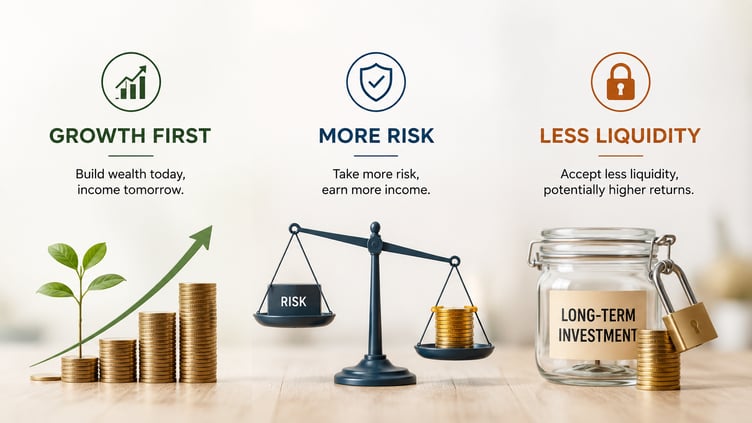
How can expats increase income from their investments?
Investors with years to accumulate can prioritize growth before moving toward income-producing assets.
Those seeking income today generally need to accept a trade-off, whether through greater investment risk or reduced access to their capital.
|
Approach |
Best suited to |
Main trade-off |
|
Build wealth first |
Investors who do not need income yet |
Less emphasis on income today |
|
Accept more risk |
Investors seeking higher potential income now |
Greater risk of loss |
|
Accept less liquidity |
Investors able to commit capital for longer |
Restricted access to money |
1. Accumulate first and switch to income later
Expats who do not need portfolio income today can focus on building wealth through a diversified growth portfolio before gradually moving toward income-producing assets.
Maximizing current income and maximizing long-term wealth are not necessarily the same objective. An investor who is still working may be able to reinvest dividends, interest and capital gains rather than withdrawing them, leaving more capital invested for the future.
A total-return approach considers both income generated through dividends or interest and changes in the value of investments. An asset therefore does not need a high dividend or coupon to contribute toward future income.
As retirement or another income requirement approaches, the portfolio can gradually shift toward assets intended to provide more predictable cash flow.
Income can also be created by periodically selling part of a diversified portfolio rather than relying exclusively on dividends and interest.
A growth-first approach still involves market risk. A significant decline shortly before withdrawals begin can reduce the capital available to generate income, making diversification, liquid reserves and the timing of the transition important.
2. Accept more investment risk
Investors who want more income today can pursue higher-yielding investments, but the additional potential return usually comes with additional risk.
This could mean accepting a greater possibility of borrower default, price volatility, currency losses or other adverse outcomes.
The important question is not simply how much an investment pays, but what risks the investor must accept to receive that yield.
3. Accept less liquidity
Investors can also pursue potentially higher returns by accepting less access to their capital.
Some investments require money to remain committed for a set period or have limited options for selling before maturity. Investors may demand additional expected returns in exchange for accepting these restrictions.
Less liquidity does not mean less risk. Illiquidity is itself a risk, and investments with restricted access can also expose investors to credit, market and structural risks.
These approaches are not mutually exclusive. A portfolio can combine growth assets, liquid income investments and less liquid holdings according to the investor's objectives and circumstances.
How can taking more risk increase investment income?
Taking more investment risk can increase potential income because borrowers and issuers often need to compensate investors for accepting a greater possibility of losing money.
Credit markets provide a straightforward example. High-yield corporate bonds generally offer higher yields than investment-grade bonds because their issuers have a higher perceived probability of default.
Similarly, a financially weaker corporate borrower will often need to offer a higher interest rate than a highly creditworthy borrower, although bond yields are also influenced by maturity, prevailing interest rates, inflation expectations, currency movements and market conditions.
The additional return can compensate investors for several forms of risk:
- Credit risk: The borrower may fail to make interest or principal payments.
- Market risk: The investment's value may fall before it is sold.
- Interest-rate risk: Fixed-rate bonds can fall in market value when prevailing interest rates rise.
- Currency risk: Income can lose value when converted into the currency in which the investor spends.
- Concentration risk: Returns may depend excessively on one issuer, sector, country or strategy.
- Leverage risk: Borrowing can magnify both gains and losses.
Does a higher interest rate always mean more risk?
A higher interest rate does not automatically mean an investment is riskier in every respect, because yields also vary with maturity, prevailing interest rates, currency and market conditions.
Two investments may offer different yields because of differences in:
- Credit quality
- Maturity
- Currency
- Liquidity
- Repayment priority
- Underlying assets
- Fees
- Tax treatment
- Embedded derivatives or conditions
The highest advertised yield may therefore not produce the best outcome.
An investment offering 10% could ultimately perform worse than one offering 5% if the issuer defaults, its market value falls substantially or the investor has to sell at a large discount.
Currency can further change the result for expats. An investment yielding 8% in one currency may perform poorly in real terms if that currency falls substantially against the currency used for living expenses.
Comparisons should consider the potential overall return after risk, fees, taxes and currency movements rather than headline yield alone.
How can giving up liquidity increase investment returns?
Giving up liquidity can potentially increase returns because investors may demand additional compensation for committing money to investments that cannot easily be sold or withdrawn.
Liquidity describes how easily an asset can be converted into cash without substantial delay or loss of value.
A simple example is a fixed-term bank deposit. Depending on prevailing rates and the bank's terms, committing money for several years may attract a higher rate than keeping it in an account offering immediate access.
Investment markets can involve a similar trade-off. If two otherwise comparable assets differ in liquidity, investors may require a higher expected return to hold the one that is more difficult to sell.
However, locking money away does not guarantee a superior return. An illiquid investment can still underperform or lose money.
What is liquidity premium?
Liquidity premium is the additional expected return investors may demand for owning an asset that is more difficult, expensive or time-consuming to convert into cash.
The principle reflects a basic economic trade-off.
Most investors prefer flexibility. If two investments offered identical expected returns and risks but one could be sold immediately while the other required capital to remain committed for five years, the liquid investment would normally be more attractive.
The less liquid investment may therefore need to offer additional expected compensation.
That does not mean every difference in return between liquid and illiquid assets is caused by liquidity.
A higher return can simultaneously compensate investors for borrower credit risk, complexity, leverage, uncertain valuations and other factors.
Liquidity premium should therefore be treated as one potential component of expected returns rather than a guaranteed bonus for locking money away.
Which investments can offer returns for accepting less liquidity?
Private credit, structured products and peer-to-peer lending are examples where investors may encounter higher potential income alongside limited liquidity, although all three introduce risks beyond restricted access to capital.
Private credit funds
Private credit funds make privately negotiated loans outside public bond markets.
Depending on the strategy, these investments can offer higher contractual yields than some publicly traded fixed-income securities.
Potential characteristics include:
- Higher contractual income
- Floating-rate loans in some strategies
- Negotiated lender protections
- Diversification beyond traditional public fixed-income markets
However, investors can also face:
- Borrower defaults
- Restricted redemptions
- Limited secondary markets
- Infrequent valuations
- Less transparent pricing
- Management and performance fees
- Exposure to leveraged borrowers
A private asset can also appear less volatile because it is valued periodically rather than continuously traded in a public market.
Lower visible volatility does not necessarily mean lower economic risk.
Structured products
Structured products typically combine a debt instrument with returns linked to an underlying asset, index, interest rate or predetermined market condition.
Some are designed to pay relatively high coupons, but those payments can compensate investors for complex conditions and risks.
Depending on the product, these can include:
- Capital losses after an underlying asset breaches a specified level
- Caps on potential gains
- Conditional capital protection
- Early redemption provisions
- Limited secondary market liquidity
- Exposure to the issuing institution
- Returns that depend on the timing of market movements
An A-rated issuing bank does not make the investment itself equivalent to a low-risk deposit.
The issuer's creditworthiness is only one component of the risk. Investors must also understand the market-linked conditions determining how the structured product pays out.
Selling before maturity can also be difficult or expensive because a liquid secondary market may not exist.
Peer-to-peer lending
Peer-to-peer lending platforms connect investors with individual or business borrowers.
Potential interest rates can exceed those available from ordinary bank deposits because investors directly assume borrower credit risk and may have limited options for exiting before the loans mature.
Risks can include:
- Borrower defaults
- Platform failure
- Limited recovery after default
- Difficulty exiting before maturity
- Regulatory changes
- Concentration among similar borrowers
Peer-to-peer lending should therefore not be treated as equivalent to an insured bank deposit.
Diversifying across borrowers can reduce the effect of an individual default, but it cannot eliminate wider credit, economic or platform-level risks.
Does giving up liquidity mean taking less risk?
Giving up liquidity does not mean eliminating investment risk because illiquidity is itself a risk and many illiquid investments also expose investors to credit, market or structural risks.
This is an important qualification to the basic liquidity-premium concept.
An investor can choose not to pursue higher returns solely by buying lower-quality debt, but accepting a lockup creates a different problem. The capital may not be available when circumstances change.
That matters particularly if the investor unexpectedly:
- Loses a job
- Receives a large tax bill
- Needs to fund medical expenses
- Buys a property
- Relocates
- Experiences a change in family circumstances
Investors should consequently distinguish between money they can genuinely commit for years and money they might need at short notice.
Emergency savings and capital intended for near-term expenses generally should not depend on investments that cannot readily be accessed.
Why is liquidity particularly important for expats?
Liquidity can be especially important for expats because international mobility can create large and unpredictable expenses while also changing which investments remain practical or legally accessible.
An expat may unexpectedly require capital for:
- Visa or residency requirements
- International school fees
- Rental deposits
- Property purchases
- Medical costs
- Tax liabilities
- Currency transfers
- Relocation expenses
- An unplanned return home
An investment that seems reasonable to lock away for five years under today's circumstances may become restrictive following a change in employment, residency or family circumstances.
Cross-border investors should also establish what happens to an investment after relocation.
Questions can include whether the product may continue to be held, whether additional investments are permitted, where distributions can be paid and how a new country of residence will tax the income or gains.
Liquidity for an expat is therefore about more than obtaining cash quickly. It can also mean retaining financial flexibility when jurisdictions change.
How can expats balance income, risk and liquidity?
Expats can balance income, risk and liquidity by matching different investments to when their money is likely to be needed rather than putting the entire portfolio into whichever asset currently offers the highest yield.
One possible framework separates capital according to time horizon.
Short-term liquidity
Cash and other suitably liquid assets can cover emergencies and known near-term expenses. Accessibility takes priority over maximizing investment income.
Medium-term income
Suitable bonds and other income-producing assets can help meet spending needs over the following years. Bond maturities can also be staggered rather than concentrated on one date.
Long-term growth
Capital that will not be required for many years can remain invested in diversified growth assets, depending on the investor's objectives and tolerance for market losses.
Limited illiquid allocation
Suitable investors may choose to allocate part of a portfolio to private credit or other less liquid investments. The allocation should be small enough that an inability to withdraw the capital does not disrupt the wider financial plan.
The objective is not necessarily to maximize one variable.
Income, growth, liquidity, diversification, capital preservation and inflation protection can all perform different roles within the same portfolio.
What should expats check before choosing a higher-income investment?
Expats should identify exactly why an investment offers a higher potential return before committing money to it.
Important questions include:
- What generates the advertised income?
- Is the return fixed, variable or conditional?
- Can income payments be reduced or suspended?
- Is the investor's capital guaranteed, conditionally protected or fully at risk?
- Who is the borrower or issuer?
- What happens if the issuer defaults?
- Can the investment be sold before maturity?
- Is there an active secondary market?
- Are redemptions restricted or subject to penalties?
- In which currency are income and capital paid?
- What happens if that currency falls against the investor's spending currency?
- What management, performance or exit fees apply?
- How will the investment be taxed?
- Can it continue to be held following another international move?
- How much of the total portfolio will depend on this investment?
The answers should be understandable before the investment is made.
Complexity does not make an investment sophisticated, and a high coupon does not compensate for risks the investor does not understand.
Is higher investment income always better?
Higher investment income is not always better for expats because additional yield can be accompanied by a disproportionate probability of capital loss, poor liquidity or weaker long-term growth.
A 10% yield is not automatically superior to a 5% yield.
The difference could reflect weaker credit quality, currency risk, complex repayment conditions, illiquidity or several of these factors simultaneously.
What ultimately matters is the return the investor receives relative to the risks taken.
For essential living expenses, a lower but more dependable source of income may be appropriate. Higher-risk or illiquid assets may be suitable only for capital that an investor can afford not to access for the required period and, where relevant, afford to lose.
For investors who do not need current income at all, maximizing yield may be solving the wrong problem. Accumulating a diversified portfolio first can provide more flexibility when income is eventually required.
Conclusion
Expats seeking more investment income can build wealth through growth assets before switching toward income, accept more investment risk, or give up some liquidity.
The appropriate approach should reflect when the income is needed and which trade-offs the investor can reasonably accept.
Higher income should not be the sole objective. The aim is to generate the income required without taking unnecessary risks or sacrificing the financial flexibility that internationally mobile investors may need.
FAQs
Can investment income be paid monthly?
Expat investment income can be paid monthly, quarterly, semi-annually or at other intervals depending on the investment.
Bonds typically pay interest according to a predetermined schedule, while dividend distributions from equities and funds depend on the company or fund. Private credit and other income-focused investments may also have scheduled distributions.
Payment frequency should not be confused with investment quality or total return. An investment that pays monthly is not necessarily safer or more profitable than one that distributes income less frequently.
What is a good investment income yield?
There is no universally good investment income yield because yield needs to be assessed against the risks required to obtain it.
Credit quality, liquidity, maturity, currency, fees, taxation and market conditions can all affect whether a particular yield is attractive.
A high percentage viewed in isolation says very little about whether an investment represents good value.
Is an illiquid investment always more profitable?
No. Illiquid investments are not guaranteed to outperform liquid investments.
Investors may demand an illiquidity premium for giving up easy access to their capital, but actual returns can still be reduced by defaults, fees, poor investment performance or unfavorable market conditions.
The existence of a potential liquidity premium is therefore not a guarantee of a higher realized return.
Should expats prioritize income or growth?
Expats who do not need portfolio income immediately may prefer to focus on total return and growth, while those already relying on their investments may place greater emphasis on income and liquidity.
The appropriate balance depends on the investor's time horizon, spending requirements, risk tolerance and other sources of income.
International investors should also consider the currencies in which future expenses will arise and how relocation could affect their investments.
Related Articles
- Best Investments for Expats: Top Options Explained
- Expat Investment Income Strategies: How to Build Wealth Across Borders
- Cross-Border Investing for Expats: How to Invest Across Multiple Countries
- How to Invest as an Expat: A Practical Framework for Building a Global Portfolio
- Financial Advisor for Income-Generating Investments for Expats
- Tax on Investment Income Abroad: Is Overseas Investment Taxable?
- How to Legally Reduce Tax on Investment Income Abroad