If you are leaving Saudi Arabia, you can decide how to use and invest your End of Service Benefit (EOSB) before departure, even if the payment will not be received until your employment ends.
First, reserve enough for relocation, outstanding liabilities and emergencies. The remaining amount can then be invested according to when you will need it, where you will live next, and how your future tax residence and currency needs will affect the portfolio.
Key Takeaways
- Immediate relocation costs and emergency savings should be set aside before investing EOSB.
- EOSB can be invested through providers in Saudi Arabia, internationally or in the new country of residence.
- The new country's tax rules and the currency of future expenses should be considered before investing.
- Global equities, ETFs, bonds, money market funds and managed portfolios offer different levels of growth potential, liquidity and risk.
My contact details are hello@adamfayed.com and WhatsApp +44-7393-450-837 if you have any questions.
The information in this article is for general guidance only. It does not constitute financial, legal, or tax advice, and is not a recommendation or solicitation to invest. Some facts may have changed since the time of writing.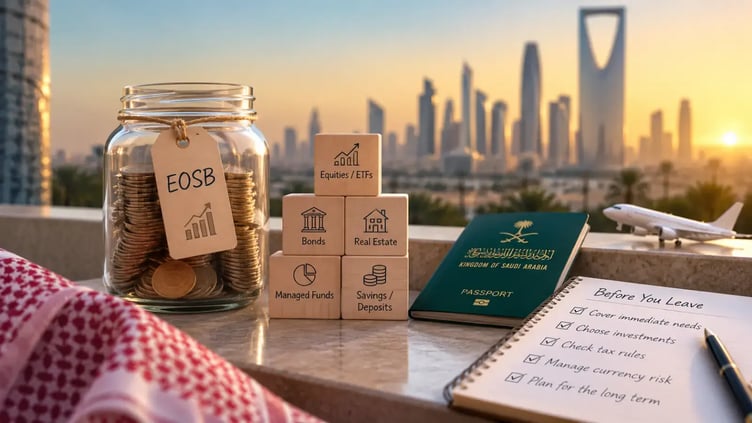
What is EOSB in Saudi Arabia?
EOSB is a statutory payment made to eligible employees when their employment ends, subject to Saudi Arabia's labor rules and the circumstances of their departure.
It is generally calculated using the employee's wage and length of service, although the amount can vary based on factors such as the reason for leaving and the terms applicable to the employment.
For an expat, EOSB can provide a useful financial buffer when relocating to another country.
It may cover moving expenses, housing deposits, emergency savings, or other immediate costs before the employee establishes a new income stream.
Once those needs are covered, the remaining amount can potentially be invested for longer-term goals.
Should I invest EOSB before leaving Saudi Arabia?
You can consider investing your EOSB before leaving, but investing the entire payout immediately is rarely the best approach.
First, identify expenses that will arise during and immediately after your move.
These could include flights, accommodation, rental deposits, relocation costs, insurance, visa expenses and several months of living expenses.
Keeping this portion in cash or other relatively liquid assets can prevent you from having to sell investments at an unfavorable time.
The remaining EOSB can then be allocated according to your investment horizon and risk tolerance.
Someone who will need the money within one or two years may favor lower-risk and more liquid investments, while someone with a longer horizon may have greater scope for diversified equities and other growth assets.
There is also a practical consideration for expats: your tax residence can change after leaving Saudi Arabia.
Saudi Arabia does not generally impose personal income tax on individuals, but your new country of residence may tax investment income or capital gains.
Understanding those rules before investing can therefore be just as important as selecting the investments themselves.
How to invest your End of Service Benefits
After establishing how much of your EOSB is available for investment, divide it according to when the money will be needed rather than selecting products solely by their potential returns.
A short-term portion may need to remain liquid, a medium-term portion may favor a more conservative balance of assets, and money intended for long-term goals may support greater exposure to diversified equities.
Account portability, currency and future tax treatment should then be used to narrow the available products.
Potential options include:
- Global equities and ETFs: Global stocks and exchange-traded funds (ETFs) can give your EOSB exposure to companies and markets outside Saudi Arabia, making them suitable for long-term growth. Broad market ETFs can provide diversification across multiple companies, sectors and countries rather than requiring you to select individual stocks.
- Bonds and fixed-income investments: Bonds can provide regular income and generally offer less volatility than equities, although they still carry risks such as interest rate and credit risk. They may be useful for the portion of your EOSB that you want to invest more conservatively, particularly if you have a medium-term investment horizon.
- Money market funds and cash equivalents: These can be considered for money that you may need relatively soon but do not want to leave entirely uninvested. They generally offer greater liquidity and lower investment risk than equities, although their returns may be more limited.
- Diversified managed portfolios: A professionally managed portfolio can combine assets such as equities, bonds and cash based on your objectives and risk tolerance. This may be useful for expats who want ongoing portfolio management, particularly when their financial affairs will span Saudi Arabia and another country.
- Real estate: Property can provide rental income and long-term capital growth, but it requires substantially more capital and is less liquid than financial investments. If you are considering property after receiving your EOSB, factor in purchase costs, financing, maintenance, taxes and whether you will still be able to manage the property after relocating.
Where can you invest End of Service Benefits?
You can invest your EOSB in Saudi Arabia, internationally, or in your new country of residence, with the best location largely determined by where you will live, spend and pay tax after leaving Saudi Arabia.
Keeping investments in Saudi Arabia can be convenient if you already have an established banking or investment relationship there.
However, check whether the provider allows you to retain the account after becoming a non-resident and whether additional documentation or restrictions will apply.
Investing through your new country may be more practical if your future expenses, income and tax obligations will primarily be there.
It can also reduce the need to transfer money between jurisdictions later and may make it easier to manage your investments alongside your other financial accounts.
Currency is another important consideration.
The Saudi riyal is pegged to the US dollar, while your future expenses may be in euros, pounds, Australian dollars or another currency.
Converting your entire EOSB into a single currency immediately could therefore leave you with unnecessary currency exposure.
For larger EOSB amounts, a cross-border investment strategy may be worth considering.
This allows you to assess where to hold and invest your money based on your future residence, tax position, currency needs and access to investment products, rather than simply choosing the country where you currently have a bank account.
What taxes apply to your EOSB after leaving Saudi Arabia?
Saudi Arabia generally does not tax individuals on employment income, including EOSB, but your new country of tax residence may tax the EOSB or the income and gains generated from investing it.
Once you become tax resident elsewhere, your interest, dividends, rental income or capital gains from EOSB investments may be taxable under that country's rules.
Some countries may also require you to report foreign bank or investment accounts even where no tax is ultimately due.
This means leaving Saudi Arabia can change the tax treatment of your EOSB even though the benefit was earned during your Saudi employment.
Before investing or transferring a substantial amount, check the rules that will apply in your new country of residence.
What should you arrange before leaving Saudi Arabia?
Your EOSB can provide starting capital for the next stage of your financial plans, but its value will hinge on how well the money remains accessible and suitable after your move.
Before departure, confirm the expected EOSB amount and payment date, settle immediate liabilities, retain records showing the source of the funds and check whether your Saudi accounts can remain open after your residence changes.
You can then decide how much should remain accessible, which currencies will fund your future expenses and where the longer-term portion can be held without creating unnecessary tax, transfer or account access problems
FAQs
How can I get my End of Service Benefits in Saudi Arabia?
Your employer should calculate and settle your EOSB as part of your final employment settlement, with payment generally due within one week of termination, or up to two weeks if you ended the contract yourself.
Can an employer deduct money from EOSB in Saudi Arabia?
An employer may be permitted to deduct certain work-related debts owed by the employee from the final entitlement. The expected net payment should therefore be confirmed before making investment or relocation plans.
Can EOSB be paid after an expat has left Saudi Arabia?
Yes, the final settlement may be completed after physical departure, depending on when employment ends and how the employer processes payment. Before leaving, confirm the payment date, destination account and whether the receiving Saudi account will remain operational.
Can EOSB be transferred from Saudi Arabia to another country?
EOSB funds can generally be transferred abroad through authorized banking channels, subject to the bank’s transfer procedures, limits and compliance checks. The employee may be asked for documents showing that the money came from a final employment settlement.
Can I leave Saudi Arabia with an unpaid loan?
An unpaid loan does not automatically prevent you from leaving Saudi Arabia, but a court-ordered travel ban related to debt enforcement can restrict your departure.
Before investing your EOSB, check your outstanding liabilities and resolve any issues that could affect your exit.
What is the final exit rule in Saudi Arabia?
Saudi Arabia’s final exit rule allows an expatriate resident to permanently leave the Kingdom through a final exit visa, which must be used within two months of its issuance.
If the visa is not used within this period, the applicable penalties can apply.
Related Articles