What are the best investment options for UK expats?
UK expatriates typically choose among investing in their country of residence, investing back in the UK, or using offshore platforms. The right choice depends on your residency status, tax situation, and long-term goals.
Whilst it is impossible to speak about every country in the world, given the 180+ places where British expats reside, I will try to generalize, based on the evidence and my experience as a Brit living overseas.
This article will focus on the best investment options for UK expats residing abroad, rather than non-British expats living in the UK, although there will be some commonalities in the analysis.
Key Takeaways
- UK expats can invest in their host country, retain UK investments or use offshore platforms.
- Host-country investments may suit long-term residents but can become difficult to retain after relocating.
- Existing ISAs retain UK tax relief, but non-residents generally cannot make new contributions.
- Offshore platforms may offer greater portability and global access but are not automatically tax-free.
My contact details are hello@adamfayed.com and WhatsApp +44-7393-450-837 if you have any questions.
The information in this article is for general guidance only. It does not constitute financial, legal, or tax advice, and is not a recommendation or solicitation to invest. Some facts may have changed since the time of writing.

How to Invest as a UK Expat: Top Investment Options
Start by assessing where you’re tax resident and whether you plan to return to the UK. This will shape your investment options and how they’re taxed.
Some expats prioritize access and flexibility by using platforms regulated in their country of residence.
Others keep ties to the UK via pensions or property, especially if they expect to retire there.
A third group uses offshore or international platforms for more portability across jurisdictions.
The best choice often combines two or more expat investing strategies, depending on your goals, risk appetite, and cross-border obligations.
1. UK Expat Investments in Your Country of Residence
As a British expat, you can invest directly in your country of residence, whether that’s Spain, Dubai, Hong Kong, Singapore, or elsewhere.
The options include local stock market investments, real estate and bank deposits. This section will go through each option:
Local Stock Market
If you are living in a place with a quality stock market, which has had 100-200 years of great performance like the US Stock Markets, it makes sense to invest with a local brokerage firm.
Likewise, some countries make it very difficult from a tax point of view to invest overseas. Again, this is especially the case in the US where they make overseas investing tax-inefficient for American tax residents.
So, if you are a British tax resident in the United States, it almost always makes sense to invest locally, from a tax point of view.
In comparison, if you live in a place like China, Colombia or any other place with a stock market which is quite unstable, you are taking a lot more risks investing locally.
I met so many British expats whilst I lived in China, that got caught up with the whole “China growth story“, forgetting that GDP and stock market growth aren’t connected.
It is of course possible to have a brokerage account in country A, and it is focused on investing in stocks in country B.
For example, you can open up an investment account in most countries, which allows you to trade on the US, UK and Mainland European stock markets.
The problem with this is if the investment platform or brokerage is too localized, it might not allow you to continue to invest if you leave that country.
As an expat, especially if you are moving a lot, it makes sense to have a portable option which can ensure that your accounts continue to function if you leave.
Not only that, but unless you are living in a 0% capital gains environment, you can be hit by very high taxes if you automatically invest in your country of residence.
Local Real Estate
Another option is buying local real estate in the country where you currently reside. In general, this makes the most sense if you plan to stay in that location long-term and use the property as a home rather than a pure investment.
For those considering rental properties, it’s important to weigh the risks.
Real estate is an illiquid asset, and selling can be challenging, especially in markets where legal systems, languages, or property rights differ from what UK-based investors are used to.
This is particularly relevant for British expats living outside native English-speaking environments.
Additionally, property valuations in many emerging markets have risen sharply over the past 10–15 years, closing the gap with UK housing prices.
Before 2007–2010, investors often received a discount to compensate for the additional risks.
Today, some overseas property markets are as expensive or even more expensive than the UK.
Even some developed markets have appreciated significantly relative to UK property values.
Local Banking
All expats need to bank for daily needs, and local accounts are often set up by employers when relocating abroad.
However, many expats also benefit from third-country banking solutions, particularly in jurisdictions with more flexible currency controls.
For example, expats in countries like China or Vietnam, where moving money across borders can be difficult, often choose to have part of their salary paid into accounts in places like Hong Kong or Singapore.
They do so to ensure smoother international transfers and greater currency flexibility.
That said, bank deposits should not be considered a real investment. In most countries, deposit rates are below inflation, meaning your purchasing power declines over time.
In some emerging markets, you may find double-digit deposit rates. however, these typically come with high currency and inflation risks.
2. UK Investment Options for British Expats
Can British expats still invest in the UK? Yes, but it comes with trade-offs.
While you can send money back to invest in UK stocks or existing accounts, expats often lose access to tax advantages like ISAs, and face additional scrutiny.
UK Stock Market Investments and ISAs
Some British expats choose to send money home and invest through UK-based platforms.
This is especially true for those on short-term assignments or maintaining close ties to the UK.
This can include stock market investments, pensions, or existing UK-based accounts.
While this may seem familiar or convenient, it’s not always tax-efficient or practical.
In fact, for most long-term expats, investing back home comes with significant limitations:
- Existing ISAs can generally remain open and retain their UK tax advantages, but non-UK residents cannot normally make new contributions. The expat’s country of residence may not recognize the ISA’s tax-free status and could tax its income or gains.
- UK brokers and banks may restrict access or close accounts if you’re no longer a UK resident.
- HMRC’s Statutory Residence Test means regular transfers and connections to the UK can blur your tax residency status, potentially triggering tax obligations.
- Anti-money laundering checks may delay or complicate transactions, as banks increasingly request proof of income or source of funds from expat clients.
While UK-based investments can still make sense in specific cases, such as keeping an existing pension active or investing before relocation, they are usually not the most efficient option for permanent expats.
UK Real Estate
Many British expats are interested in rental properties in the UK, but profitability has become more challenging over time.
Recent tax changes have reduced the appeal for non-resident landlords, including higher stamp duties, reduced mortgage interest relief, and broader capital gains tax rules.
Both major parties supported increased taxes on overseas buyers in their 2019 manifestos, further tightening the landscape.
Mortgage access has also become more limited, with many UK lenders imposing stricter requirements on expats. That said, expat mortgages are still available, albeit with higher thresholds.
Despite these hurdles, UK property valuations, particularly outside major cities, may be more reasonable compared to some overheated global markets.
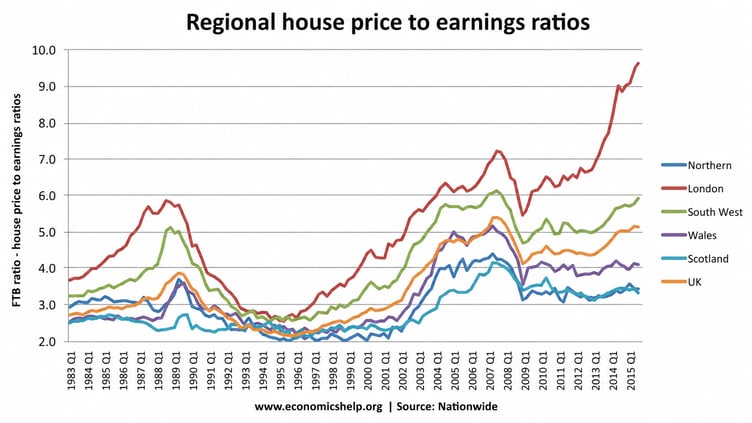
As per the graph above, UK property prices apart from London, are still lower than the peak of 2007-2008.
So if you can find an excellent buy, buying a UK property isn’t the worst option.
It is merely just much more difficult compared to the past, to do it profitably.
UK Bank Deposits
As mentioned earlier, it doesn’t usually make sense for British expats to send large amounts of money to a UK bank account for investment purposes.
Small amounts of money to pay bills is a different matter, of course. It also makes sense to at least keep UK bank accounts open, with small balances, in case you ever return to the UK.
This also allows you to keep a UK “correspondent address” whilst still living overseas.
3. Investing in a Third Country (Offshore Investments for UK Expats)
British expats can invest through platforms based in third countries, which are jurisdictions outside both the UK and their country of residence.
Examples of third countries could include Luxembourg, Isle of Man, Bermuda and any other 0% capital gains country.
International Stock Market Investing via Offshore Platforms
There are many advantages to expats investing with a third country solution.
The main advantage is that an expat-focused account in the Isle of Man, Bermuda, Luxembourg, or another popular jurisdiction is both tax-efficient and more likely to be portable.
By portable, I mean that as many international providers are specialised in the expat market, they allow customers to simply update their details online, if they move from country A to country B.
The only exceptions tend to be if you move to the US or to a country under US sanctions, like Iran or Venezuela, which applies to very few British expats.
From a tax point of view, it is quite essential to be invested in a 0% capital gains environment as well.
Taxes on capital gains can be hundreds of thousands or more, especially if you are a long-term investor.
Many people don’t consider how important taxes are to the cost equation, especially if they are only starting with a small investment. Small monthly investments soon add up over the years, though.
The biggest reason stopping people from investing in the stock market is fear.
Typically after a negative news story about an election, virus or the economy, people worry and try to time the market — meaning, decide when the best time to invest is.
This is almost impossible to do. At a previous client event, the Shark Tank (previous Dragons Den) star Kevin O’Leary admitted that he had tried and failed to time the markets:
Video: Adam’s interview with Kevin O’Leary of Shark Tank and Dragons’ Den.
International Real Estate
Investing in property in a third country does have some of the same risks as buying in your country of residence.
Real estate remains an illiquid asset, and you may face legal or language challenges in unfamiliar jurisdictions.
The increasingly high valuations in countless places also makes this an increasingly risky option, unless you pick very wisely.
That said, international real estate offers distinct advantages. You can shop globally for the best deals, comparing rental yields, tax regimes, and long-term growth prospects.
You don’t need to pick America, Australia, Canada, Bulgaria, or Romania.
You can merely speak to a property expat, look objectively at valuations and rental yields, and make your decisions based on data — not hype.
In many countries, property ownership also opens the door to citizenship-by-investment schemes.
In other words, you can get a second residency, in return for property ownership.
This is especially popular for expats that have finished their work assignment but still want to live abroad.
Expat Offshore Bank Account
Whilst it should be mentioned again that bank accounts shouldn’t be used as investments, having an expat bank account in a third country makes a lot sense.
The main advantage is portability. When your bank understands that you’re an expatriate, you’re far less likely to face account closures, frozen funds, or excessive documentation requests when you relocate.
Expat-friendly bank accounts usually support multiple currencies, offer online international transfers, and comply with international banking standards.
Although offshore accounts are not designed for investment growth, they are often a key part of a well-structured international financial plan.
They offer flexibility, currency control, and sometimes access to global financial services that local banks might not provide.
Do UK expats pay taxes on investments?
If you are non-resident for UK tax purposes:
- You don’t pay UK tax on foreign income or capital gains (except on UK property).
- However, UK-sourced investment income, like dividends or rental income from UK real estate, may still be levied.
- Existing ISAs retain their UK tax advantages after the owner becomes non-resident, but new contributions are generally prohibited. Income and gains may still be taxable in the owner’s country of residence.
Most countries tax worldwide income, so your local tax laws may require you to declare and pay taxes on your investments even if they’re offshore or in the UK.
Many jurisdictions have double taxation agreements with the UK to prevent being taxed twice, but you must file correctly to benefit from these.
Investments held in jurisdictions like the Isle of Man can offer tax deferral or efficiency, but are not tax-free unless structured correctly.
Investing Tips for British Expats
- Clarify your tax status early. Know if you’re still a UK tax resident or not as it affects whether ISAs or UK-based investments are advantageous.
- Avoid over-concentration. Diversify across jurisdictions to reduce geopolitical, currency, and regulatory risk.
- Use expat-friendly platforms. Choose international providers familiar with cross-border compliance and portability.
- Keep emergency funds accessible. Don’t lock all your capital in illiquid property or long-term vehicles.
- Review your plan when relocating. Each move may change your optimal strategy due to new tax rules or investment access.
- Consider local currency exposure. Weigh whether to hedge or accept foreign exchange risk based on your long-term targets.
Bottom Line
In general, it makes sense to focus on “third country” or offshore options when it comes to banking and investing as a UK expat. This is especially the case for those moving from country to country every few years.
The reasons are simple enough. It is usually more tax-efficient and specialised in the expat niche.
The main exceptions to this rule are if you live in the United States, and/or you are only on a short-term expat assignment. If you are short-term, you are often still considered a UK tax resident in any case.
The fall in markets which has happened during March 2020, after the unexpected government shutdowns globally, once again shows that nobody can predict stock markets. Therefore, having a long-term plan is always best, which you can follow, through thick and thin.
Long-term, investing makes a lot more sense to keeping money in cash.
FAQs
Can UK expats invest in index funds and ETFs?
Yes. UK expats can usually invest in index funds and ETFs through a local, UK-based, or international investment platform, subject to the provider’s residency restrictions.
International platforms may offer greater portability for expats who expect to move between countries, but fund taxation depends on the investor’s country of residence.
Can I keep my UK ISA after moving abroad?
Yes. You can normally retain an existing ISA after becoming non-UK resident, and it remains tax-exempt in the UK.
However, you generally cannot make new contributions while non-resident, and your country of residence may tax the income and gains generated inside it. You must also inform your ISA provider when you become non-resident.
Can British expats continue paying UK pension?
Some British expats can continue contributing to an existing UK pension, but eligibility for UK tax relief depends on factors such as UK earnings, recent UK residence and the pension provider’s rules.
Expats should confirm whether contributions will receive tax relief and how pension withdrawals will be treated in their country of residence.
Are offshore investments tax-free for UK expats?
No. Holding an investment through an offshore platform does not automatically make its income or gains tax-free. The platform’s jurisdiction may impose little or no local tax, but the expat’s country of tax residence may still tax worldwide income and capital gains.
Offshore investments should therefore be assessed for portability, regulation, costs and tax treatment—not merely their location.
Should UK expats invest in pounds or another currency?
The appropriate currency depends on where the expat expects to live and spend the money.
Someone planning to retire in the UK may retain meaningful pound exposure, while an expat staying overseas may need investments connected to their future spending currency.
Holding assets across currencies can reduce concentration risk, although exchange-rate movements can still affect returns.
What happens to my overseas investments if I return to the UK?
Returning to the UK can change how overseas income and capital gains are taxed. UK residents generally become liable for UK tax on worldwide income and gains, subject to applicable reliefs and exemptions.
Temporary non-residence rules may also apply to certain gains realised while abroad, so investments should ideally be reviewed before the return date.
Do UK expats pay Capital Gains Tax when selling UK property?
Non-residents may have to pay UK Capital Gains Tax when selling UK property or land.
The disposal must generally be reported to HMRC within 60 days of completion, even when no tax is ultimately due or the property is sold at a loss.
The country where the expat lives may impose additional reporting or tax requirements.
Can UK expats be taxed twice on their investments?
Potentially, but double-taxation agreements may prevent the same income or gain from being fully taxed twice.
Depending on the relevant treaty, an expat may receive a foreign tax credit, exemption or reduced withholding rate. The available relief and filing process vary by country and type of investment.
Related Articles
- Investing as a UK Expat
- Offshore Investments for UK Expats
- Tax-Efficient Investing for UK Expats
- Investing in UK funds from abroad
- Best Investments for British Expats in Singapore
- Best Investments for British Expats in Hong Kong
- Best Investment Options for Expats: Expat Investing Guide
- How to Invest as an Expat: A Practical Framework for Building a Global Portfolio
- Should You Invest Internationally or in Your Home Country as an Expat?
- Expat Financial Planning for Cross-Border Wealth
Further Reading
I am the most viewed writers on social media platform Quora for investing and personal finance, receiving over 218 million views in the last few years.
I regularly share answers from that platform on adamfayed.com. In the answers below, I answer the questions including:
- What does a beginner need to know in terms of investing in the stock market? More importantly perhaps, what things are often neglected by people new to investing.
- Is it possible to support yourself financially from a stock market investment portfolio? In other words, can you eventually stop working due to your stock investments? What do people get wrong when they think about “passive income”?
- If you want to become a millionaire investing in stocks, how much do you need to invest every month or year? Is it less or more than you might expect?
As a preview of the answers I have copied a section below:
The basics in any domain is key. If you want to get fit, the basics of good nutrition, exercise and posture is important.
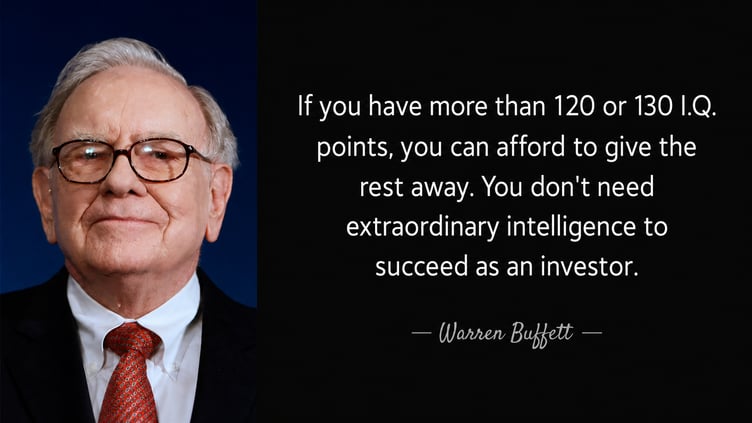
The same is true in investing. It is a myth that you need to be very intelligent to be a good investor as the quote below says:
What people need is
1.Actually get started – 80% of success is just showing up. The same in investing. Just setting up that investing account sounds obvious, but it is key. Beyond that, simple tricks like investing one day after you are paid can increase how much you invest dramatically. Some studies have even shown that people are able to invest 3x more by investing at the start of the month, as opposed to at the end. Over time, how much you invest and for how long, will be even more important than compounded returns.
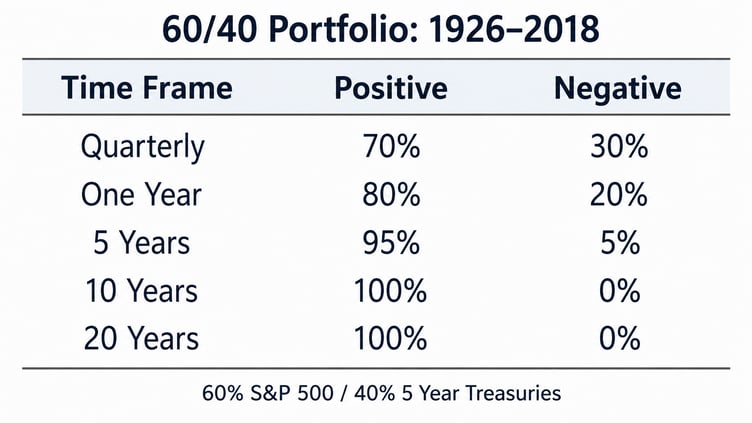
2.Time and patience – The easiest way to make money, with less risk, is to leverage time. Stocks are risky if you only hold them for a year. Even some of the bets ETFs and indexes are. If you hold them for decades, they aren’t. Don’t confuse volatility and risk.
3. Be diversified. If you hold stocks and bonds together, it is even safer:
4.Basic knowledge at the very least – Or outsource the process to somebody that does have that knowledge. Plenty of people make the mistake of investing without knowing that much about it.
5. Nobody can predict the future – Now sure, countless people can get one prediction right. Some can even get many right. Plenty have an excellent run at predicting things. Over a 40–50 year period, however, it is very unlikely that you will beat the market by making moves based on listening to the talking heads on the media. Countless academic studies have shown that people can’t beat the market by listening to CNBC, Bloomberg and many other media outlets. At least on a long-term basis.
6. Emotional control – This is the most undervalued point. Most people think that the bets investors are the most knowledgeable ones. Yet a very emotional and super knowledgable person doesn’t do well in investing. Every time there is a crash, they panic sell. Even some PHDs in portfolio theory have been found to have broken their own rules in investing.
With the last point, what’s more important is nobody knows how they will react to a stock market crash until they experience one.
Back in early 2020, the stock market hadn’t really crashed in a big way since 2008.
I personally know so many people who “pledged” to me that they would never panic sell like those “idiots” (to use their words) in 2008.
Then 2020 came along, the media screamed this time is different like they always do, and many of those people panic sold.
Another part of emotional control is not getting too excited during the good times or too depressed during the bad times.
Most people look at a stagnant stock market and think it isn’t worth investing in.
Few people wanted to invest in the S&P500 in 1982 after 17 years of stagnation.
Likewise, few wanted to invest in it in 2010 after a “lost decade” . Yet after both periods, stocks went on long bull runs from 1982–2000 and 2009–2020.
Likewise, people shouldn’t be put off by the fact that some markets like the FTSE All Stars has underperformed the US markets in recent times.