Managing foreign exchange (FX) risk involves identifying currency exposure and using strategies such as natural hedging, forward contracts, futures, options, or swaps to reduce the financial impact of exchange rate fluctuations.
Effective FX risk management helps businesses, investors, and traders protect cash flow, improve financial certainty, and minimize losses caused by volatile currency markets.
This article covers:
- What are the three types of foreign exchange risk?
- How do you calculate risk in forex?
- How do you manage risk in forex?
- What are the risk management tools in forex?
Key Takeaways:
- FX risk has three forms, including transaction, translation, and economic risk.
- FX risk management needs structure, from identifying exposure to choosing suitable tools.
- Hedging tools vary, with forwards, futures, options, swaps, and natural hedges serving different exposures.
- The best strategy is based on the exposure, time horizon, objectives, and risk tolerance of the business, investor, or trader.
My contact details are hello@adamfayed.com and WhatsApp +44-7393-450-837 if you have any questions.
The information in this article is for general guidance only. It does not constitute financial, legal, or tax advice, and is not a recommendation or solicitation to invest. Some facts may have changed since the time of writing.
What are the three types of FX risk?
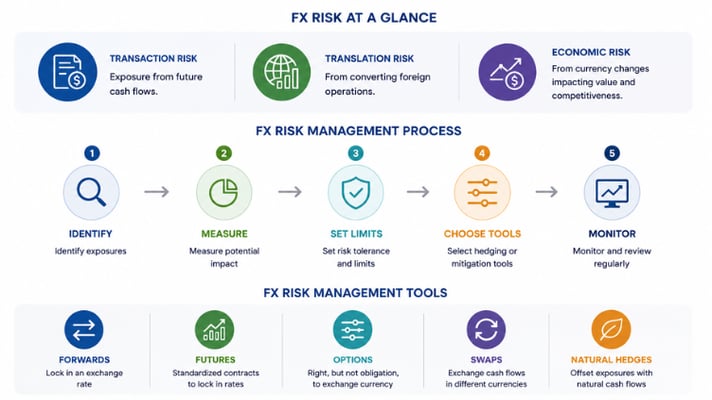
Foreign exchange risk generally falls into three main categories: transaction risk, translation risk, and economic risk.
Understanding which type of exposure you face is the first step toward selecting an appropriate risk management strategy.
Transaction risk
Transaction risk arises when a company agrees to receive or pay a foreign currency at a future date.
If exchange rates move before payment is made, the final value in the company's home currency may increase or decrease.
For example, a UK importer purchasing goods priced in US dollars may ultimately pay more pounds if the US dollar strengthens before settlement.
Likewise, an exporter may receive fewer home-currency proceeds if the foreign currency weakens.
This is often the most common form of FX risk for businesses involved in international trade.
Translation risk
Translation risk, sometimes called accounting exposure, affects multinational companies that consolidate the financial statements of overseas subsidiaries.
Even if no cash changes hands, changes in exchange rates can alter the reported value of foreign assets, liabilities, revenue, and profits when they are translated into the parent company's reporting currency.
While translation risk does not usually affect immediate cash flow, it can influence reported earnings, financial ratios, and investor perceptions.
Economic risk
Economic risk, also known as operating exposure, reflects the long-term effect of exchange rate movements on a company's competitiveness and future profitability.
For instance, a manufacturer whose domestic currency strengthens significantly may find its exports becoming more expensive overseas, reducing demand and market share.
Similarly, a weaker currency may increase the cost of imported raw materials over an extended period.
Unlike transaction risk, economic risk can reshape a business's long-term competitive position rather than simply affecting individual transactions.
How is FX risk calculated?
FX risk is calculated by measuring the size of a foreign currency exposure and estimating how exchange rate movements could affect cash flow, revenue, costs, or investment value.
A simple calculation starts with the expected foreign currency inflows and outflows.
For example, if a business expects to receive US$800,000 and pay US$500,000, its net exposure is US$300,000.
The next step is to estimate how a change in the exchange rate would affect that exposure.
Suppose an Australian exporter expects to receive US$500,000 in three months. At an exchange rate of 1 AUD = 0.70 USD, the proceeds would be about A$714,286.
If the Australian dollar strengthens to 1 AUD = 0.75 USD, the proceeds fall to about A$666,667.
In this example, the currency movement reduces the exporter’s revenue by roughly A$47,619.
Businesses may also use sensitivity analysis or scenario analysis to test the impact of 5%, 10%, or 15% currency movements.
Larger companies and financial institutions may use Value-at-Risk (VaR) models, but smaller businesses often rely on simpler exposure calculations and scenario testing.
What is FX risk management strategy?
An FX risk management strategy is a structured plan for identifying currency exposure, measuring potential losses, and choosing the right tools to reduce the impact of exchange rate movements.
A practical strategy usually follows five steps:
- Identify exposure. List the foreign currency payments, receipts, loans, investments, and operating costs that could be affected by exchange rate changes.
- Measure the risk. Estimate the potential impact using net exposure calculations, sensitivity analysis, scenario modelling, or Value-at-Risk for more complex portfolios.
- Set risk tolerance. Decide how much currency movement the business can accept before hedging becomes necessary.
- Choose suitable tools. Use forward contracts, FX options, swaps, natural hedging, or multi-currency accounts depending on the amount, timing, and certainty of the exposure.
- Review regularly. Update the strategy as exchange rates, contracts, forecasts, suppliers, and business operations change.
The purpose is not always to eliminate FX risk completely, but to manage it within a level the business can afford and understand.
How do you manage risk in forex?
Foreign exchange risk is managed by reducing uncertainty around future exchange rates through operational strategies, financial hedging instruments, or a combination of both.
The most suitable approach depends on the size of the exposure, the currencies involved, the time frame, and the organization's risk appetite.
Use forward contracts
A forward contract allows two parties to agree on an exchange rate today for a future transaction.
This provides certainty over future costs or revenue and is one of the most widely used hedging tools for importers and exporters with predictable cash flows.
Use currency futures
Currency futures operate similarly to forward contracts but are standardized and traded on regulated exchanges.
They are commonly used by financial institutions and investors seeking transparent pricing and liquidity, although they may be less flexible than customized forward agreements.
Buy FX options
FX options give the holder the right, but not the obligation, to exchange currencies at a predetermined rate before or on a specified date.
This allows businesses to protect against adverse exchange rate movements while still benefiting if market rates move in their favor.
The flexibility comes at the cost of an option premium.
Enter currency swaps
Currency swaps involve exchanging principal and interest payments in different currencies over an agreed period.
These arrangements are often used by multinational companies and financial institutions to manage long-term financing needs and access more favorable borrowing conditions.
Create a natural hedge
Some businesses reduce currency exposure without using financial derivatives.
Examples include:
- Paying suppliers in the same currency used for customer payments.
- Borrowing in the currency that generates business income.
- Locating production facilities closer to key markets.
- Matching overseas revenue with overseas operating expenses.
Natural hedging can lower transaction costs while reducing dependence on financial contracts.
Diversify currency exposure
Businesses operating across several countries may reduce overall risk by diversifying revenues and expenses across multiple currencies.
Although diversification does not eliminate FX risk, it can reduce reliance on the performance of a single currency.
Use multi-currency accounts
Holding funds in multiple currencies allows businesses to delay conversions until exchange rates become more favorable or when payments are due.
This approach can reduce unnecessary conversion costs while providing greater flexibility in managing international cash flows.
What are the most basic tools of forex risk management?
The most basic tools of forex risk management for traders include risk controls such as stop-loss orders, position sizing, leverage limits, and risk-reward rules.
|
Tool |
How It Works |
Why It Matters |
|
Stop-loss orders |
Automatically close a trade when the price reaches a set loss level. |
They help prevent one losing trade from causing excessive damage. |
|
Position sizing |
Controls how much capital is risked on each trade. |
It keeps losses manageable even when trades move against the trader. |
|
Leverage limits |
Restrict how much borrowed exposure a trader uses. |
They reduce the risk of large losses from small currency movements. |
|
Risk-reward rules |
Compare the potential profit of a trade with the possible loss. |
They help traders avoid setups where the downside is too large. |
|
Trading journal |
Records entries, exits, reasons for trades, and results. |
It helps traders identify repeated mistakes and improve discipline. |
|
Daily loss limit |
Sets a maximum amount a trader is willing to lose in one day. |
It prevents emotional trading after a series of losses. |
These tools are different from business hedging instruments because forex traders are usually managing active market positions rather than protecting a confirmed payment or receipt.
The goal is not to eliminate risk entirely, but to make sure each trade has a defined loss limit, controlled exposure, and a clear reason for entry and exit.
What is a key feature of an FX option in foreign exchange risk management?
A key feature of an FX option in FX risk management is that it gives the buyer the right, but not the obligation, to exchange currencies at a predetermined rate.
This allows a business to protect against unfavorable currency movements while still benefiting if exchange rates move in its favor.
For example, a company that needs to buy US dollars in three months can use an FX option to secure a fixed rate if the dollar strengthens, while still choosing the market rate if the dollar weakens.
Unlike a forward contract, which usually locks both parties into the agreed exchange rate, an FX option gives the buyer more flexibility.
The trade-off is cost, as the buyer typically pays an upfront premium.
Common features of FX options include:
- Strike price: The exchange rate at which the option can be exercised.
- Premium: The cost of buying the option.
- Expiry date: The deadline for using the option.
- Call or put option: The right to buy or sell a currency.
FX options are often useful when future cash flows are uncertain or when a business wants protection without giving up potential gains from favorable exchange rate movements.
What is the difference between speculation and hedging?
The difference between speculation and hedging is that hedging reduces an existing currency risk, while speculation takes on currency risk in the hope of making a profit.
|
Hedging |
Speculation |
|
Reduces existing currency exposure. |
Creates currency exposure to seek profit. |
|
Protects cash flow, margins, or investments. |
Aims to profit from exchange rate movements. |
|
Is usually linked to a real payment, receipt, loan, or investment. |
May not be linked to an underlying business need. |
|
Focuses on protection and certainty. |
Focuses on return and market opportunity. |
For example, an importer that buys US dollars forward to pay a supplier is hedging because it is protecting a real future payment.
A trader who buys US dollars because they expect the dollar to rise is speculating because the position is based on a market view.
Hedging should be tied to measurable exposure, while speculation requires stricter controls around capital, leverage, and losses.
Best practices for foreign exchange risk management
Foreign exchange risk management best practices include setting a written FX policy, measuring exposure regularly, matching hedges to real currency risks, and avoiding unnecessary speculation.
Create a written FX policy
A written FX policy sets clear rules for which exposures are hedged, who can approve hedges, which tools may be used, and how often currency exposure is reviewed.
Hedge real exposure, not market opinions
FX risk management should focus on confirmed or measurable exposure, not predictions about where exchange rates may move.
The goal is to reduce uncertainty, not turn business treasury activity into speculation.
Match the hedge to the exposure
The hedge should match the currency, amount, and timing of the underlying risk.
A mismatch can create new risks, especially if the expected payment, receipt, or loan changes.
Avoid over-hedging
Over-hedging happens when a business hedges more currency than it actually needs.
Hedges should be based on realistic cash flow forecasts rather than overly optimistic sales or revenue assumptions.
Review exposure regularly
Currency exposure changes as contracts, suppliers, loans, sales forecasts, and payment schedules change.
Regular reviews help ensure hedges still reflect the business’s actual risk.
Consider the cost of hedging
Hedging may involve premiums, spreads, margin requirements, or opportunity costs.
A good strategy balances protection with cost rather than choosing the cheapest or most complex tool by default.
Get advice for complex exposure
Businesses with large, long-term, or multi-currency exposure may need support from banks, treasury advisers, accountants, or risk specialists, especially when using options, structured products, or cross-currency swaps.
Conclusion
Foreign exchange risk is not only a market problem; it is a planning problem.
The businesses and investors most exposed to currency losses are often those that do not know where their exposure sits, when it will materialize, or how much volatility they can realistically absorb.
A good FX risk management strategy does not require predicting exchange rates correctly.
It requires knowing which risks matter, which can be naturally reduced, and which should be hedged through suitable tools.
The aim is not to remove every possible currency movement, but to prevent exchange rate volatility from disrupting cash flow, margins, investment returns, or long-term business decisions.
FAQs
What is hedging the foreign exchange rate?
Hedging the FX rates means using financial tools or operational strategies to reduce the risk of unfavorable exchange rate movements.
For example, a business may use a forward contract to lock in a future exchange rate for an overseas payment.
What is foreign exchange risk also known as?
Foreign exchange risk is also known as currency risk, exchange rate risk, or FX risk.
These terms all refer to the possibility that changes in exchange rates may affect the value of payments, assets, liabilities, income, or investments.
What is an example of a natural hedge?
An example of a natural hedge is a company that earns US dollars from international customers and also pays US dollar suppliers.
Because income and expenses are in the same currency, the business reduces the need to convert funds and lowers its exchange rate exposure.
How do banks hedge currency risk?
Banks hedge currency risk by matching currency assets and liabilities, netting exposures, using forward contracts, FX swaps, options, and other derivatives, and setting internal risk limits.
They also monitor foreign exchange exposure through treasury systems and risk models. hedging
Related Articles
- Inflation Hedging Strategies 2025: Protecting Your Wealth in Uncertain Times
- Currency Hedging Strategies: A Comprehensive Guide
- How Colombian Expats Can Hedge Currency Risk
- Forex Trading – Everything You Need to Know
- 20 Mistakes Forex Traders Make That You Should Avoid
- How hard is it to predict the exchange rates of Forex markets?