In Malaysia, MES stands for the MIDA Expatriate System. It is a centralised, fully digital platform launched on 16 March 2026 by the Malaysian Investment Development Authority (MIDA).
The aim is to manage the end-to-end expatriate application process for companies in the manufacturing and selected services sectors.
MES replaces a fragmented multi-agency process with a single-window system.
Companies submit applications through Xpats Gateway, which routes into MIDA's InvestMalaysia portal for processing, pass approval, and ePass endorsement.
This article covers:
- What does MES mean in Malaysia and how does it work?
- What is the role of MIDA in expat applications?
- How does MIDA Expatriate System differ from Investor Pass?
- How to apply for an Employment Pass through MES?
- How do you access InvestMalaysia?
Key Takeaways:
- MES centralizes Malaysia's expat work pass process under one digital platform managed by MIDA.
- Only MIDA-approved manufacturing and selected services companies can apply via MES.
- MES processes Employment, Professional Visit, and Dependent Passes applications in one workflow.
- Companies must register in InvestMalaysia before submitting expatriate applications via Xpats Gateway.
My contact details are hello@adamfayed.com and WhatsApp +44-7393-450-837 if you have any questions.
For digital nomad or residence visas that require income, assets, or qualifying investments, we can help structure suitable investment solutions that may align with those requirements, depending on your circumstances.
The information in this article is for general guidance only, does not constitute financial, legal, or tax advice, and may have changed since the time of writing.

What is MIDA in Malaysia?
MIDA is Malaysia's principal government agency for promoting and coordinating investment in the manufacturing and services sectors.
Previously known as the Malaysian Industrial Development Authority, it operates under the Ministry of Investment, Trade and Industry (MITI).
MIDA serves as the first point of contact for investors entering Malaysia.
It evaluates investment proposals, facilitates licensing, and since 2003, has acted as the approving authority for expatriate posts in its covered sectors.
What does MIDA do in Malaysia?
MIDA promotes inbound investment, evaluates manufacturing licences, manages incentive approvals, and oversees expatriate hiring for its regulated sectors.
It connects investors with government resources and facilitates the entire lifecycle of investment applications.
Its mandate covers:
- Approving manufacturing licences and investment incentives
- Evaluating expatriate post applications (since 2003)
- Coordinating industrial development policy across relevant ministries
- Facilitating foreign direct investment (FDI) into Malaysia
Since being mandated by the Ministry of Home Affairs in 2023, MIDA has served as the sole agency for evaluating and approving work passes within its purview.
What is InvestMalaysia?
InvestMalaysia is MIDA's official digital investment platform, operational since 2017, and the infrastructure on which MES is built.
It provides companies with a single portal to manage their investment registration, licence applications, and since March 2026, expatriate applications.
The platform integrates directly with the Malaysian Immigration System (MYImms), allowing seamless data flow between MIDA and the Immigration Department of Malaysia.
Before submitting any work pass applications through MES, companies must first complete their registration in InvestMalaysia under the Expatriate Module.
What is MES in Malaysia?
MES is a centralised, end-to-end digital platform that consolidates all expatriate pass applications under one system managed by MIDA.
This ranges from post approval to ePass endorsement.
It launched on 16 March 2026 and integrates with the existing Xpats Gateway and MYImms infrastructure.
Before MES, companies in manufacturing and selected services had to navigate multiple agencies and separate systems at different stages of the expatriate application process.
MES eliminates this duplication by placing every stage under a single coordinating authority without introducing new bureaucratic layers.
Which sectors are covered under MIDA Malaysia?
MES applies to companies in the manufacturing sector and selected services sector holding valid MIDA approvals.
Companies outside these sectors continue using the Expatriate Services Division (ESD) system.
Eligible companies must hold one of the following:
- A valid Manufacturing Licence (ML), Interim Approval Letter, or Letter of Exemption (for manufacturing sector)
- A valid MIDA Incentive Approval, Status Approval, or Grant Approval Letter (for selected services sector)
If your company does not fall under these categories, you are not currently eligible to use MES and must apply through the ESD.
Which work passes are covered under MES?
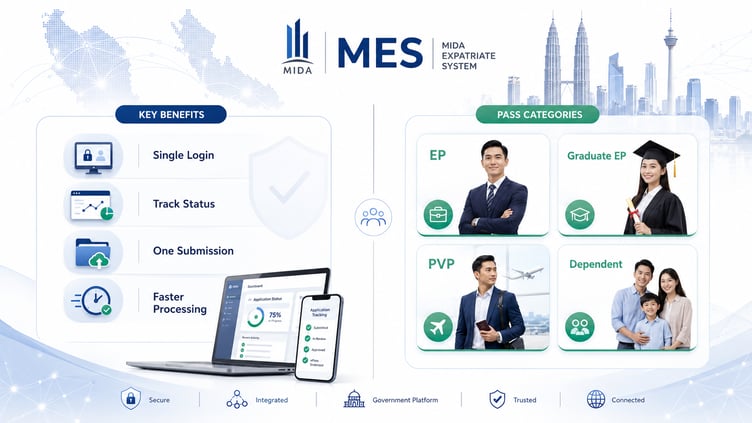
MES covers four main pass categories: Employment Pass (EP), Employment Pass for Foreign Graduates (EP Foreign Graduate), Professional Visit Pass (PVP), and Dependent Pass/Long-Term Social Visit Pass.
1. Employment Pass (EP):
The Employment Pass is for foreign professionals in senior or specialised roles at MIDA-regulated companies. Under MES, two EP post types apply:
- Key Post: Permanent senior role critical to company operations. Minimum salary: RM 15,000/month
- Term Post: Time-bound role focused on knowledge transfer. Minimum salary: RM 5,000/month
Important update effective 1 June 2026: Revised salary thresholds will apply to all new and renewal applications:
- Category I: Requires a minimum monthly salary of RM 20,000 or more and allows a maximum Employment Pass tenure of up to 10 years.
- Category II: Requires a monthly salary between RM 10,000 and RM 19,999 and allows a maximum tenure of up to 10 years, but a succession plan is required.
- Category III: Requires a monthly salary between RM 5,000 and RM 9,999 and allows a maximum tenure of up to 5 years, with a mandatory succession plan.
Other EP eligibility requirements include a minimum company paid-up capital of RM 250,000–500,000, a valid passport of at least 12 months, and a MyFutureJobs job posting (unless exempted).
2. Employment Pass for Foreign Graduate (EP Foreign Graduate):This is a new EP category introduced alongside MES, specifically for international graduates from Malaysian institutions who wish to work in Malaysia after graduation.
It is restricted to five high-priority sectors:
- Electrical & Electronics
- Specialty Chemicals
- Aerospace
- Pharmaceuticals
- Medical Devices
The maximum approved duration is two years.
This category is designed to retain global talent trained within Malaysia's own education system and is only available within MIDA's regulated sectors.
3. Professional Visit Pass (PVP):The PVP is for short-term foreign assignments such as technical work, training, installation, or consultancy. It is now processed entirely through MES.
Key PVP rules:
- Applicant must be employed by an overseas company, not a Malaysian entity
- Maximum stay: 12 months, non-extendable
- PVP holders cannot bring dependents
- A PVP can be converted to an EP, but the PVP must be shortened first
The Dependent Pass allows eligible EP holders to bring their immediate family members to Malaysia.
Starting 1 June 2026, all EP categories (I, II, and III) are eligible to sponsor dependents.
Eligible dependents include:
- Spouse or equivalent
- Children
- Parents and parents-in-law
Previously, only EP Categories I and II were eligible for dependent sponsorship.
The expanded policy reflects Malaysia's broader goal of attracting and retaining global talent.
What are the advantages of MES?
Expats and their employer-sponsors benefit from faster approvals, real-time application tracking, and reduced administrative uncertainty thanks to MES.
The single-window design means fewer delays caused by inter-agency handoffs.
Key benefits include:
- Single login to the InvestMalaysia portal for all pass-related submissions.
- End-to-end visibility allows to track every application stage in real time.
- One-time document submission, so there is no need to re-upload the same documents at different stages.
- No new infrastructure as it is built on existing and proven systems.
- Faster decisions, as centralised processing reduces waiting time and eliminates duplication
For global mobility managers and HR teams, MES delivers structured, accountable workflows with clearer documentation standards and stronger alignment across approval stages.
How to apply through the MIDA Expatriate System Malaysia?
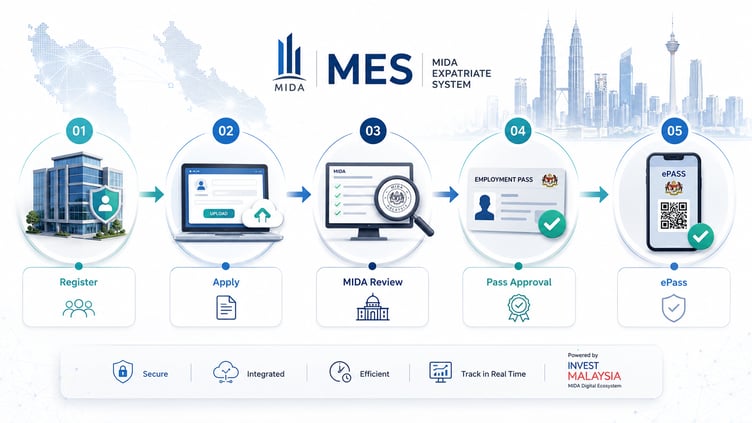
Eligible companies submit expatriate work pass applications through the MIDA Expatriate System (MES) by registering in InvestMalaysia before filing applications via Xpats Gateway for MIDA evaluation and approval.
The steps are:
- Ensure your company is registered and active in InvestMalaysia under the Expatriate Module
- Submit the expatriate application through the Xpats Gateway portal
- The application is routed automatically to InvestMalaysia for MIDA review
- MIDA evaluates the post and applicant eligibility
- Upon approval, pass issuance and ePass endorsement occur within the same platform
Companies should confirm their InvestMalaysia account credentials are current and valid before submission.
Any discrepancy in company registration data can cause processing delays.
How to access the system?
Access MES via the InvestMalaysia portal using your existing company login credentials under the Expatriate Module.
No new account creation is required if your company is already registered with MIDA.
To access:
- Go to the InvestMalaysia portal at investmalaysia.com.my
- Log in using your registered company ID and password
- Navigate to the Expatriate Module to begin submissions
- Applications are then routed via Xpats Gateway within the same interface
If your company does not yet have an InvestMalaysia account, registration must be completed first before any expatriate applications can be submitted through MES.
How long does MES application process take?
Malaysia’s MIDA Expatriate System does not have fixed processing times. Timelines vary by application type and depend on MIDA's evaluation and the Immigration Department's processing.
Key benchmarks to track:
- Company registration in InvestMalaysia: Complete before first submission
- Expatriate post approval: Processed by MIDA following submission via Xpats Gateway
- Pass approval and ePass endorsement: Handled within the same system post-approval
MIDA recommends submitting well in advance of the intended start date.
How to check status of a MES application
MIDA Expatriate System (MES) application status can be tracked in real time through the InvestMalaysia portal under the Expatriate Module.
The portal displays each stage of the application, including post approval, pass approval, and ePass endorsement, within a single dashboard.
This is one of the primary improvements MES introduces over the previous multi-agency process.
Log in to your InvestMalaysia account and navigate to the active application dashboard.
What does an incomplete MIDA Expatriate System application mean?
An incomplete MES application means mandatory documents or data fields were not fully provided at the time of submission, causing the application to be placed on hold or returned.
Under MES, the tolerance for incomplete submissions is lower than before.
The centralised structure means errors surface more quickly and must be corrected before processing can continue.
Common causes of incomplete applications:
- Missing or expired supporting documents
- Inconsistent data across submission stages
- Company account details not updated in InvestMalaysia
- Failure to meet eligibility criteria at the time of submission
Ensuring all documentation is in order before submission is critical.
An incomplete application does not restart automatically, it requires active correction and resubmission by the applicant.
How much does a MIDA Expatriate System application cost?
MIDA evaluation fees are charged per application type, exclusive of 8% SST. These fees remain consistent with pre-MES rates.
- Employment Pass (Key Post):
- Employment Pass (Term Post):
- Professional Visit Pass:
- Dependent Pass:
The MIDA evaluation fee is RM 2,000 (excluding 8% SST), with additional immigration charges including RM 125 processing fees, RM 300 issuance fees, and applicable visa fees.
The MIDA evaluation fee is RM 2,000 (excluding 8% SST), plus RM 125 processing fees, RM 200 issuance fees, and applicable visa fees.
The MIDA evaluation fee is RM 1,200 (excluding 8% SST), with additional immigration fees ranging from RM 180 to RM 360, plus visa fees.
The MIDA evaluation fee is RM 500 (excluding 8% SST), along with applicable immigration fees.
Note: SST (Sales and Services Tax) at 8% applies on top of all MIDA evaluation fees. Budget for both MIDA and Immigration Department costs when planning expatriate hiring.
Can I apply again if my MES application is rejected?
If your MIDA Expatriate System (MES) application is rejected, you can submit a new application after resolving the issues identified by MIDA.
However, there is no automatic reinstatement, a fresh application must be filed.
Before reapplying:
- Review the rejection reason carefully
- Correct the eligibility issue (e.g., salary, documentation, company licence status)
- Ensure your InvestMalaysia company account data is current and accurate
- Consult MIDA or a qualified immigration adviser if the rejection reason is unclear
Repeated rejections for the same issue can delay your hiring timeline significantly. It is advisable to seek professional guidance before a second submission.
How does the Immigration Department's Cooling-Off Period affect MES applications?
The Immigration Department's Cooling-Off Period (COP) temporarily prevents employers or expatriates from submitting new applications after certain immigration compliance violations.
This includes allowing a pass to lapse, misrepresenting information, or failing to cancel a pass upon termination.
If a COP applies, it can delay or prevent new applications through the MIDA Expatriate System (MES) until the restriction is lifted.
Employers must ensure:
- All previous passes are properly cancelled when an expat leaves
- Applications are not submitted with outdated or incorrect company data
- Staff departures are reported to MIDA and the Immigration Department promptly
MIDA Expatriate System vs Investor Pass: What’s the difference?
The MIDA Expatriate System (MES) processes work-based passes for expatriates employed by eligible MIDA-regulated companies, while the Investor Pass is designed for qualifying foreign investors.
As of 13 March 2026, the Expatriate Services Division (ESD) removed the Existing Investor category from the Xpats Gateway system.
This means investors who already own or hold directorships in Malaysian companies are no longer eligible for the Investor Pass.
The table below highlights the main differences.
|
Feature |
MIDA Expatriate System (MES) |
Investor Pass |
|
Purpose |
Work pass applications for employed expatriates |
Entry route for qualifying foreign investors |
|
Managed by |
MIDA |
Expatriate Services Division (ESD) |
|
Eligible applicants |
Expatriates employed by eligible MIDA-regulated companies |
Qualifying foreign investors |
|
Passes covered |
Employment Pass, Professional Visit Pass, Dependent Pass |
Investor Pass |
|
Sector restrictions |
Manufacturing and selected services sectors |
Not sector-specific |
|
Existing company owners |
Apply for an Employment Pass or Professional Visit Pass through MES, where eligible |
Existing Investor category removed (effective 13 March 2026) |
MIDA Expatriate System (MES)
Governed by Malaysian Investment Development Authority (MIDA), this route targets employed expatriates in the manufacturing and selected services sectors.
Applications are processed through the InvestMalaysia and Xpats Gateway platforms.
Dependent passes are available for all Employment Pass categories from June 2026 onward.
Investor Pass
Governed by the Expatriate Services Division (ESD), this route is designed for foreign investors without an existing local company stake.
Applications are submitted through the Xpats Gateway platform, and the scheme is not restricted to specific sectors.
Following the removal of the Existing Investor category in March 2026, investors who already own or direct Malaysian companies must instead apply for an appropriate Employment Pass through MES, where eligible.
Dependent eligibility under the Investor Pass remains limited.
Bottom Line
The MIDA Expatriate System (MES) centralises expatriate work pass applications for eligible companies in Malaysia's manufacturing and selected services sectors.
By integrating application submission, evaluation, approval, and ePass endorsement into a single digital workflow, it simplifies a process that was previously handled across multiple systems.
Companies should confirm their eligibility, maintain an active InvestMalaysia account, and ensure applications are complete to help avoid unnecessary delays.
FAQs
What is the difference between MIDA and MITI?
MIDA (Malaysian Investment Development Authority) is the agency that promotes and facilitates investment, manages manufacturing licences, and processes expatriate applications.
MITI (Ministry of Investment, Trade and Industry) is the ministry that MIDA operates under.
MITI sets policy; MIDA implements it on the ground.
How much do I need to invest in Malaysia to get PR?
There is no fixed investment amount that guarantees permanent residency (PR) in Malaysia.
PR pathways are separate from MIDA's work pass system, and programs like the Malaysia My Second Home (MM2H) and the Premium Visa Programme (PVIP) each have distinct investment or income thresholds.
The PVIP, for example, requires offshore income of at least RM 40,000 per month and minimum assets of RM 1.5 million.
These programmes are administered by the Immigration Department, not MIDA. Consult a licensed adviser for the current requirements.
Why invest in Malaysia?
Malaysia offers a competitive combination of strategic location, bilingual workforce, established manufacturing infrastructure, and a range of tax incentives administered through MIDA.
The country is part of key free trade agreements and is positioned as a regional hub for sectors including E&E, aerospace, and pharmaceuticals.
MES itself is part of a broader effort to improve ease of doing business for foreign investors.
What is the minimum salary for expatriate in Malaysia?
Effective 1 June 2026, the revised Employment Pass salary thresholds are RM 20,000+ per month for EP Category I, RM 10,000–19,999 for Category II, and RM 5,000–9,999 for Category III (with RM 7,000–9,999 applying to specific manufacturing-related services).
All new and renewal applications submitted on or after that date must comply.