Portugal taxes qualifying short-term cryptocurrency gains at 28%, while certain long-term holdings may qualify for a capital gains exemption.
Staking rewards, mining income, certain DeFi and NFT transactions, tax reporting obligations, and available exemptions can all affect an investor's overall crypto tax liability.
Key Takeaways
- Qualifying crypto held for at least 365 days may be exempt from capital gains tax, while short-term gains are generally taxed at 28%.
- Portugal's 2026 guidance clarifies the tax treatment of passive staking rewards.
- DAC8 and CARF expand the crypto-asset information that providers must report to tax authorities.
- Portuguese tax residents are generally taxed on worldwide crypto income and gains, while non-residents face more limited rules.
My contact details are hello@adamfayed.com and WhatsApp +44-7393-450-837 if you have any questions.
The information in this article is not tax advice and may have changed since the time of writing. I can connect you with expert tax support for your specific situation.
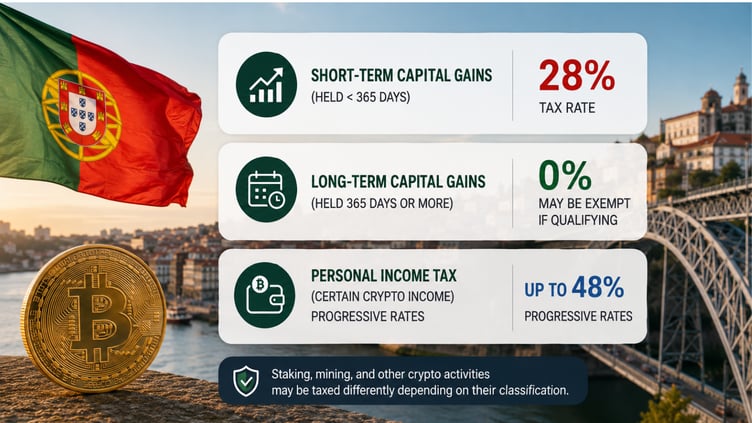
What are the tax rates for cryptocurrency in Portugal?
Portugal generally taxes qualifying cryptocurrency capital gains at 28% when the assets have been held for less than 365 days, while qualifying crypto assets held for at least 365 days may benefit from an exemption.
Other crypto-related income may be taxed under Portugal's personal income tax or business income rules, with progressive personal income tax rates reaching 48% for residents.
The specific treatment depends on the type of crypto activity and how it is classified for tax purposes.
For most individual investors, the key distinction is between capital gains from disposing of crypto assets and income generated through crypto-related activities.
The applicable treatment can also depend on the holding period and whether the activity is considered an investment or a business.
What is DAC8 and how does it affect crypto investors in Portugal?
DAC8 is an EU tax transparency framework that expands the reporting and information-sharing obligations for crypto-asset service providers.
In Portugal, the framework was further implemented and updated in 2026, requiring reporting crypto-asset service providers to collect and report information on reportable crypto users who are tax residents in Portugal.
It increases the amount of information that tax authorities can receive about crypto transactions and account holders.
Key Aspects of the 2026 Framework
- Legal Integration: Law No. 26/2026 incorporates the DAC8 and CARF reporting framework into Portugal's domestic rules and updates Article 124-A of the Personal Income Tax Code to establish the reporting obligations for crypto-asset service providers.
- Expanded Due Diligence: Providers must identify reportable users and establish tax residence.
- More Standardized Reporting: Providers must collect and report specified user and transaction information.
- Annual Reporting: Information for the preceding calendar year is reported to AT by May 31.
- Automatic Information Exchange: Reported information is exchanged automatically with the relevant EU tax authorities.
What Has Not Changed?
- DAC8 Is Not a New Crypto Tax: It concerns reporting and transparency.
- Existing Crypto Tax Rules: The applicable treatment of gains and crypto-related income remains governed by Portugal's tax rules.
- 365-Day Rule: Qualifying crypto held for at least 365 days can still benefit from the applicable exemption.
How are staking, mining and airdrops taxed?
In Portugal, staking rewards may be taxed as Category E investment income, mining and validation are generally taxed as Category B business or professional income, and airdrops are taxed according to how and why the tokens were received.
Staking
Portugal's Tax Authority issued further guidance on staking in 2026, confirming that passive staking rewards can fall under Category E as investment income.
When staking rewards are received in crypto-assets, taxation is generally deferred until the received tokens are subsequently disposed of.
The later disposal is then considered under Portugal's crypto capital gains rules.
This means receiving staking rewards in crypto does not necessarily create an immediate tax liability based on the tokens' market value at the time of receipt.
Taxation becomes relevant when the rewarded tokens are later sold, exchanged, spent, or otherwise disposed of.
Mining
Mining and validating crypto transactions through consensus mechanisms are generally classified as Category B business or professional activities in Portugal.
The income is therefore treated differently from passive investment income and may give rise to business-related tax and reporting obligations.
Airdrops
Airdrops do not have a single tax treatment in Portugal. The applicable rules depend on why the tokens were distributed and the circumstances in which they were received.
Where an airdrop represents remuneration for a crypto-related activity, it may fall within the applicable income rules. In other circumstances, tax may arise when the tokens are subsequently disposed of under the crypto capital gains regime.
Keeping records of why the tokens were awarded and whether the recipient provided services or performed activities in return can help establish the appropriate tax treatment.
Do I have to pay taxes on NFTs?
Yes, certain NFT transactions may be taxable in Portugal, while others may not create an immediate tax liability.
The tax treatment depends on whether the NFT is held as a personal investment, created and sold as part of a business, or generates income through commercial activities.
Generally:
- Buying an NFT does not usually create a taxable event.
- Holding an NFT without selling or otherwise disposing of it is generally not taxable.
- Selling an NFT for a profit may be taxable, although the applicable tax rules vary according to the nature of the NFT and the transaction.
- Creating and regularly selling NFTs may be treated as a commercial activity and taxed under Portugal's business income rules rather than the capital gains regime.
Because Portugal's NFT tax rules are less clearly defined than those for cryptocurrencies, the tax treatment may vary based on the facts of each case.
Professional tax advice may be appropriate for significant NFT transactions.
Do you pay taxes on DeFi?
Possibly. Many DeFi transactions are taxable in Portugal, particularly those that generate crypto rewards or involve disposing of digital assets.
Activities such as lending crypto for interest, yield farming, earning liquidity pool rewards, and receiving governance tokens may create taxable income, while exchanging crypto through DeFi protocols may also trigger capital gains tax where applicable.
Simply holding cryptocurrency in a DeFi wallet without generating income or disposing of the assets generally does not create a taxable event.
Because DeFi taxation continues to evolve, maintaining detailed transaction records remains important for complying with Portugal's crypto tax rules.
What crypto transactions are not taxable?
Under Portugal's crypto tax rules, buying cryptocurrency with fiat currency, holding crypto without disposing of it, transferring assets between wallets owned by the same person, and selling qualifying cryptocurrency after a holding period of at least 365 days are generally not taxable.
Certain crypto-to-crypto exchanges may also defer taxation until a later taxable disposal under the applicable rules.
By contrast, cryptocurrency received as compensation, staking rewards, mining income, or through commercial activities may be treated as taxable income even if the assets are not immediately sold.
Who has to pay taxes in Portugal for crypto?
Individuals who are Portuguese tax residents are generally taxed on their worldwide cryptocurrency income and gains, regardless of whether the assets are held on Portuguese or foreign exchanges.
Non-residents are generally taxed only on income that falls within Portugal's taxing rights under Portuguese law and applicable tax treaties.
Professional traders, miners, and businesses engaged in crypto activities may also have additional reporting and tax obligations beyond those of casual investors.
How to declare crypto on tax return?
To declare cryptocurrency on a Portuguese tax return, report all taxable crypto transactions in the annual IRS (Modelo 3) income tax return submitted through Portugal's Portal das Finanças.
The return is generally filed between 1 April and 30 June of the year following the tax year in which the income or gains were earned.
Depending on the type of transaction, reporting may include:
- Capital gains
- Business income
- Investment income
- Other taxable crypto-related earnings
Supporting documentation should generally include:
- Purchase dates
- Sale dates
- Acquisition cost
- Disposal proceeds
- Wallet addresses
- Exchange statements
- Transaction fees
Maintaining complete transaction records is increasingly important as Portugal moves toward expanded crypto-asset reporting under international frameworks such as the OECD's Crypto-Asset Reporting Framework (CARF) and the EU's DAC8 rules.
These developments increase the amount of information that crypto-asset service providers may be required to report to tax authorities.
Is there a way to avoid paying taxes on crypto?
No. Portugal does not provide a legal way to avoid taxes on taxable cryptocurrency transactions.
However, lawful tax planning may help reduce the amount of tax payable in certain situations.
Examples include:
- Holding qualifying crypto investments for at least 365 days before selling.
- Maintaining accurate transaction records. Keeping complete records of acquisition costs, disposal proceeds, and transaction fees helps ensure capital gains are calculated correctly and prevents overpaying tax.
- Offsetting eligible gains with allowable losses. Where permitted under Portuguese tax rules, capital losses may reduce taxable gains and lower the overall tax liability.
- Determining whether crypto activities are treated as investing or a business. Individuals who trade, mine, or otherwise conduct crypto activities on a commercial basis may be subject to different tax rules than private investors, making proper classification important.
- Seeking professional tax advice before major transactions.
Portugal crypto taxes vs other European countries
Portugal offers more favorable tax treatment for many long-term cryptocurrency investors than several European countries, although it is no longer the completely tax-free jurisdiction it once was.
Qualifying long-term capital gains may be exempt, while many other European countries continue to tax crypto gains regardless of the holding period or under different tax regimes.
|
Country |
General Crypto Tax Treatment |
Indicative Individual Tax Rate |
|
Portugal |
Long-term qualifying gains generally exempt; short-term gains generally taxed |
28% on taxable short-term gains |
|
Germany |
Many long-term individual holdings may also qualify for exemption after one year |
0%–45% on taxable gains, based on the individual’s income tax rate; plus an annual exemption threshold of €1,000 for private sale gains |
|
Spain |
Capital gains generally taxable regardless of holding period |
19%–30% under the savings-income tax bands |
|
France |
Flat-rate taxation generally applies to many private crypto gains |
31.4% PFU from 2026 |
|
Italy |
Crypto gains realized by individuals are generally subject to substitute tax |
33% from 2026 |
Portugal remains one of Europe's more attractive crypto jurisdictions for investors who primarily buy and hold cryptocurrency, particularly when compared with countries that generally tax both short- and long-term crypto gains.
Conclusion
Portugal's crypto tax environment is becoming more mature rather than simply more restrictive.
The 2026 developments show a shift toward clearer treatment of newer crypto activities and greater visibility over transactions, while the core tax framework remains largely intact.
For investors, the practical issue is no longer just whether a transaction is taxable.
How the activity is classified, when a taxable event occurs, and whether the transaction can be properly documented are becoming equally important.
As crypto reporting becomes more standardized, maintaining a clear record of activity and understanding its tax treatment can help investors manage both their tax exposure and their compliance obligations.
FAQs
Is there anywhere where bitcoin is untaxed?
Yes. A few jurisdictions, such as the United Arab Emirates, Cayman Islands, and Singapore (for many individual investors), do not impose personal capital gains tax on qualifying Bitcoin investments.
However, income from activities such as mining, staking, or professional trading may still be taxable, and many tax-free regimes apply only under specific conditions.
Is crypto airdrop taxable?
Often, yes. Promotional or reward-based airdrops may be treated as taxable income when received, with additional tax consequences if the tokens are later sold for a profit.
Does staking crypto get taxed?
Generally, yes. Staking rewards are commonly treated as taxable income when received.
If those tokens later increase in value before being sold, an additional capital gain may also arise.
Does crypto count as self-employed?
Not necessarily. Cryptocurrency investing alone does not generally make an individual self-employed in Portugal.
However, crypto activities carried out on a commercial or professional basis, such as operating a mining business or trading as a business, may be classified as business or self-employment income.
Related Articles
- Best Crypto Tax-Free Countries in Europe
- Paraguay Crypto Tax Reporting Guide for Investors
- Placing Crypto in a Trust: Key Steps, Tax Rules, and Benefits
- Top Offshore Countries for Crypto Companies
- Why Use Offshore Companies for Crypto
- FATCA, CRS & CARF: What Wealth Planning Still Requires
- Why Compliance Is No Longer Optional in International Wealth Planning
- Why High-Net-Worth Investors Are Watching Non-CARF Countries