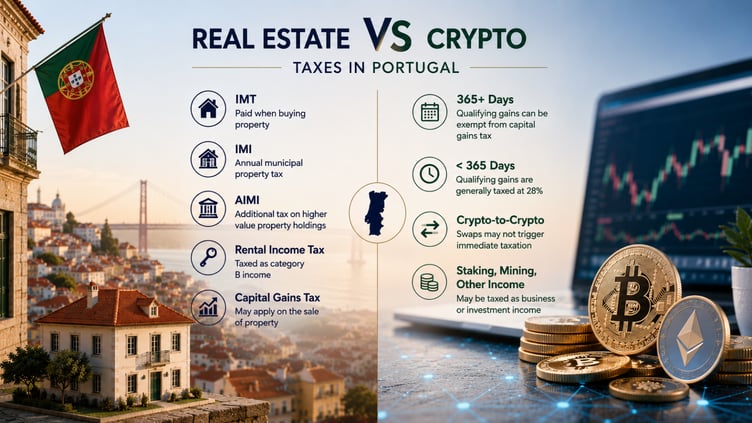
Portugal taxes real estate through IMT on purchases, IMI on property ownership, tax on rental income, and capital gains tax on sales, while crypto taxation is largely based on the asset and how it is used or disposed of.
Qualifying crypto assets held for at least 365 days can generally benefit from a capital gains tax exemption, whereas qualifying crypto held for less than 365 days is generally subject to a 28% tax rate.
This makes the holding period a key factor when comparing the tax treatment of Portuguese real estate and crypto.
Key Takeaways
- Real estate investors in Portugal may face IMT, IMI, AIMI, rental income tax, and capital gains tax.
- Qualifying crypto held for at least 365 days can generally benefit from a capital gains tax exclusion.
- Qualifying crypto held for less than 365 days is generally subject to a 28% autonomous tax rate.
- Residency, holding periods, income type, deductions, and double-tax relief can affect the final tax bill.
My contact details are hello@adamfayed.com and WhatsApp +44-7393-450-837 if you have any questions.
The information in this article is not tax advice and may have changed since the time of writing. I can connect you with expert tax support for your specific situation.
Portugal Real Estate vs Crypto: Tax Comparison
Real estate generally carries more tax points in Portugal, including purchase and annual property taxes, while qualifying crypto can benefit from a capital gains tax exemption after 365 days.
|
Tax consideration |
Real estate |
Crypto |
|
Purchase/acquisition |
IMT and potentially stamp duty |
Generally no equivalent Portuguese acquisition tax simply for buying crypto |
|
Annual holding tax |
IMI; potentially AIMI |
No equivalent annual wealth tax simply for holding qualifying crypto |
|
Income |
Rental income generally taxed at special rates |
Staking, mining and other crypto income can be taxed under different categories |
|
Capital gains |
Taxable under Portuguese capital gains rules |
Generally 28% for qualifying assets held under 365 days |
|
Long-term holding |
No general property equivalent to the crypto 365-day exemption |
Qualifying assets held at least 365 days can generally have gains excluded |
|
Liquidity |
Low; selling property requires a transaction |
High; crypto can generally be disposed of quickly |
|
Transaction costs |
Potentially significant |
Usually lower transaction costs, but exchange and blockchain fees apply |
|
Tax complexity |
Purchase, ownership, rental, and sale taxes |
Cost basis, holding period, disposals, and crypto income |
What taxes do you pay on real estate in Portugal?
Real estate in Portugal is taxed when you buy, own, and, in some cases, sell or generate income from the property.
The main property taxes are IMT on purchases, IMI during ownership, and potentially AIMI for higher-value holdings, with stamp duty also applying to certain transactions.
IMT when buying property
IMT is a transfer tax imposed when purchasing Portuguese real estate. The applicable rate depends on factors including the property's type, value, and intended use.
For example, in 2026, residential property that is not covered by the rules for a primary permanent residence is subject to progressive IMT rates, with higher-value properties reaching a 7.5% rate, as per PwC.
Other urban properties can generally be subject to a 6.5% rate, while rural property is subject to a 5% rate.
The taxable base is generally the higher of the transaction value or the property's taxable patrimonial value (VPT), subject to the specific rules of the IMT Code.
IMI on property ownership
IMI is an annual municipal property tax based on the property's taxable patrimonial value.
For urban properties, municipalities generally set IMI rates between 0.3% and 0.45%, although certain exceptional circumstances can allow rates up to 0.5%.
Rural properties are generally subject to a rate of 0.8%.
The tax is generally payable by whoever is registered as the owner, usufructuary, or superficiary on December 31 of the relevant year.
AIMI for higher-value property holdings
AIMI is an additional property tax that can apply to certain Portuguese urban properties.
For individuals, a €600,000 deduction generally applies to the taxable value of qualifying properties.
For married couples or couples in a de facto union who elect for joint taxation, the deduction can rise to €1.2 million.
Rates for individuals range from 0.7% to 1.5%, depending on the applicable value bands.
For high-net-worth investors with substantial Portuguese property holdings, AIMI can therefore become an important part of the overall tax calculation.
Does Portugal tax cryptocurrency?
Portugal taxes crypto based on how the asset is held, disposed of, or used to generate income, with the 365-day holding period playing a key role for qualifying capital gains.
Qualifying crypto held for less than 365 days is generally subject to a 28% tax rate, while gains on qualifying assets held for at least 365 days can generally be excluded from taxation.
Crypto held for less than 365 days
As a general rule, the positive balance between gains and losses from qualifying crypto disposals can be subject to a 28% autonomous tax rate when the crypto assets have been held for less than 365 days.
For example, if an investor buys qualifying crypto assets for €100,000 and later disposes of them for €150,000 before satisfying the 365-day holding period, the €50,000 gain can generally fall within the 28% capital gains regime.
That would produce a potential tax liability of €14,000 before considering the detailed rules applicable to the taxpayer's circumstances.
Crypto held for at least 365 days
The Portuguese tax code provides an important exemption for qualifying crypto assets held for 365 days or longer.
Article 10 of the Portuguese Personal Income Tax Code excludes gains and losses from qualifying crypto disposals where the assets have been held for at least 365 days.
However, the exemption is not universal.
The specific classification of the crypto asset and the taxpayer's circumstances matter, and the law contains additional rules for assets that fall outside the relevant definition.
Crypto-to-crypto transactions
Portugal also has specific rules where the consideration for a crypto disposal is itself another crypto asset.
Under Article 10, when the transaction falls within the relevant conditions, the disposal may not trigger immediate taxation. Instead, the crypto received generally takes the acquisition value of the crypto that was given up.
This means investors should not assume that every swap is equivalent to selling crypto for euros.
Staking, mining and other crypto income
Crypto taxation becomes more complicated when an investor is earning crypto rather than simply investing in it.
Mining and certain on-chain validation activities, including staking through consensus mechanisms, can be treated as commercial or industrial activities under Category B business and professional income.
Other remuneration generated from investing crypto assets can potentially fall under investment income rules.
The exact treatment can depend on how the income is generated and whether it is received in cash or crypto assets.
This distinction is important because the favorable 365-day capital gains rule should not simply be assumed to apply to every form of crypto income.
How to avoid paying tax on your investments?
In Portugal, investors can legally reduce or avoid tax by using available exemptions, deductions, and tax planning opportunities.
The key is to plan transactions before they occur and keep proper records to support the tax treatment applied.
Investors should:
- Plan disposals carefully to avoid unnecessary taxable gains.
- Document eligible costs that can reduce taxable gains.
- Keep complete transaction records for tax reporting.
- Review your tax residency before major investment transactions.
- Check double-tax relief when income or gains involve another country.
- Get professional advice for complex or high-value investments.
Legal tax planning is different from tax evasion. Failing to report taxable income or gains can result in additional tax, interest, and penalties.
Conclusion
Portugal’s tax treatment can materially influence the timing and structure of an investment, not just its eventual return.
A property investor may need to account for tax at several points throughout ownership, while a crypto investor can face a sharper tax consequence from the timing and nature of a disposal.
For investors planning a large transaction, reviewing the tax position before buying, selling, or changing residency can prevent a tax cost that is difficult to reverse afterward.
FAQs
Is Portugal a crypto tax haven?
No. Portugal is not considered a general crypto tax haven because crypto gains and crypto-related income can be taxable under Portuguese law.
Its tax regime can nevertheless be favorable for certain investors, particularly those who qualify for specific exemptions or reliefs.
How to avoid crypto tax in Portugal?
You cannot legally avoid a tax that is due, but you can reduce or eliminate crypto tax by using applicable exemptions, reliefs, and deductible losses.
Proper reporting is still required, even when a transaction ultimately qualifies for tax-free treatment.
Is property tax high in Portugal?
Portugal’s annual property tax is generally moderate, but the overall tax burden can be significant because buyers may also face IMT and stamp duty, while higher-value properties may incur AIMI.
How to avoid double taxation in Portugal?
Portugal generally prevents double taxation through its tax treaties and foreign tax credit system, allowing eligible taxpayers to offset qualifying foreign taxes against Portuguese tax.
Related Articles