Some Golden Visa and comparable property residence programs allow owners to earn rental income. Mauritius permits owners of qualifying properties to rent them out, while Greece allows long-term leasing but prohibits short-term rental of qualifying Golden Visa properties.
Other programs may require rental registration, licensing or approval, making the intended rental strategy an important consideration before purchasing a qualifying property.
Key Takeaways
- Renting generally does not cancel a Golden Visa, as long as the qualifying investment is maintained.
- Greece permits long-term leasing but prohibits short-term letting of properties qualifying under its current Golden Visa rules.
- Selling a qualifying property can affect visa renewal, particularly before the required holding period ends.
- Rental rules vary by country, with licensing, registration and property-specific requirements applying in some programs.
My contact details are hello@adamfayed.com and WhatsApp +44-7393-450-837 if you have any questions.
The information in this article is for general guidance only. It does not constitute financial, legal, or tax advice, and is not a recommendation or solicitation to invest. Some facts may have changed since the time of writing.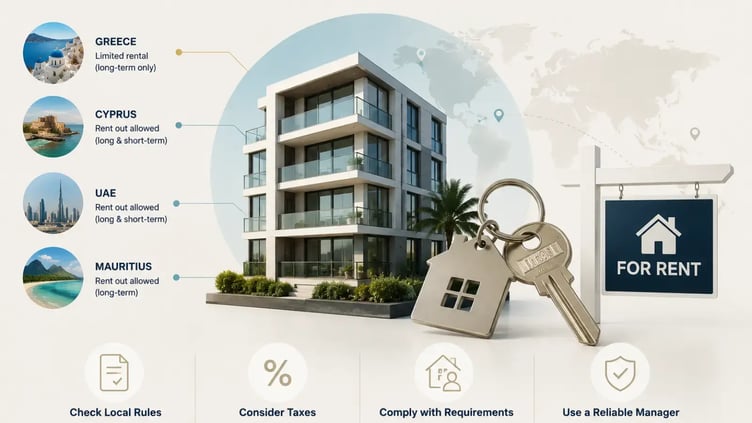
What happens to your Golden Visa if you rent out the property?
In many Golden Visa programs that permit property investment, renting out the qualifying property does not by itself cancel the residence permit.
The important requirement is generally that the investor continues to meet the program's investment conditions.
This means an investor may be able to purchase an eligible property, obtain residency, and generate rental income from it without having to occupy the property personally.
However, the rules can differ significantly between countries.
Some programs impose minimum holding periods for qualifying investments, while others may have specific conditions attached to the property itself.
There is also an important distinction between renting out a property and selling it.
Renting generally allows the investor to retain ownership and therefore maintain the underlying investment.
Selling the property can remove the qualifying investment and potentially affect future visa renewals.
Investors should also check whether any change in the property's use requires notification to immigration authorities or compliance with additional local regulations.
Are there restrictions on short-term rentals?
Yes, short-term rentals can be subject to stricter rules than long-term leases, and a property that qualifies for a Golden Visa may not necessarily be eligible for Airbnb-style holiday rentals.
Golden Visa requirements and rental regulations are separate.
A country may allow an investor to rent out a qualifying property while its tourism or local authorities impose additional rules on short-term accommodation.
Greece provides a clear example.
Properties acquired through its Golden Visa program cannot be used for short-term rentals under the sharing economy.
This means an investor may retain the property as a qualifying Golden Visa investment but cannot use it as an Airbnb-style holiday rental.
Investors considering renting out a Golden Visa property should therefore check:
- Whether short-term or holiday rentals are permitted
- Whether a local accommodation or tourism license is required
- Whether the property is located in an area with additional restrictions
- Whether the building's condominium or homeowners' association rules permit short-term rentals
- Whether minimum or maximum rental periods apply
- Whether rental income is subject to additional taxes or reporting requirements
Golden Visa countries that allow property rentals
Several Golden Visa and comparable property-based residence programs allow investors to rent out qualifying real estate, including Cyprus, Mauritius, Malta, Indonesia, the UAE, Qatar, Saudi Arabia, Oman and Bahrain, although rental rules vary by program.
The main differences concern short-term rentals, licensing and registration requirements, investment holding periods, and whether the property must be used as the investor's residence.
Countries With Relatively Flexible Rental Rules
These programs are generally more suitable for investors who want their qualifying property to generate rental income, although each has different residence, licensing and tax requirements.
Cyprus allows investors under its property-based permanent residence program to rent out qualifying real estate while maintaining the required investment.
Rental income is subject to Cyprus tax rules.
From 2026, rental income is no longer subject to Special Defence Contribution, but it can still be subject to income tax and a 2.65% GESY contribution.
Investors should also check the applicable VAT treatment before purchasing property specifically for rental income.
Mauritius allows non-citizens who acquire qualifying residential property under approved schemes such as the Integrated Resort Scheme (IRS), Real Estate Scheme (RES) and Property Development Scheme (PDS) to rent out their properties.
The Economic Development Board also states that owners may rent out the property without restrictions on repatriating rental revenue, making Mauritius relatively flexible for investors seeking both residence and rental income.
Countries Where Rental Is Allowed but Conditions Apply
Some property-based residence programs allow investors to generate rental income, but the property may be subject to holding requirements, licensing rules or other local conditions.
Malta's Permanent Residence Programme (MPRP) allows investors who purchase qualifying property to lease it out while they are not residing in Malta.
The qualifying property must generally be retained for at least five years, and rental activity remains subject to Malta's ordinary tenancy and tax rules.
Investors can potentially generate rental income from the property, but short-term accommodation is subject to separate business and licensing requirements.
Hosts operating accommodation businesses must obtain a Business Identification Number (NIB) through Indonesia's OSS system before obtaining the relevant licenses.
Owners can generally rent out their property, but short-term holiday rentals require separate approval.
In Dubai, properties must be registered with the Department of Economy and Tourism (DET) and have a Holiday Home permit before they can be listed for short-term stays.
Long-term rentals are subject to the UAE emirate's ordinary tenancy rules, while holiday-home rentals have additional licensing requirements.
Qatar allows non-Qatari property owners to rent out qualifying real estate, including property held through its property-based residence route.
The key requirement is that the lease must be registered with the relevant authority, with the property owner responsible for registration.
Rental activity must also comply with Qatar's applicable leasing rules and any restrictions on where non-Qatari-owned property can be located.
Saudi Arabia's Premium Residency real estate route does not specifically prohibit investors from renting out their qualifying property.
Rental activity is instead subject to the country's general real estate and leasing regulations.
Investors must also ensure that the property is eligible for non-Saudi ownership under Saudi Arabia's geographic and ownership rules.
Lease arrangements must comply with the applicable landlord-tenant requirements.
Oman's Golden Residency allows qualifying investors to own property in designated Integrated Tourism Complexes (ITCs) for accommodation or investment.
Such properties can be held as investment assets, including for rental purposes, subject to the rules governing the specific tourism complex.
Short-term rental is not automatically permitted, however.
Whether a unit can be used for holiday or tourist letting can depend on the complex's own rules and applicable tourism regulations, so investors should confirm this before purchasing if rental income is the objective.
Bahrain allows Golden Residency property owners to rent out their qualifying real estate, subject to the country's property rental rules.
The key requirement is that the lease agreement must be registered, with registration generally being the lessor's responsibility.
Non-Bahraini owners must also ensure that the property is located in an area or project where foreign ownership is permitted.
Countries With Significant Rental Restrictions or Unclear Rules
Greece's Golden Visa allows qualifying property investment, but properties acquired through the program cannot be used for short-term rentals or subletting under the sharing economy.
Long-term leasing remains possible, making the program more suitable for investors seeking conventional rental income than Airbnb-style returns.
The current official MM2H conditions do not clearly state that participants may rent out the compulsory residence, while professional guidance commonly interprets the property as being for personal use.
Investors intending to generate rental income should therefore obtain written confirmation from the relevant Malaysian authority before relying on the property as a rental investment.
At a Glance
Relatively flexible
Cyprus and Mauritius
Rental is generally permitted, subject to standard local rules.
Allowed with conditions
Malta, Indonesia, UAE, Qatar, Saudi Arabia, Oman and Bahrain
Rental may be possible, but licensing, registration or property-specific conditions can apply.
Rental restrictions or unclear rules
Greece and Malaysia
Greece prohibits short-term rental of qualifying Golden Visa properties. Malaysia's rules on renting the compulsory MM2H property remain unclear.
Is renting out a Golden Visa property a good investment strategy?
Renting out a Golden Visa property can make sense when the investor wants the property to produce income while also satisfying an investment residency objective.
The strategy can be particularly attractive when the property is located in a market with strong rental demand and the expected rental yield is sufficient to offset the costs of ownership.
However, the Golden Visa benefit should not be confused with investment performance.
A property can qualify for residency but still be a poor rental investment if it has:
- Low rental demand
- High vacancy rates
- Expensive property management
- High transaction costs
- Significant maintenance expenses
- Low net rental yield
- Limited resale liquidity
Investors should calculate net rental yield, rather than focusing only on advertised rents.
They should also consider the eventual exit strategy.
If the property must be retained for a particular period to preserve Golden Visa eligibility, the investor may have less flexibility to sell when market conditions are favorable.
Conclusion
For investors considering a Golden Visa property, the ability to rent it out can make the investment more practical beyond simply meeting a residency requirement.
But being allowed to rent is only the starting point; the type of rental permitted, local taxes and the costs of managing the property can all affect how useful the strategy is.
Before buying, investors should confirm that their intended rental use is permitted and understand how the resulting income will be taxed.
A property may qualify for residency and generate rental income, yet still fall short of expectations once taxes and other ownership costs are taken into account.
FAQs
What happens to Golden Visa if you sell property?
Selling a qualifying Golden Visa property before completing the required holding period can cause you to lose your Golden Visa or affect its renewal.
Once the holding period is met, you may be able to sell without affecting your status, depending on the program's rules.
Which golden visa doesn't offer property route?
Portugal and Hungary are examples of Golden Visa or investor residence programs that do not currently offer direct property purchase as a qualifying route.
Portugal removed real estate from its Golden Visa program in 2023, while Hungary's current Guest Investor Program uses qualifying fund investments or donations instead of direct property purchases.
Is rental income from a Golden Visa property taxable?
Rental income may be taxable in the country where the property is located and potentially in the investor’s country of tax residence. Applicable deductions, reporting requirements and tax rates depend on the jurisdiction and the investor’s circumstances.
Which is the easiest Golden Visa to get?
Latvia and Greece are among the more accessible options currently.
Latvia stands out for its relatively low-cost investor routes, while Greece offers a straightforward residence-by-investment framework; the best option ultimately depends on the applicant's investment capacity, eligibility and preferred route.
Related Articles
- Golden Visa Countries List: Where Investors Can Buy Residency or Citizenship
- Top 10 Golden Visa and Citizenship by Investment (CBI) Programs
- Should I Buy or Rent Property as an Expat?
- Rental Guarantee: 5 Essential Points You Need to Know
- How to Choose an Investment Property: A Guide
- Shariah Compliant Property Investment Guide