How to hold on to your freedom in retirement, whatever year you stop working.
I've advised expats and high-net-worth individuals on investments and retirement planning for close to a decade and a half, and have written about it for Forbes.
Most people assume that retirement success depends mainly on how much money they have when they stop working.
What they overlook is that the first few years after they retire can have a disproportionate impact on how long their money lasts. In my experience, it's one of the least understood risks in retirement, and it can catch out even careful, disciplined savers.
Let's compare two retirees.
Both retire with $1 million. Same S&P 500 fund. Same 4% withdrawals, raised with inflation every year. The only difference is the year they stop working: one in January 1996, the other in January 2000.
By mid-2026, the first has almost $10 million. The second has about $23,000 left. One can spend freely for the rest of their life. The other is wondering how long $23,000 will last.
This article will explain how you can reduce retirement risks, and maximize how much you can withdraw. You'll see:
- Why the 2000 retiree ran into trouble, despite making the same choices as the one who ended up with $10 million
- What would have happened if they hadn't been 100% in stocks, and why it made such a difference
- Why expats have less to fall back on when markets fall
- How to help protect decades of saving from a crash early in your retirement
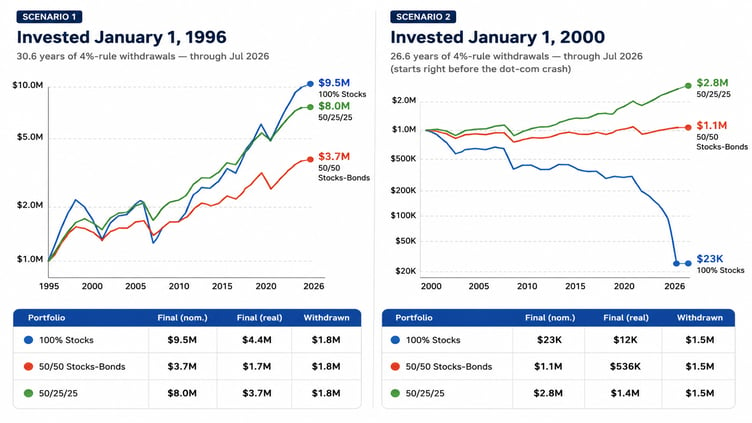
Figures are before inflation. Adjusted for inflation, the gap is roughly $4.4 million against $12,000
Why did the person who retired in 2000 run into trouble?
On paper, they did everything right. Same investment, same withdrawals, same discipline.
The 1996 retiree simply had four strong years first. By the time the dot-com crash arrived, their portfolio had already grown, so they were drawing income from a much bigger pot when markets fell.
The 2000 retiree started taking income just before one of the biggest market falls in recent decades. Every withdrawal in a falling market meant selling investments at low prices. Those investments were gone before the recovery came, so they never got the chance to recover with it.
This has a name: sequence risk. The order your returns arrive in matters, not just the average. It's one of the biggest risks retirees face, and one of the least understood.
Not sure you've saved enough to retire?
Take my free Financial Freedom Scorecard. Answer 11 quick questions to see how ready you are, and my team and I will review your results and get back to you.
No obligation. Plus, you'll get two free investing guides for expats.
Already have savings and want to talk through your retirement plan?
As featured in

Why a crash hurts more once you stop working
While you're working, a market fall is almost a sale. You keep investing, and you buy at lower prices.
Retirement flips that. You're no longer adding money. You're taking it out, and in a falling market that means selling cheap. If markets take five years to recover, that's a very different experience at 65 than at 35.
I see two extremes among people approaching retirement. Some want everything in stocks, because markets have done so well over the last 15 or 20 years. Others want everything in cash, because they're worried about the next crash.
Both carry risk. All stocks leaves you exposed to a 2000-style start. All cash leaves you exposed to inflation, quietly, every year. If your bank pays 2.5%, inflation runs at 3.5% and you're spending 3% a year, your money is shrinking in real terms.
There's an emotional side too. Most people approaching retirement have spent decades saving. Switching from building a pot to drawing it down is hard, and a falling market in the first few years is exactly when staying calm is hardest.
Why this matters even more if you live abroad
Back home, many people have a safety net they barely think about. National Insurance or social security builds a state pension. A workplace pension comes straight out of their pay. Often the mortgage is paid off by their fifties.
Many expats earn more than their peers back home, but spend years outside those systems. The pension they build is often much smaller, so more of their retirement rests on their own portfolio, and a bad start does more damage.
There are a few more layers:
- Currency. Many expats don't know which currency they'll retire in. If you spend in one currency and your savings sit in another, a currency swing can land at the same time as a market fall.
- Retiring early. Many people abroad hope to stop work early. A retirement that starts at 50 can mean 40 years or more of withdrawals, which gives a bad sequence more time to do damage. In many countries a state pension can't be claimed until 66 or later, so there's nothing to lean on for the first decade or more.
- Advice gaps. When people move country, the adviser back home often can't keep looking after them.
What could the person who retired in 2000 have done differently?
They didn't choose to retire into a crash. Nobody does. As early as 1996, the head of the US Federal Reserve was warning that stocks looked overpriced. Yet stocks kept rising for another three years.
Nobody can consistently predict when a crash will come.
But you do get to choose how your money is set up for one.
Here's the chart again. It compares three mixes:
Figures are before inflation. Adjusted for inflation, the gap is roughly $4.4 million against $12,000
- 100% stocks. Everything in the S&P 500.
- 50/50. Half stocks, half bonds.
- 50/25/25. Half stocks, a quarter bonds, a quarter hedge funds.
For the 1996 retiree, 100% stocks came out on top. Markets rose strongly in their early years, so the extra growth paid off.
For the 2000 retiree, the picture flips. With 100% stocks, they were down to about $23,000 by mid-2026. With the 50/50 mix, they'd still have had about $1.1 million. With the 50/25/25 mix, about $2.8 million. (All before inflation.)
Why did the mixes behave so differently?
When stocks fell, the other parts of the portfolio didn't all fall with them. That means withdrawals can come from money that hasn't dropped, rather than selling shares while prices are low. Some hedge fund strategies are designed to rely less on stock markets rising, so they may hold up when stocks fall.
They aren't suitable for everybody: fees are often higher and your money can be harder to access, managers vary a lot, and many are only open to wealthier or professional investors.
And it isn't only markets. AI, shifting currencies, governments moving the goalposts on pensions. If the future feels less predictable than it did for your parents, you're right. That's exactly why your plan can't rely on any one thing.
In practice, people usually plan for a bad start in three ways:
- Spread it out. Across asset types that don't all move together, and across countries and currencies.
- Keep some of it within reach. A few years of spending in steadier assets, so you aren't forced to sell shares in the middle of a crash to pay the bills.
- Build in flexibility. Being able to take a little less in a bad year gives the portfolio room to recover. Many experienced retirees say this matters more than anything else.
None of these is right for everyone, and each has trade-offs. Being 100% in stocks can make sense while you're building wealth. Once you're living off your savings, having your eggs in different baskets is often the more sensible approach.
A diversified portfolio won't produce the highest return in every market, as the 1996 retiree shows. What it can do is reduce the chance that bad timing, rather than bad investing, decides how your retirement goes.
This isn't a reason to spend less
None of this means living on as little as possible. Most people spend more in the active early years of retirement, travelling and doing the things they waited decades for, and less later on.
Planning for sequence risk is what lets you enjoy those years without worrying that one bad stretch in the markets will undo everything. I explain more in: You're Probably Hoarding Too Much: Why You Can Spend More in Retirement Than You Think.
The real point
The 1996 and 2000 retirees didn't differ in skill, discipline or intelligence. They differed in luck.
A good retirement plan is one that doesn't depend on luck. Whether it's a life abroad you've already built or the retirement you're still working towards, the aim is simple: make sure one bad stretch in the markets can't take it away.
About me
I'm Adam Fayed. I advise expats and high-net-worth individuals on investments and retirement planning, with clients in more than 100 countries and team members on the ground in places like Singapore and Mauritius. I'm a member of the Chartered Insurance Institute, I've appeared on CNBC, written for Forbes, and many people know me from the money questions I answer on Quora.
What clients say (Trustpilot, 4.7/5, 60 Client Reviews)
"In a distrustful world, Adam provides transparent, professional portfolio guidance. He's always accessible (phone, WhatsApp) with thorough answers. I have direct portfolio access and easy withdrawals…" Paul Isaaksohn, Verified LinkedIn recommendation
"Adam treats me like a person, not a portfolio. He takes the time to truly listen, understand my goals, and adapt his advice to my real life…" Nikolaos Vafeidis, Trustpilot
"Adam was a great advisor to help navigate the world of pension planning when I moved abroad." Nadia Turgeon, Trustpilot

“In a distrustful world, Adam provides transparent, professional portfolio guidance. He’s always accessible (phone, WhatsApp) with thorough answers. I have direct portfolio access and easy withdrawals; it’s performed well. I recommend him for realistic, secure growth and peace of mind.”
Paul Isaaksohn
Verified LinkedIn recommendation

Nikolaos Vafeidis
GR · 2 reviews
All you want
Adam treats me like a person, not a portfolio. He takes the time to truly listen, understand my goals, and adapt his advice to my real life—not just market trends. That human approach builds trust and makes every decision feel thoughtful, personal, and aligned with what I actually need. I recommend 100%

Nadia Turgeon
EG · 1 review
Great advisor
Adam was a great advisor to help navigate the world of pension planning when I moved abroad.
Unlike other advisors I have gad, he is very active and passionate about his work and sends a wealth of information on a regular basis that helps me understand the world of personal finances
What happens next
If you're within 10 or 15 years of retiring, or you've already stopped work, it's worth having a second pair of eyes on your plan. Even careful, well-prepared people tell me they don't know what they don't know.
Here's how it works:
- Take the free Financial Freedom Scorecard. 11 quick questions about where you are now and where you want to be.
- We review your results. If it looks like I can help, we'll arrange a free call to go through your plan and your options.
- You decide. There's no obligation and no pressure. If working together makes sense, great. If not, you'll still leave with a clearer picture.
Common questions
Isn't now a bad time to be making plans, with markets so uncertain?
There's always a reason to wait. Nobody can time markets consistently. The point of planning for sequence risk is that you don't need to predict what happens next.
Can't I just do this myself?
Many people do, and some do it well. The hard part is usually behaviour: staying calm and flexible when markets fall in the first few years. It also doesn't have to be all or nothing. Some people invest part of their money themselves and part with me.
Can I get advice without investing with you?
Yes. I offer standalone consultations, such as a review of your portfolio or a second opinion on a pension, bond or savings plan you already hold. Fees start from USD 1,500, depending on what's involved. You can email me at hello@adamfayed.com if you’d like to book a standalone consultation.
What happens if something happens to you?
Your investments remain secure, as I do not hold client funds, and there is a structured process in place to ensure continuity of service by other qualified team members.
What about tax when I retire?
I'm not a tax adviser, and nobody knows what the tax rules will be in 10 or 20 years, or even which country you'll live in by then. We plan around today's rules and review as they change.
What does working with you cost?
Fees depend on the service, and my typical fees are published, so you know what working with me costs before we speak: See FAQs for more details.
The figures in this article are historical simulations, based on 4% first-year withdrawals adjusted for inflation, from January 1996 and January 2000 to July 2026. They are shown before inflation unless stated. Past performance is not a reliable indicator of future results.