Sequence of returns risk can produce dramatically different retirement outcomes based on when gains and losses occur.
For expats, the outcome can become even more sensitive when retirement assets, income and everyday spending are spread across different currencies.
This article looks at how the order of market returns affects withdrawals and what can happen when unfavorable exchange rates enter the picture.
What is sequence of returns risk for expats?
Sequence of returns risk for expats is the risk that poor investment performance early in retirement damages a portfolio while withdrawals are being made, potentially made worse when exchange rates move against the currency funding life abroad.
An expat can face two unfavorable sequences at once when investment losses reduce the portfolio while currency movements increase the amount needed to cover the same overseas expenses.
This matters because investment returns do not arrive as a smooth average.
Two retirees can start with the same amount, own the same investments and follow the same withdrawal strategy but experience very different outcomes because gains and losses occur in a different order.
For someone still accumulating investments, a market decline may provide an opportunity to continue buying at lower prices. Retirement reverses that process. Money is coming out of the portfolio.
When investments are sold after a major decline, those assets are no longer available to participate fully in a later recovery.
For expats, the calculation can become more complicated because the amount that needs to come out may also change with exchange rates.
Want help retiring on your terms?
Answer a few short questions about your financial situation, goals and international needs.
AS FEATURED IN






How much difference can retirement timing make?
The same $1 million portfolio and withdrawal approach can produce radically different outcomes when retirement begins at different points in the market cycle.
Consider two hypothetical retirees starting with $1 million.
Both begin with 4%-rule withdrawals and increase those withdrawals over time. The comparison looks at three portfolio mixes:
- 100% stocks: entirely invested in the S&P 500.
- 50/50: half stocks and half bonds.
- 50/25/25: half stocks, one-quarter bonds and one-quarter hedge funds.
The main difference is the starting date.
-
One retiree starts on January 1, 1996.
-
The other starts on January 1, 2000, just before the dot-com crash.
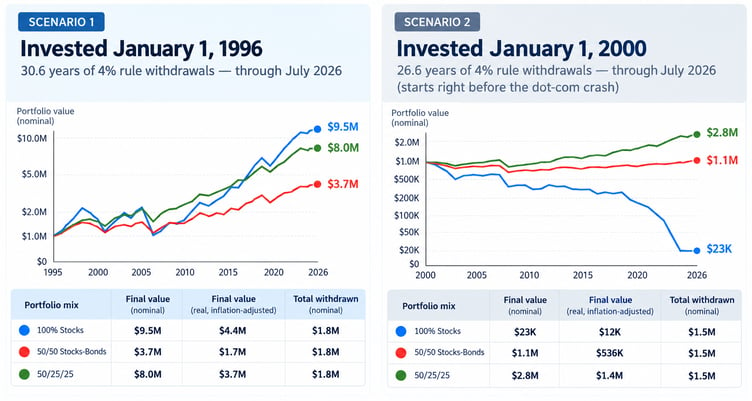
Figures shown are nominal. After adjusting for inflation, the ending values of the 100% stock portfolios are approximately $4.4 million for the 1996 start and $12,000 for the 2000 start.
For the 1996 retiree, strong early returns allowed the portfolio to build value before later downturns. After approximately 30.6 years of withdrawals:
|
Portfolio |
Ending value |
Inflation-adjusted |
Total withdrawn |
|
100% stocks |
$9.5m |
$4.4m |
$1.8m |
|
50/50 stocks-bonds |
$3.7m |
$1.7m |
$1.8m |
|
50/25/25 |
$8.0m |
$3.7m |
$1.8m |
The 2000 retiree encountered the dot-com crash almost immediately and later experienced the global financial crisis while continuing to make withdrawals.
After approximately 26.6 years:
|
Portfolio |
Ending value |
Inflation-adjusted |
Total withdrawn |
|
100% stocks |
$23k |
$12k |
$1.5m |
|
50/50 stocks-bonds |
$1.1m |
$536k |
$1.5m |
|
50/25/25 |
$2.8m |
$1.4m |
$1.5m |
The comparison does not establish that one allocation is universally better.
In fact, that is part of the insight.
The 100% stock portfolio finished with the most money for the retiree starting in 1996, yet the same allocation came closest to depletion for the retiree starting in 2000.
The allocation did not change, but the order in which the good and bad years arrived did.
For an expat, there can be another sequence happening at the same time, i.e., exchange rates.
Why can sequence risk be greater for expats?
Sequence risk can be greater for expats when retirement income and investments are held in currencies different from the currency used for everyday spending.
A retiree who remains in their home country may receive income, hold assets and pay most expenses in the same currency.
An expat might instead have:
- investments primarily valued in US dollars;
- a pension paid in British pounds;
- property income in another currency; and
- rent, groceries and healthcare paid in euros, Thai baht or another local currency.
The portfolio does not only need to withstand market movements but also has to convert into enough local currency to pay the retiree's bills.
That can create additional pressure if an unfavorable exchange rate movement coincides with poor investment returns, particularly during the first years of retirement.
What happens if markets and your currency fall at the same time?
An expat can face a double hit when investments fall while the currency funding retirement also weakens against the currency being spent.
Suppose an expat's investments are primarily in Currency A while their retirement expenses are paid in Currency B.
Then two events occur during the first years of retirement.
- Markets fall. The investment portfolio is now worth substantially less.
- Currency A weakens. Converting the portfolio into Currency B now buys less local spending power.
The retiree still needs to pay for housing, food, utilities, healthcare and other essential costs.
They may therefore have to sell more of a portfolio that is already down.
Markets and exchange rates may eventually recover. The difficulty is that retirement spending cannot necessarily wait for that recovery.
Assets sold to meet expenses during the downturn are no longer invested when conditions improve.
How can currency movements increase an expat's retirement withdrawals?
Exchange rate movements can increase the effective withdrawal rate from an expat's portfolio even when their local lifestyle and spending have not changed.
Take a simplified example.
Suppose an expat needs 40,000 units of local currency each year.
At an exchange rate of 1:1, that requires 40,000 units from the currency funding the portfolio.
Now assume that funding currency falls 10% against the spending currency.
Approximately 44,444 units of the funding currency would now be required to obtain the same 40,000 units of spending currency, before transaction costs.
The retiree has not taken another holiday, rent has not necessarily increased, they have not increased their standard of living, yet more money has to leave the portfolio.
If the investment portfolio has simultaneously fallen 20% or 30%, the higher withdrawal is being taken from a considerably smaller asset base.
That interaction is what makes currency movements particularly relevant to sequence risk for expats.
Which expats face the greatest currency sequence risk?
Currency sequence risk is most relevant for expats with a significant mismatch between the currencies supporting their retirement and those used to pay essential expenses.
Exposure may be greater when:
- most investments are concentrated in one currency;
- pensions are paid in a currency different from local expenses;
- the retiree relies heavily on portfolio withdrawals;
- a large proportion of local spending is fixed or essential;
- little short-term liquidity is available;
- retirement begins close to a major market downturn; or
- the retiree expects to move between countries and spending currencies.
Consider a British retiree receiving most retirement income in pounds while living somewhere where expenses are denominated in another currency.
The pension payment may remain unchanged in sterling, yet the amount of rent, food and healthcare it buys locally can rise or fall as the exchange rate changes.
The same applies to an American expat relying on a dollar-based investment portfolio abroad.
You should account for not only where to retire but which currencies fund the life you intend to live there.
Does retiring abroad always increase sequence risk?
No. Retiring abroad does not automatically create greater sequence risk because the additional exposure hinges on how income, investments and spending currencies are structured.
An expat whose income, liquid assets and expenses are largely aligned in the same currency may have much less currency mismatch.
Exchange rates can also move favorably.
If the currency funding retirement strengthens against the spending currency, the same overseas lifestyle may require smaller withdrawals from the portfolio.
The risk comes from relying on that outcome.
A retirement plan built around today's exchange rate may look very different if the relevant currency pair moves significantly several years after retirement.
For that reason, currency risk should be considered as a range of possible outcomes rather than assuming current exchange rates will persist.
Can diversification reduce sequence risk for expats?
Diversification can reduce an expat's dependence on the performance of a single market or asset class, although it cannot remove sequence or currency risk.
The 1996 and 2000 comparison illustrates the trade-off.
For the 1996 retiree, the 100% stock portfolio ultimately produced the largest ending balance.
For the 2000 retiree, the diversified 50/25/25 portfolio finished substantially ahead of the all-stock portfolio.
This does not establish 50/25/25 as the better retirement allocation.
It shows that an allocation capable of capturing more upside can also experience greater pressure when substantial losses arrive early and withdrawals have already started.
For expats, diversification may need to be considered alongside:
- where assets are invested;
- the currencies in which investments are valued;
- the currencies in which pensions and other income arrive; and
- where future expenses will occur.
Owning investments denominated in several currencies also does not automatically remove currency risk. The underlying assets and the currency of future spending still matter.
Can flexible withdrawals help expats manage sequence risk?
Flexible withdrawals can reduce pressure on an expat's portfolio when poor market returns or unfavorable currency movements make withdrawals unusually expensive.
Some retirement costs offer little flexibility. Housing, food, healthcare, insurance and utilities still need to be paid. Other expenses may be adjustable.
After a particularly poor market year, a retiree may be able to postpone or reduce spending on:
- major holidays;
- a new vehicle;
- home improvements;
- large gifts; or
- other discretionary purchases.
For an expat, the decision may also be affected by exchange rates.
A large discretionary purchase in the local currency becomes more expensive in portfolio terms when the currency funding retirement has weakened.
Having some flexibility gives the retiree another response besides selling additional investments at an unfavorable time.
Should expats hold retirement cash in their spending currency?
Holding some near-term retirement spending in the currency in which expenses will actually be paid can reduce the need to sell investments or make large conversions during unfavorable conditions.
This is not the same as trying to predict the foreign-exchange market.
The purpose is to consider how upcoming expenses will be paid if markets fall while the exchange rate also becomes less favorable.
For example, someone planning to remain in a eurozone country for several years has reasonably foreseeable euro expenses.
Holding some near-term liquidity for those costs may reduce the need to convert assets immediately after a sharp currency movement.
There is still a trade-off.
Holding too little liquidity can increase the likelihood of forced asset sales. Holding too much in cash can reduce long-term growth potential and expose purchasing power to inflation.
Should expats avoid stocks because of sequence risk?
No. Sequence risk does not mean expats should automatically avoid equities, particularly when retirement may last several decades and continued portfolio growth is required.
The 1996 comparison demonstrates the potential benefit of equity growth.
The issue is not that volatility exists. It is what happens when volatility coincides with withdrawals.
A portfolio may perform very well when strong stock market returns occur immediately after retirement and struggle when major losses arrive first.
How can expats prepare for sequence risk before retiring?
Expats can prepare for sequence risk by testing whether their retirement plan can withstand early market losses, unfavorable currency movements and continued withdrawals at the same time.
The value of the portfolio on retirement day is only the starting point.
The 4% withdrawals used in the earlier comparison are useful for illustrating sequence risk. They should not be interpreted as a guaranteed safe withdrawal rate for every retiree.
For expats in particular, the effective withdrawal requirement can increase when retirement assets and spending are in different currencies.
A retirement stress test should therefore examine markets, withdrawals and currencies together.
Conclusion
The bigger lesson from the $1 million comparison is that a retirement plan should not be judged only by how well it performs under average conditions.
For expats, the margin for error can narrow when spending and retirement assets cross currencies. A market decline may reduce the portfolio at the same time that the same overseas expenses require more money to fund.
Retirement planning should account for periods when several unfavorable conditions occur together.
The more room there is to adjust withdrawals, draw on available liquidity or manage currency exposure, the less damage a difficult early sequence may cause.
About me
I'm Adam Fayed. I advise expats and high-net-worth individuals on investments and retirement planning, with clients in more than 100 countries and team members on the ground in places like Singapore and Mauritius. I'm a member of the Chartered Insurance Institute, I've appeared on CNBC, written for Forbes, and many people know me from the money questions I answer on Quora.
What clients say (Trustpilot, 4.7/5, 60 Client Reviews)

“In a distrustful world, Adam provides transparent, professional portfolio guidance. He’s always accessible (phone, WhatsApp) with thorough answers. I have direct portfolio access and easy withdrawals; it’s performed well. I recommend him for realistic, secure growth and peace of mind.”
Paul Isaaksohn
Verified LinkedIn recommendation

Nikolaos Vafeidis
GR · 2 reviews
All you want
Adam treats me like a person, not a portfolio. He takes the time to truly listen, understand my goals, and adapt his advice to my real life—not just market trends. That human approach builds trust and makes every decision feel thoughtful, personal, and aligned with what I actually need. I recommend 100%

Nadia Turgeon
EG · 1 review
Great advisor
Adam was a great advisor to help navigate the world of pension planning when I moved abroad.
Unlike other advisors I have gad, he is very active and passionate about his work and sends a wealth of information on a regular basis that helps me understand the world of personal finances
What happens next
If you're within 10 or 15 years of retiring, or you've already stopped work, it's worth having a second pair of eyes on your plan. Even careful, well-prepared people tell me they don't know what they don't know.
Here's how it works:
- Take the free eligibility quiz. Answer a few short questions to see whether your financial situation, goals and international needs align with Adam Fayed’s specialist advice.
- We review your results. If it looks like I can help, we'll arrange a free call to go through your plan and your options.
- You decide. There's no obligation and no pressure. If working together makes sense, great. If not, you'll still leave with a clearer picture.
FAQs
Can exchange rates affect how long an expat's retirement savings last?
Yes. Exchange rates can change how much an expat needs to withdraw to maintain the same lifestyle abroad.
If the currency funding retirement weakens against the spending currency, the effective withdrawal requirement can increase without any increase in local spending.
Is sequence risk only a problem at the start of retirement?
No, but losses during the early withdrawal years can be particularly damaging. Selling investments after early declines leaves less capital available to participate in a subsequent recovery.
What is the difference between sequence risk and currency risk?
Sequence risk concerns when investment gains and losses occur relative to withdrawals, while currency risk concerns changes in exchange rates.
For an expat, the two can interact when investments fall at the same time as the currency funding retirement weakens.
Can delaying retirement reduce sequence risk for expats?
Delaying retirement changes when withdrawals begin and can provide more time to accumulate assets, but it cannot guarantee a favorable market or currency sequence.
The effect also varies according to spending needs, other retirement income and how long the portfolio will need to provide withdrawals.
The figures in this article are historical simulations, based on 4% first-year withdrawals adjusted for inflation, from January 1996 and January 2000 to July 2026. They are shown before inflation unless stated. Past performance is not a reliable indicator of future results.