Singapore Dependant’s Pass (DP) and Long-Term Visit Pass (LTVP) allow eligible family members of foreign professionals to live in Singapore, but they cover different family relationships and have different eligibility requirements.
The DP is generally for legally married spouses and unmarried children under 21, while the LTVP covers qualifying common-law spouses, stepchildren, adult handicapped children and, subject to a higher salary threshold, parents.
Key Takeaways
- Salary requirements start at S$6,000 per month and rise to S$12,000 when sponsoring a parent under the MOM LTVP route.
- Employment requires separate work authorization because neither pass automatically permits employment.
- Application process is handled by the main pass holder’s employer or appointed employment agent through MOM.
- Pass validity is generally tied to the main EP or S Pass and must be renewed when the relevant requirements continue to be met.
For second residencies that require income, assets, or qualifying investments, we can help structure suitable investment solutions that may align with those requirements, depending on your circumstances.
My contact details are hello@adamfayed.com and WhatsApp +44-7393-450-837 if you have any questions.
The information in this article is for general guidance only, does not constitute financial, legal, or tax advice, and may have changed since the time of writing.
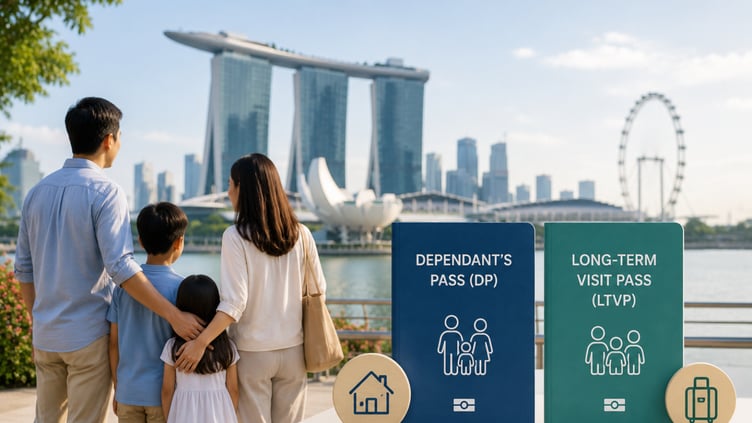
What are the key differences between the Dependant's Pass and Long-Term Visit Pass?
Singapore's Dependant’s Pass is generally for the legally married spouse and unmarried children under 21 of eligible Employment Pass (EP) or S Pass holders, while the Long-Term Visit Pass covers qualifying common-law spouses, stepchildren, adult handicapped children and parents.
The main difference is the type of family relationship covered by each pass.
|
Feature |
Dependant’s Pass |
Long-Term Visit Pass |
|
Main purpose |
Allows eligible spouses and children to join an EP or S Pass holder |
Allows certain other family members to join an EP or S Pass holder |
|
Eligible family members |
Legally married spouse; unmarried children under 21, including legally adopted children |
Common-law spouse; unmarried stepchildren under 21; unmarried handicapped children aged 21 or above; parents |
|
Main pass holder salary |
At least S$6,000 fixed monthly salary |
At least S$6,000; S$12,000 for parents |
|
Who applies |
Employer or appointed employment agent |
Employer or appointed employment agent |
|
Application fee |
S$105 |
S$105 |
|
Issuance fee |
S$225 |
S$225 |
|
Multiple Journey Visa |
S$30, if applicable |
S$30, if applicable |
|
Work rights |
Must obtain a work pass to work for a Singapore employer. The employer can apply for an Employment Pass, S Pass or DP Work Permit, subject to the relevant requirements. |
Must obtain a work pass to work in Singapore. The prospective employer must apply for an Employment Pass, S Pass or Work Permit, and the holder must meet the applicable requirements. |
|
Validity |
Tied to the main work pass or requested duration, whichever is shorter |
Tied to the main work pass or requested duration, whichever is shorter |
Who is eligible for a Dependant’s Pass?
The Dependant’s Pass in Singapore is available to immediate family members of qualifying Employment Pass and S Pass holders.
The sponsoring foreign professional must:
- Hold an Employment Pass or S Pass.
- Earn at least S$6,000 in fixed monthly salary.
- Be sponsored by an established Singapore-registered company, normally the employer.
The family member must be either:
- A legally married spouse; or
- An unmarried child below 21, including a legally adopted child.
Children who are married or have reached 21 generally no longer qualify under the standard Dependant’s Pass category.
Certain other work pass categories, including the Overseas Networks & Expertise Pass and EntrePass, have separate family-member rules.
Who is eligible for a Singapore LTVP?
The standard MOM Long-Term Visit Pass is available to certain family members who do not fall within the Dependant’s Pass category.
For an EP or S Pass holder earning at least S$6,000 per month, the eligible family members generally include:
- A common-law spouse
- An unmarried stepchild under 21
- An unmarried handicapped child aged 21 or above
Parents may also qualify, but the sponsoring EP or S Pass holder must earn at least S$12,000 in fixed monthly salary.
The sponsoring work pass holder's employer must generally be an established Singapore-registered company.
For standard EP and S Pass family applications, the employer or its appointed employment agent submits the application to MOM.
How to get a Dependant’s Pass and LTVP in Singapore?
To get a Dependant’s Pass or LTVP in Singapore, the eligible family member must have the main EP or S Pass holder’s employer or appointed employment agent submit the application to MOM.
The process involves:
- Confirm eligibility — Check that the EP or S Pass holder meets the applicable salary requirements and that the family member qualifies for a DP or LTVP.
- Prepare documents — Provide the required passport details and proof of the family relationship, such as a marriage or birth certificate. Documents not in English must generally be accompanied by an English translation.
- Submit the application — The employer or appointed employment agent submits a separate application for each family member through MOM. The application can be submitted with the main work pass application or separately.
- Await the outcome — MOM processes most DP and LTVP applications for dependants of EP and S Pass holders within three weeks.
- Issue the pass — Once approved, pay the S$225 issuance fee and complete any required formalities. A S$30 Multiple Journey Visa fee may also apply.
How much does it cost to get a Dependant Pass and LTVP in Singapore?
A Dependant’s Pass or MOM-issued LTVP costs S$105 to apply and S$225 to issue, for a total of S$330 per pass, excluding the S$30 Multiple Journey Visa fee where applicable.
The current MOM fees for both passes are:
- S$105 — application fee
- S$225 — issuance fee
- S$30 — Multiple Journey Visa, if applicable
The fees apply per family member, so a spouse and two children would require three separate applications and fees.
Professional or administrative fees charged by an employer, employment agent or immigration adviser are separate.
These fees apply to MOM-issued Dependant’s Passes and LTVPs for eligible family members of EP or S Pass holders.
ICA-issued LTVPs follow different fee structures.
What are the benefits of holding an LTVP and Dependant’s Pass?
The most practical benefits of the LTVP and Dependant’s Pass are the ability to remain in Singapore without relying on short-term visitor status, pursue employment through a separate work authorization, and maintain family status when the main work pass is renewed.
Employment flexibility
A DP or LTVP does not automatically authorize employment, but holders can pursue work by obtaining the appropriate work pass.
DP holders may qualify for an EP, S Pass or DP Work Permit, while LTVP holders generally need their prospective employer to apply for an EP, S Pass or Work Permit.
No foreign worker quota or levy for DP holders
Employers hiring eligible Dependant’s Pass holders are not subject to the foreign worker quota or monthly foreign worker levy that generally applies to Work Permit and S Pass holders.
This can make a DP holder more straightforward to hire in some situations.
Ability to move to an independent work pass
A dependant who secures an Employment Pass or S Pass can hold a work pass independently rather than remaining dependent on the family member's immigration status.
This can provide greater flexibility if the dependant later changes employers or the main pass holder stops working in Singapore.
Family status can continue with the main pass
When the main EP or S Pass is renewed, eligible DP and LTVP holders can generally renew their passes as well, provided they continue to meet the relevant requirements.
This allows the family's immigration arrangements to remain aligned with the main pass holder's employment.
No automatic PR or citizenship
The passes do not provide permanent residence or citizenship, and holding one does not by itself create a PR pathway.
However, a holder who later qualifies under an independent PR category can apply separately through ICA.
Limitations of the Dependant’s Pass and LTVP
The main limitations are restricted work rights, dependence on the main pass holder, no automatic path to permanent residence, and eligibility requirements that must continue to be met.
- No automatic right to work: Neither pass itself authorizes employment. The holder must obtain the appropriate work authorization before starting work.
- Dependent on the main pass holder: The DP or LTVP is linked to the sponsoring EP or S Pass. If the main pass is cancelled or not renewed, the dependant’s status may also be affected.
- No guaranteed PR pathway: Holding a DP or LTVP does not automatically qualify the holder for Singapore permanent residence.
- Renewal is not automatic: Continued eligibility must be met when the pass is renewed, including the applicable requirements for the family relationship.
- Age limits can affect children: Certain family members, particularly children, may stop qualifying when they reach the applicable age threshold.
- Employment options differ: DP holders have specific employment routes available to them, while LTVP holders generally require their prospective employer to obtain an appropriate work pass.
Conclusion
The most important planning point is to look beyond the initial pass approval.
A family may qualify for a DP or LTVP today but face a different immigration position later if a child reaches the age limit, a spouse starts working, or the main pass holder changes employment.
For families expecting a multiyear stay, it can therefore be useful to map out likely status changes in advance rather than treating the DP or LTVP as a fixed arrangement.
This is particularly relevant for families with older children or a spouse who intends to build a career in Singapore.
Planning transitions early can reduce the risk of a dependant suddenly needing to change status, leave Singapore, or secure a new pass under time pressure.
FAQs
Can a Dependant’s Pass holder get a job in Singapore?
Yes, but a Dependant’s Pass does not itself authorize employment.
A DP holder must obtain an appropriate work pass, such as an Employment Pass, S Pass or, where eligible, a DP Work Permit, before starting work.
Is LTVP considered a Dependant’s Pass?
No. An LTVP and Dependant’s Pass are separate Singapore immigration passes with different eligibility requirements.
The DP generally covers a legally married spouse or unmarried child under 21, while the LTVP covers other qualifying family members such as common-law spouses, stepchildren, adult handicapped children and parents.
Can LTVP apply for PR in Singapore?
Yes, an LTVP holder can apply for Singapore PR if they independently qualify under an eligible PR category, but holding an LTVP alone does not create PR eligibility.
For example, an LTVP holder who is the spouse of a Singapore citizen or PR may apply under the relevant spouse category, subject to ICA’s assessment.
Related Articles
- Who Is Eligible For Singapore ONE Pass?
- Singapore Expat Investment Options: Best Investments for Singaporeans Abroad
- Top International Health Insurance for British Expats in Singapore
- Singapore Tax for Expats: Residency and Rates
- Wealth Management for Singapore Expats: How to Grow and Protect Global Assets