Sukuk are Shariah-compliant investment certificates that allow expats in Saudi Arabia to invest and earn returns without relying on interest-based lending.
Often referred to as Islamic bonds, sukuk are structured around ownership of assets, projects, or business activities, making them one of the most widely used halal investment products in the Kingdom.
This article covers:
- Is sukuk really halal?
- What are the common types of sukuk?
- How to buy sukuk in Saudi Arabia as an expat?
- What are the risks of sukuk for expats in Saudi?
Key Takeaways:
- Sukuk are ownership-based investment certificates designed to comply with Islamic finance principles.
- Returns are generated from underlying assets or business activities rather than interest payments.
- Saudi Arabia is one of the world's largest and most active sukuk markets.
- Expats in Saudi can access sukuk through Saudi banks, brokers, investment funds, and wealth management platforms.
My contact details are hello@adamfayed.com and WhatsApp +44-7393-450-837 if you have any questions.
The information in this article is for general guidance only. It does not constitute financial, legal, or tax advice, and is not a recommendation or solicitation to invest. Some facts may have changed since the time of writing.
Why Are Sukuk Popular for Expats in Saudi Arabia?
Sukuk are popular among expats in Saudi Arabia because they offer access to Shariah-compliant investments that can provide portfolio diversification and potentially stable returns.
As one of the world's largest sukuk markets, Saudi Arabia gives expatriates access to a broad range of government and corporate issuances across different sectors.
This makes them particularly attractive to Muslim expats who wish to align their investments with Islamic finance principles.
Many expatriates also use sukuk to balance portfolios that are heavily invested in equities.
Depending on the issuer and structure, sukuk may offer a steadier income stream and lower volatility than stocks, making them a useful component of long-term financial planning.
The Saudi sukuk market has expanded significantly in recent years as government entities and major companies raise capital for infrastructure, development, and business projects.
What is the meaning of sukuk?
Sukuk are financial certificates used in Islamic finance that give investors an ownership interest in an underlying asset, project, or business activity.
The term sukuk comes from the Arabic word sakk, which historically referred to a certificate, deed, or legal document representing ownership rights.
In Saudi Arabia, sukuk are widely used by the government, corporations, and financial institutions to raise capital in a Shariah-compliant manner, making them a common investment option for both local and expatriate investors.
They are also a cornerstone of the Kingdom's economic strategy and the Vision 2030 framework.
Unlike conventional debt instruments, sukuk are structured to link investor returns to the performance or income generated by real economic assets rather than interest payments.
Today, sukuk are issued to finance a variety of projects and activities, ranging from government funding needs and infrastructure development to corporate expansion and business operations.
What are the different types of sukuk?
The main types of sukuk are Ijarah, Murabaha, Musharakah, Mudarabah, Wakalah, and Istisna, each using a different Shariah-compliant structure to generate investor returns.
- Sukuk Ijarah: Based on leasing arrangements and rental income.
- Sukuk Murabaha: Based on cost-plus sale transactions.
- Sukuk Musharakah:Based on partnership and profit-sharing arrangements.
- Sukuk Mudarabah: Based on investment partnerships where profits are shared between investors and managers.
- Sukuk Wakalah: Based on agency agreements where a manager invests assets on behalf of investors.
- Sukuk Istisna: Commonly used for construction and infrastructure projects.
Each structure generates returns through different Shariah-approved mechanisms.
How does investing in sukuk work?
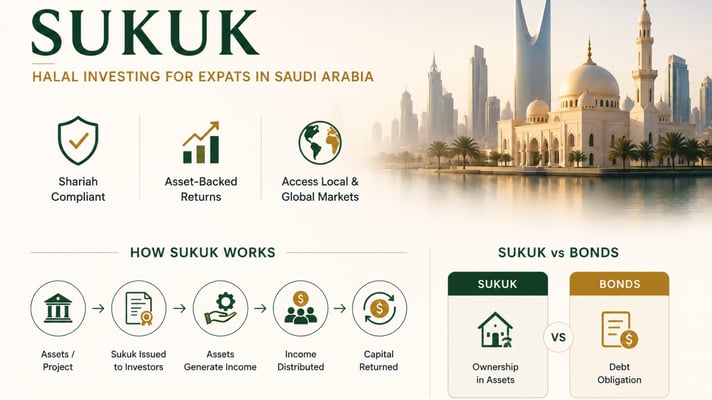
Investing in sukuk allows investors to participate in the income generated by an underlying asset, project, or business activity.
Rather than receiving fixed interest payments, investors earn returns derived from sources such as lease payments, business profits, project revenues, or asset sales.
A typical sukuk transaction generally follows these steps:
- An issuer identifies assets or an investment project.
- Sukuk certificates are issued to raise capital from investors.
- The capital is used to acquire, develop, or finance the underlying assets or activities.
- Income generated by those assets is distributed to investors according to the sukuk structure.
- Upon maturity, the assets are sold, redeemed, or repurchased, and investors receive their capital back.
The specific return mechanism is based on the type of sukuk being used, such as Ijarah (leasing), Musharakah (partnership), or Mudarabah (profit-sharing).
Are sukuk actually halal?
Yes. Properly structured sukuk are generally considered halal because they avoid riba (interest), excessive uncertainty (gharar), and prohibited activities (haram industries).
To better understand sukuk, it helps to distinguish between a few closely related Islamic finance terms:
-
Halal. Halal means permissible under Islamic law.
-
Shariah-Compliant Investments. Shariah-compliant investments follow Islamic principles regarding finance, ownership, risk-sharing, and ethical business activities.
What is the difference between asset-based sukuk and asset-backed sukuk?
Asset-backed sukuk give investors a stronger ownership interest and potential claim over the underlying assets, while asset-based sukuk are mainly supported by the issuer’s payment obligations.
The main difference between asset-based and asset-backed sukuk is the level of investor protection.
For expats in Saudi Arabia investing in sukuk, understanding this difference is important because most sukuk available in the Saudi market are typically asset-based structures, meaning the credit strength of the issuer remains a key factor.
Asset-Based Sukuk
Asset-based sukuk use underlying assets to structure the transaction, but investors usually do not have direct ownership or enforcement rights over those assets.
If the issuer defaults, investors generally rely on the issuer’s ability to repay rather than claiming the underlying assets. As a result, the issuer’s financial strength and credit rating are important considerations.
Asset-based sukuk are widely used in Saudi Arabia and other major sukuk markets because they offer flexibility for governments, banks, and corporations seeking Sharia-compliant financing.
Asset-Backed Sukuk
Asset-backed sukuk provide investors with a stronger ownership interest in the underlying assets.
In the event of default, investors may have rights to the assets supporting the sukuk structure, providing an additional layer of protection compared with asset-based sukuk.
However, asset-backed sukuk are less common because they require a clearer transfer of asset ownership and more complex legal arrangements.
What Sukuk Investments Are Available to Expats in Saudi Arabia?
Expats in Saudi Arabia can access several types of sukuk investments, ranging from government-backed issuances to professionally managed investment funds.
Saudi Government Sukuk
Saudi government sukuk are issued to help finance public spending and development initiatives.
They are generally viewed as one of the lower-risk sukuk investments available in the Kingdom and may appeal to expats seeking relatively stable returns and capital preservation.
Corporate Sukuk
Many Saudi companies and financial institutions issue sukuk to raise capital for business operations and expansion.
Corporate sukuk may offer higher potential returns than government sukuk, although they can also involve greater credit and business risks depending on the issuer.
Sukuk Investment Funds
Sukuk funds pool money from multiple investors and allocate it across a portfolio of sukuk holdings.
These funds can provide instant diversification and professional management, making them a convenient option for expats who prefer not to select individual sukuk issuances.
International Sukuk Funds and ETFs
Expats seeking broader geographic exposure may also invest in international sukuk funds and exchange-traded funds (ETFs).
These investments typically hold sukuk issued by governments and corporations across multiple countries, helping reduce reliance on a single market or issuer.
By combining different sukuk investments, expatriates can build a diversified fixed-income allocation that complements other assets such as equities, real estate, and cash holdings.
Sukuk vs Conventional Bonds: Which Is Better for Expats in Saudi Arabia?
For many expats in Saudi Arabia, sukuk may be the better choice when seeking Shariah-compliant investments or gaining exposure to the Kingdom's growing Islamic capital market.
However, conventional bonds may offer a wider selection of issuers, sectors, and global investment opportunities.
| Feature | Sukuk | Conventional Bonds |
|---|---|---|
| Structure | Ownership interest | Debt obligation |
| Return Source | Asset income or profits | Interest payments |
| Shariah Compliance | Yes | Generally No |
| Asset Requirement | Required | Not required |
| Risk Sharing | Shared between parties | Primarily borrower-lender |
How to buy sukuk in Saudi Arabia
To buy sukuk in Saudi Arabia, expats typically need to open an investment account with a Saudi bank or licensed broker, complete the required compliance checks, and select eligible sukuk investments.
-
Open an Investment Account: Open an account with a Saudi bank, licensed investment firm, or other approved investment platform.
-
Complete KYC and Compliance Checks: Provide the required identification, residency, and financial information to satisfy regulatory requirements.
-
Choose a Sukuk Investment: Select from individual sukuk issuances, sukuk funds, ETFs, or Tadawul-listed sukuk products, depending on availability.
-
Fund the Account and Invest: Transfer funds to the investment account and place the purchase order.
Availability may vary depending on residency status, broker access, and product eligibility requirements.
What is the minimum investment for sukuk?
The minimum sukuk investment for can start from as little as SAR 1,000 for certain Saudi retail sukuk offerings, although requirements vary based on the issuer and investment platform.
Retail sukuk funds may require only a few hundred or a few thousand Saudi Riyals to get started.
Individual sukuk issuances often have higher minimum subscription amounts, while institutional and private placements may require substantially larger investments.
For most expats, sukuk funds and retail sukuk programs are typically the most accessible entry points into the sukuk market.
What are the risks of sukuk for Saudi expats?
The main risks of investing in sukuk include credit risk, market risk, liquidity risk, asset performance risk, and Shariah compliance risk.
- Credit Risk: The issuer may experience financial difficulties.
- Market Risk: Prices can fluctuate as market conditions change.
- Liquidity Risk: Some sukuk issues may be difficult to sell quickly.
- Interest Rate Environment Risk: Although sukuk do not pay interest, their market value can still be affected by broader rate movements.
- Asset Performance Risk: Returns depend on the performance of underlying assets or business activities.
- Shariah Compliance Risk: Interpretations of Shariah standards can vary between jurisdictions and scholars.
What Tax Considerations Should Expats Know Before Investing in Sukuk?
The main tax considerations for expats investing in sukuk are how income distributions, capital gains, and foreign investment reporting obligations are treated in their home country.
Saudi Arabia generally does not impose personal income tax on investment income for most individuals, but expats may still face tax obligations in their home jurisdictions.
Depending on the applicable tax rules, sukuk income may be subject to income tax, withholding tax, or capital gains tax. Some countries also require foreign investment holdings and income to be reported annually.
Double tax treaties may help reduce the risk of being taxed twice on the same income, although the available relief varies by jurisdiction.
Cross-border tax advice is often advisable before making significant investments.
Conclusion
Sukuk represent more than just a Shariah-compliant alternative to conventional bonds.
For expats in Saudi Arabia, they provide a way to participate in the Kingdom’s expanding capital markets while aligning investments with Islamic finance principles.
However, the key to using sukuk effectively is understanding what is actually being invested in.
The presence of an underlying asset does not always mean investors have direct ownership rights, and factors such as issuer strength, sukuk structure, liquidity, and tax treatment can significantly affect outcomes.
For expats building long-term wealth in Saudi Arabia, sukuk can serve as a strategic portfolio component rather than a standalone solution.
When combined with other investments and selected based on individual objectives, they can provide diversification, potential income, and exposure to one of the world’s most developed Islamic finance markets.
FAQs
Which is the largest sukuk market in the world?
Malaysia is generally regarded as the largest sukuk market in the world, reportedly accounting for approximately 36% of global outstanding sukuk.
Can non-Muslims invest in sukuk?
Yes. Sukuk are available to both Muslim and non-Muslim investors.
The investment structure is based on Islamic finance principles, but ownership is not restricted by religion.
Can expats invest in the Saudi stock market?
Yes. Many expatriates can invest in Saudi-listed securities through eligible investment accounts, subject to applicable regulatory and brokerage requirements.
What is sukuk commonly known as?
Sukuk are commonly known as Islamic bonds, although they are technically ownership-based investment certificates rather than traditional debt securities.
Why can't Muslims invest in bonds?
Muslims generally cannot invest in traditional bonds because bondholders earn interest, which is considered riba and prohibited under Islamic law.
Sukuk were developed as a Shariah-compliant alternative that generates returns from underlying assets or business activities rather than interest payments.
Related Articles:
- Shariah-Compliant Estate Planning for Expats: Protecting Wealth Across Borders
- Shariah Compliant Investments in Europe: Halal Stocks, Islamic Banks & Risk Guide
- Islamic Finance Portugal: Halal Banking and Investment Guide
- Top Islamic Investments in Singapore: Halal Portfolio Guide
- Islamic Investments UK: Top Halal Options