Prenuptial agreements are recognized in countries including the US, the UK, Canada, Australia, France, Germany, Spain, Italy, the Philippines and the Netherlands.
However, their enforceability and the financial arrangements couples can establish vary under each country's marriage and family laws.
Key Takeaways
- Prenuptial agreements are recognized in many countries, but legal enforceability varies.
- Some jurisdictions allow broad financial agreements, while others limit couples to specific matrimonial property regimes.
- Financial disclosure, independent legal advice and notarization can affect a prenup's validity.
- International couples should consider cross-border recognition and applicable laws when protecting assets.
Email hello@adamfayed.com if you have any questions.
The information in this article is for general guidance only. It does not constitute financial, legal, or tax advice, and is not a recommendation or solicitation to invest. Some facts may have changed since the time of writing.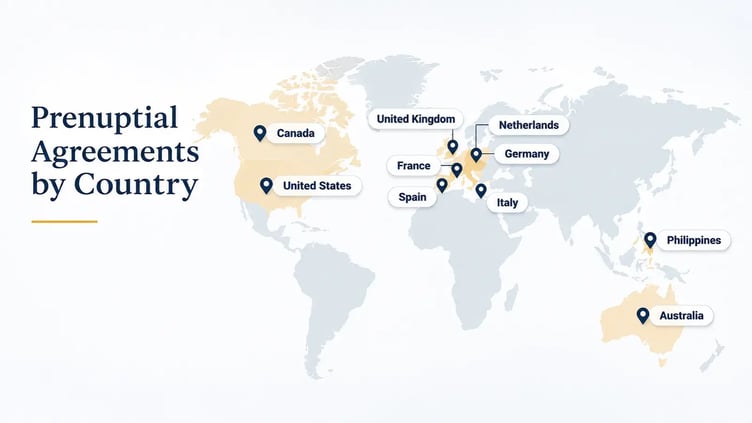
Which countries recognize prenuptial agreements?
Prenuptial agreements are recognized in the US, UK, Canada, Australia, France, Germany, Spain, Italy, the Philippines and several other countries.
However, the extent of their legal protection depends on domestic family law, formal requirements and the types of provisions couples can include.
Being legally recognized does not necessarily mean every provision of a prenup will be enforceable. Some countries treat these agreements as binding contracts, while others allow courts to review their fairness or apply specific matrimonial property rules.
The following countries provide different legal frameworks for couples seeking to establish financial arrangements before marriage.
|
Country |
Legal recognition and approach |
|
United States |
Recognizes prenuptial agreements, subject to state-specific legislation and enforceability requirements. |
|
United Kingdom |
Courts in England and Wales consider prenups but retain discretion over their enforcement. |
|
Canada |
Recognizes marriage contracts and domestic agreements under provincial and territorial laws. |
|
Australia |
Recognizes binding financial agreements under the Family Law Act 1975. |
|
France |
Allows couples to select a matrimonial property regime through a notarized marriage contract. |
|
Germany |
Allows couples to establish or modify their matrimonial property regime through a notarial marriage contract. |
|
Spain |
Recognizes marriage agreements that establish or modify the applicable matrimonial property regime, subject to regional law. |
|
Italy |
Allows couples to choose a separation-of-property regime or other arrangements permitted by law. |
|
Philippines |
Recognizes marriage settlements that allow future spouses to select their matrimonial property regime. |
|
Netherlands |
Allows couples to establish different matrimonial property arrangements through a marriage contract. |
United States
Prenuptial agreements are recognized throughout the US, although their enforceability is governed by state law.
Many states follow principles established under the Uniform Premarital Agreement Act or similar legislation.
These agreements can address property ownership, asset division, spousal support and financial obligations during marriage or following divorce.
However, courts may refuse to enforce provisions that violate public policy or were obtained through fraud, coercion or inadequate disclosure.
The requirements also differ between states.
California, for example, imposes specific procedural safeguards, including independent legal counsel requirements in certain circumstances.
United Kingdom
In England and Wales, prenuptial agreements are not automatically legally binding.
However, following the Supreme Court's decision in Radmacher v Granatino (2010), courts generally give significant weight to agreements entered into freely by both parties with a full understanding of their implications, unless it would be unfair to uphold them.
The agreement's enforceability may depend on whether both parties received independent legal advice, disclosed their financial circumstances and signed voluntarily.
Scotland has a separate legal framework, so the treatment of prenuptial agreements can differ across the UK.
Canada
Canadian provinces and territories recognize domestic contracts, including marriage agreements that establish financial arrangements between spouses.
These agreements can address property ownership, the division of assets and spousal support, although the rules vary by province.
Courts may set aside agreements in certain circumstances, including inadequate financial disclosure, exploitation of a party's vulnerability or significant procedural unfairness.
Australia
Australia recognizes prenuptial agreements under the Family Law Act 1975, where they are legally referred to as binding financial agreements.
Couples can establish arrangements for property division, financial resources and spousal maintenance before marriage.
Both parties must receive independent legal advice before signing, and the agreement must satisfy the statutory requirements to become binding.
France
France allows couples to choose their matrimonial property regime through a marriage contract executed before a notary.
Available arrangements include separation of property, universal community of property and participation in acquisitions.
Without a marriage contract, the default regime is community of property reduced to acquisitions.
The agreement must be completed before the marriage to establish the chosen regime.
Germany
German law allows couples to modify their default matrimonial property regime through a notarized marriage contract.
The statutory default is community of accrued gains, under which each spouse generally retains ownership of their assets during marriage while the increase in wealth is considered when the regime ends.
Couples can instead agree to separation of property or other legally permitted arrangements.
Spain
Spain recognizes marriage contracts (capitulaciones matrimoniales) through which couples can establish or modify their matrimonial property arrangements.
The default property regime differs across the country.
In many regions, the applicable regime is community of acquisitions, while other regions apply separation of property or have distinct regional rules.
Couples should consider the relevant regional legislation when preparing an agreement.
Italy
Italian couples can choose between the statutory community property regime and separation of property.
The choice can be formalized through a marriage declaration or a notarized agreement, depending on the circumstances.
A separation-of-property regime allows each spouse to retain ownership of assets acquired individually rather than automatically sharing them under the default community regime.
Philippines
The Philippines recognizes prenuptial agreements through marriage settlements under the Family Code.
Future spouses can agree to an absolute community of property, conjugal partnership of gains, complete separation of property or another legally permitted regime.
The agreement must be in writing, signed by both parties and executed before the marriage.
In the absence of a valid marriage settlement, the default regime is absolute community of property.
Netherlands
The Netherlands recognizes prenuptial agreements through a notarial marriage contract (huwelijkse voorwaarden).
Couples can use this agreement to establish a matrimonial property arrangement that differs from the statutory limited community of property regime.
They can, for example, agree to separate their assets or establish other arrangements permitted under Dutch law.
How do prenuptial agreements differ between countries?
Prenuptial agreements differ between countries in their enforceability, permitted financial provisions, disclosure requirements and formalities for signing.
The main differences concern the following areas:
1. Legal enforceability
Some countries treat qualifying prenuptial agreements as binding contracts, while others allow courts to consider the agreement without requiring them to follow every provision.
2. Available matrimonial property regimes
Countries differ in how they divide assets acquired before and during marriage.
Some legal systems allow couples to choose between separation of property and community-based arrangements, while others provide greater contractual flexibility.
The available choices affect how ownership and financial interests are treated during marriage and following divorce.
3. Financial disclosure requirements
Full financial disclosure is an important consideration in many jurisdictions.
Both parties may need to provide accurate information about their assets, liabilities, income and financial interests before signing.
Failure to disclose significant financial information can weaken an agreement's enforceability or provide grounds for setting it aside.
4. Spousal maintenance and support
Some jurisdictions allow couples to establish arrangements for spousal maintenance, while others restrict their ability to waive or limit these rights.
Even where maintenance provisions are permitted, statutory protections may allow courts to intervene in certain circumstances.
5. Requirements for signing
The formalities also vary. Some countries require notarization, while others emphasize independent legal advice, written agreements or specific registration procedures.
An agreement that satisfies the formal requirements in one country may need additional steps to be recognized or enforced elsewhere.
Prenuptial agreement pros and cons
The pros of prenuptial agreements include asset protection, financial clarity and fewer disputes over property, while the cons include legal costs, limited enforceability and potential disagreements between partners.
However, their overall benefits depend on the agreement's terms and whether the relevant courts will enforce it.
Pros of prenuptial agreements
- Asset protection: A prenup can establish how assets acquired before marriage, inheritances, investments and business interests will be treated if the marriage ends.
- Financial clarity: Couples can agree on how they will manage property, debts and other financial responsibilities.
- Business protection: Business owners can establish arrangements intended to prevent personal marital disputes from unnecessarily affecting business ownership or operations.
- Inheritance planning: A prenup can help clarify the treatment of certain inherited assets and family wealth, alongside appropriate estate planning arrangements.
- Reduced disputes: Clearly documented financial arrangements may reduce disagreements over property division during separation or divorce.
Cons of prenuptial agreements
- Limited enforceability: A court may refuse to uphold certain provisions if the agreement does not meet legal requirements or conflicts with public policy.
- Restrictions on financial claims: One spouse may agree to give up certain financial rights, potentially leaving them with fewer resources following divorce.
- Preparation costs: Drafting an agreement that meets the requirements of multiple jurisdictions can involve significant legal fees.
- Potential relationship tensions: Discussions about asset division and financial protection can create disagreements before marriage.
- Changing circumstances: An agreement that was reasonable when signed may become unsuitable following major changes in wealth, family responsibilities or financial circumstances.
A prenup is not a guarantee of complete asset protection.
Its effectiveness depends on careful drafting, compliance with applicable laws and consideration of the couple's long-term financial circumstances.
Conclusion
A prenuptial agreement is also a way to establish financial independence within a marriage, particularly when one or both spouses have significant assets, business interests or family wealth.
For couples with international financial ties, the choice of jurisdiction and legal structure can have implications beyond the marriage itself.
Rather than treating a prenup as a standard legal formality, it should be approached as a deliberate financial arrangement that reflects the couple's ownership interests, wealth distribution and estate planning priorities.
The objective is to establish a clear legal foundation for those interests, with appropriate consideration of the laws governing the marriage and the assets involved.
FAQs
Does a prenup protect you 100%?
No. A prenup cannot guarantee complete asset protection, as courts may invalidate agreements involving coercion, inadequate financial disclosure or terms that violate applicable laws.
Its enforceability also depends on the jurisdiction and the specific provisions included.
Do Muslims get prenups?
Yes. Muslim couples can enter into prenuptial agreements covering asset ownership, financial responsibilities and property division, provided the terms comply with applicable laws and Islamic principles.
However, the mahr, a financial obligation from the husband to the wife under an Islamic marriage contract (nikah), is not equivalent to a conventional prenup because it does not automatically determine how marital assets are divided or other financial claims are settled.
What two countries do not allow divorce?
Vatican City and the Philippines are commonly cited as countries where divorce is generally unavailable.
However, the Philippines permits divorce for Muslim marriages under the Code of Muslim Personal Laws and recognizes certain foreign divorces involving Filipino citizens.
Related Articles
- International Prenup Agreements: Protect Assets Before Saying “I Do”
- Remarrying Abroad? What a Prenup Can and Cannot Protect
- How to Protect Your Assets From Divorce
- Expat Divorce and Asset Division: A Guide for HNWIs
- Prenup vs Offshore Trust: Which is Better for Wealth Protection?
- Expat Guide to Protecting Wealth Before Marriage
- How does divorce affect your finances if you’re living abroad?