Setting up a holding company in Singapore involves incorporating a private limited company, meeting local compliance requirements, and structuring it to hold shares or investments.
Singapore’s low taxes, foreign ownership flexibility, and strong legal framework make it one of the most efficient jurisdictions for holding structures.
This article covers:
- Why do companies choose Singapore?
- How to properly set up a holding company?
- Are holding companies taxed in Singapore?
- Does a holding company need a bank account?
- What is the downside of holding companies?
Key Takeaways:
- Singapore holding companies benefit from low taxes and no capital gains tax.
- Foreigners can own 100% but need a local resident director.
- Bank accounts are required for managing dividends and investments.
- Compliance with local director, office, and reporting requirements is essential to maintain tax exemptions and avoid penalties.
My contact details are hello@adamfayed.com and WhatsApp +44-7393-450-837 if you have any questions. We also offer bespoke structuring solutions tailored to your situation.
The information in this article is for general guidance only, does not constitute financial, legal, or tax advice, and may have changed since the time of writing.

Why set up a holding company in Singapore?
Singapore offers a combination of tax efficiency, stability, and global credibility that makes it ideal for holding structures.
Its regulatory framework, strong economy, and strategic location make it a preferred base for regional and international investments.
Key advantages include:
- Low corporate tax rate capped at 17% – Singapore’s corporate tax system is straightforward, and exemptions for new companies or qualifying income can reduce the effective tax rate significantly.
- No capital gains tax – Profits from the sale of investments or subsidiaries are generally not taxed, making Singapore attractive for long-term investment holdings.
- Extensive tax treaty network (around 100 countries) – The treaties minimize double taxation and provide favorable withholding tax rates for dividends, interest, and royalties from international investments.
- Political and economic stability – Singapore has a predictable legal and regulatory environment, which reduces risks for international investors and ensures business continuity.
- Strong banking system and global reputation – Access to reliable banking, investment services, and professional networks supports smooth financial operations for holding companies.
Holding companies in Singapore are often used to:
- Own shares in international subsidiaries – Centralizing ownership allows easier management, oversight, and strategic control of investments across multiple countries.
- Centralize dividend flows – A holding company can collect dividends from subsidiaries efficiently, simplifying cash management and reinvestment decisions.
- Hold intellectual property (IP) – Companies often use Singapore to hold IP rights, licensing them to subsidiaries while benefiting from favorable tax treatment and legal protection.
- Facilitate mergers and acquisitions – Singapore-based holding structures simplify corporate reorganizations, cross-border acquisitions, and fundraising by acting as a clear legal entity.
How to create a holding company in Singapore?
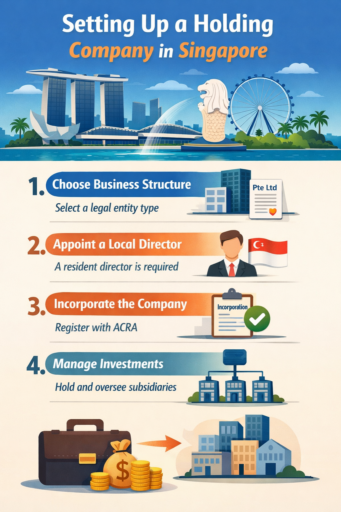
To create a holding company in Singapore, you need to incorporate a private limited company, appoint a local director, register a business address, and set up a corporate bank account to hold and manage investments.
The process is straightforward but requires compliance with local rules and corporate governance standards.
1. Choose a company structure
Most holding companies in Singapore are registered as a Private Limited Company (Pte Ltd), which limits shareholder liability and provides a flexible structure for holding investments.
2. Reserve a company name
You must register your business name with the Accounting and Corporate Regulatory Authority (ACRA).
The name must be unique and approved before incorporation can proceed.
3. Appoint directors and shareholders
-At least one local resident director is required to meet regulatory requirements.
-100% foreign ownership of shares is allowed, making it possible for international investors to fully control the company.
-A minimum of one shareholder is needed, which can be an individual or a corporate entity.
4. Register a local address
A Singapore-registered office address is mandatory for official correspondence and legal compliance. This cannot be a P.O. Box.
5. Hire a corporate secretary
A corporate secretary must be appointed within six months of incorporation to ensure proper corporate governance and statutory record-keeping.
6. Open a corporate bank account
A bank account is necessary to manage dividends, pay expenses, and handle intercompany transfers.
Banks may require in-person verification and supporting documents about the company and its owners.
7. Transfer or acquire assets
After incorporation, the holding company can acquire shares in subsidiaries, manage investments, or hold intellectual property, forming the core of its asset structure.
Can a foreigner set up a company in Singapore?
Yes, foreigners can fully own and control a Singapore holding company, as the country allows 100% foreign ownership across most business structures.
However, there are a few requirements:
- You must appoint at least one local resident director – This director must be a Singapore citizen, permanent resident, or someone holding a valid work pass, ensuring local accountability and compliance.
- You may need to engage a corporate service provider – Many foreign investors rely on incorporation firms to handle registration, compliance, and ongoing administrative requirements efficiently.
- You are not required to live in Singapore – There is no residency requirement for shareholders, allowing you to manage the company remotely while maintaining full ownership.
Foreign investors commonly use nominee director services to meet compliance requirements, especially if they do not have a trusted local partner.
However, it’s important to ensure proper agreements and oversight are in place, as the legal responsibility of the company still applies regardless of ownership structure.
What is the tax rate for holding companies in Singapore?
The tax rate for Singapore holding companies is a flat corporate tax of up to 17%, with exemptions that can significantly reduce the effective rate.
Singapore’s tax system is designed to favor investment holding structures, especially those receiving foreign income.
Key tax features:
- Corporate tax rate: 17% (with exemptions reducing effective rates) – Partial tax exemptions and startup incentives can lower the effective tax rate, particularly for new or smaller companies.
- Dividend income: Generally tax-exempt under the one-tier system. Dividends paid by Singapore companies are not taxed again at the shareholder level, preventing double taxation.
- Foreign-sourced income: May be exempt if conditions are met. Foreign dividends, branch profits, and service income can qualify for tax exemption if they meet specific criteria.
- Capital gains: Not taxed – Gains from selling shares or investments are typically not subject to tax, which is highly beneficial for holding companies.
This makes Singapore especially attractive for holding companies that receive foreign dividends, manage cross-border investments, or plan to exit investments tax-efficiently.
What are the disadvantages of a holding company?
The disadvantages of a holding company in Singapore include substance requirements, compliance costs, banking challenges, and increased tax scrutiny on cross-border structures.
While the jurisdiction is business-friendly, these factors can add complexity and cost if not properly managed.
Common disadvantages include:
- Substance requirements – Authorities increasingly expect companies to demonstrate real economic activity, such as having local directors, employees, or decision-making functions in Singapore.
- Bank account challenges – Opening a corporate bank account can be difficult without a clear business purpose, local presence, or strong supporting documentation.
- Compliance costs – Ongoing obligations like annual filings, bookkeeping, and potential audits can increase administrative expenses over time.
- Local director requirement – The need for a resident director may require nominee arrangements, which can add cost and require careful legal structuring.
- Tax scrutiny – Cross-border holding structures are more closely monitored under global tax rules, especially regarding profit shifting and economic substance.
Alternative jurisdictions for holding companies in Asia
The best alternative jurisdictions to Singapore for setting up a holding company in Asia include Hong Kong, Labuan (Malaysia), and the UAE, each offering different tax, regulatory, and strategic advantages.
These options may be more suitable depending on where your investments are located and how your structure is designed.
Hong Kong
Hong Kong is often compared directly with Singapore due to its low taxes and territorial tax system.
Only locally sourced income is taxed, and foreign-sourced income is often exempt.
It is especially attractive for businesses focused on China or North Asia, although recent regulatory changes have increased scrutiny and substance requirements.
Labuan (Malaysia)
Labuan offers a low-tax offshore regime within Malaysia, with flexible structures for holding and trading companies.
It can be a cost-effective alternative to Singapore, particularly for regional investments, though it has a weaker international reputation compared to Singapore.
United Arab Emirates (UAE)
The UAE, particularly free zones like DIFC or ADGM, is increasingly used for holding companies due to its low or zero tax environment and strong banking infrastructure.
It is well-suited for investors with Middle East, Africa, or global portfolios, though substance and compliance expectations have increased in recent years.
Conclusion
A Singapore holding company is most effective when it is part of a broader strategy, not just a standalone structure.
The real advantage comes from how it is used: aligning tax efficiency with genuine business activity, clear ownership planning, and long-term investment goals.
As global tax rules tighten and substance becomes more important, simply setting up in a low-tax jurisdiction is no longer enough.
Investors who combine proper structuring with real economic presence and compliance are the ones who benefit most from what Singapore offers.
There is no single best jurisdiction for a holding company in Asia.
Singapore stands out for its balance of tax efficiency, credibility, and stability, but the optimal choice depends on where your investments are located, how income flows, and how much substance you can realistically maintain.
FAQs
Is Singapore still a tax haven?
Singapore is not considered a traditional tax haven.
While it is a low-tax jurisdiction, it is highly regulated, requires local substance for companies, and complies with international transparency and reporting standards unlike traditional tax havens that allow secrecy and minimal oversight.
Does Singapore tax foreign income?
Foreign income is generally not taxed in Singapore unless it is remitted into the country.
However, exemptions often apply if:
-The income was taxed in the source country
-The foreign tax rate is at least 15%
-The exemption is beneficial to the taxpayer
What is another name for a holding company?
A holding company is also commonly called a parent company or an investment holding company.
It refers to a business that primarily owns shares or assets of other companies rather than conducting its own operations.
Pained by financial indecision?

Adam is an internationally recognised author on financial matters with over 830million answer views on Quora, a widely sold book on Amazon, and a contributor on Forbes.