Non-residents can legally establish a UK company, allowing foreign entrepreneurs to register and operate a private limited company while managing their business from abroad.
This makes the UK an attractive option for international business due to its stable legal system, access to global markets, and straightforward company registration process.
This article covers:
- Which law governs UK companies?
- How much does it cost to start a company in the UK?
- Can a non-UK resident start a UK company?
Key Takeaways:
- Non-residents can legally own and run a UK limited company.
- UK company formation is fast and can often be completed online within 24 hours.
- Corporate tax residency and compliance obligations must be carefully managed from abroad.
- Setup costs range from £100 to £500, and a private limited company can be formed with £1 in share capital.
My contact details are hello@adamfayed.com and WhatsApp +44-7393-450-837 if you have any questions. We also offer bespoke structuring solutions tailored to your situation.
The information in this article is for general guidance only, does not constitute financial, legal, or tax advice, and may have changed since the time of writing.

Can I Setup a Company in the UK Without Residency?
Yes, you can set up a company in the UK without residency, and you do not need to be a UK citizen to do so.
The UK does not restrict company formation based on nationality, meaning foreigners can legally register and own a UK limited company.
There is no requirement for directors or shareholders to live in the UK, making it one of the most accessible jurisdictions for international entrepreneurs.
However, every company must maintain a registered office address within the UK to receive official correspondence from Companies House and tax authorities.
While incorporation can usually be completed online within 24 hours, non-residents should also consider practical matters such as corporate tax residency, ongoing compliance obligations, and banking requirements.
Even though physical presence is not required to form the company, where the business is managed and controlled may affect its tax position.
Overall, the UK offers a straightforward and globally recognized company formation process for non-residents, provided all statutory and reporting requirements are properly maintained.
What Are the Requirements to Register a Company in the UK?
To register a private limited company in the UK, the required officers must be appointed, a registered office address must be provided, and incorporation documents must be submitted to Companies House.
Specifically, you need:
- At least one director (can be non-resident)
- At least one shareholder
- A UK registered office address (can be provided by formation services)
- Memorandum and Articles of Association
- A company name that is unique and complies with UK naming rules
These requirements apply equally to UK residents and non-residents, making the incorporation process straightforward as long as all statutory information is properly submitted.
How Much Money Is Required to Open a Company in the UK?
The cost to open a UK private limited company typically ranges from £100 to £500, with lower fees for direct registration with Companies House and higher fees when using a non-resident formation package.
The official Companies House incorporation fee is £100 for standard online registration and £156 for same-day digital registration.
Under UK company law, there is no statutory minimum share capital requirement, so a company can legally be incorporated with as little as £1 in nominal share capital.
Non-resident formation packages, which often include a registered office, service address, mail forwarding, and support, cost £100–£500, depending on the services included.
Even though the legal minimum capital is low, you should also budget for ongoing costs such as:
- Annual confirmation statements and filing fees
- Accounting and tax compliance services
- Virtual office or registered office services
- Business banking setup fees
What Laws Do UK Companies Have to Comply With?
UK companies must comply with the Companies Act 2006, which governs company formation, director duties, shareholder rights, and statutory reporting obligations, as well as HMRC corporation tax regulations that require companies to report profits and pay taxes annually.
These legal frameworks form the backbone of UK corporate compliance. In practice, companies must:
- File annual accounts and a confirmation statement with Companies House
- Register for and pay corporation tax with HMRC
- Comply with VAT rules if taxable turnover exceeds the threshold
- Follow employment laws if hiring staff
- Adhere to UK GDPR and data protection regulations when handling personal data
Failure to meet these obligations can result in financial penalties, late filing fines, strike-off proceedings, or director disqualification.
These compliance requirements apply equally to resident and non-resident company owners.
Can I Open a Business Bank Account in the UK as a Non-Resident?
Opening a UK business bank account as a non-resident is possible but can be challenging.
Banks typically require:
- Proof of identity for directors
- UK registered office address
- Company incorporation documents
- Some banks may require a personal visit, while others accept remote verification through fintech solutions
Non-resident packages often provide guidance or introductions to banks that accommodate foreign business owners.
What Are the Benefits of Registering a Company in the UK?
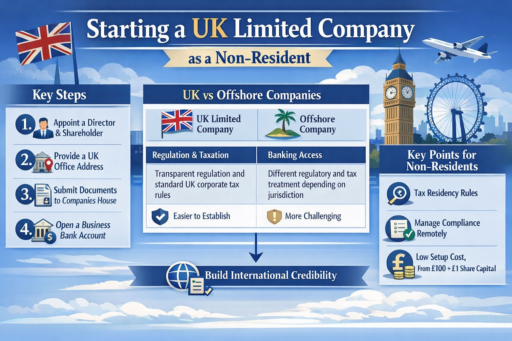
Registering a UK private limited company provides foreign entrepreneurs with market access, legal credibility, and a low-cost startup framework.
Key advantages include:
- Access to the UK and EU markets – A UK company can trade freely within the UK and, in some cases, benefit from trade agreements that make EU or international business easier.
- Enhanced credibility with customers and business partners – A registered UK company signals professionalism and reliability, helping to build trust with clients, suppliers, and investors.
- Low startup costs and no minimum capital requirement – Incorporation is inexpensive, and there is no statutory minimum share capital, making it accessible for startups and small businesses.
- Simple corporate structure and straightforward accounting rules – UK companies enjoy a clear legal framework, minimal bureaucracy, and relatively easy-to-follow accounting and reporting requirements.
- Potential tax benefits depending on business structure and residency – Certain allowances, deductions, or tax planning opportunities may be available depending on whether the company is managed in the UK or abroad.
What Are Common Challenges for UK Companies?
Non-resident entrepreneurs often face challenges such as opening a UK bank account remotely and navigating complex tax and VAT obligations when running a company from abroad.
These include:
- Opening a bank account remotely – Many UK banks require in-person identity verification, making it difficult for non-residents to access banking services without specialist support or fintech alternatives.
- Understanding UK tax and VAT obligations – Foreign directors must comply with corporation tax, VAT registration, and HMRC reporting rules, which can be complex without local guidance.
- Ensuring compliance with Companies House filing deadlines – Annual accounts, confirmation statements, and other mandatory filings must be submitted on time to avoid penalties or fines.
- Managing the business from abroad – Coordinating operations, staff, and UK service providers remotely requires careful planning and reliable local partners to ensure smooth management.
UK Limited Company vs Offshore Company Structures
A UK limited company offers greater regulatory transparency and global credibility, while offshore company structures typically emphasize tax neutrality and privacy.
Although both allow 100% foreign ownership, they differ significantly in compliance requirements, banking access, and international perception.
A UK limited company operates within a well-established legal system and is subject to corporation tax, public filings with Companies House, and defined reporting standards.
This transparency generally improves trust with banks, payment processors, investors, and commercial partners.
In contrast, many offshore company structures such as those formed in jurisdictions like the British Virgin Islands or Seychelles, are commonly used for asset holding or tax planning.
While they may offer low or zero corporate tax, they can face heightened scrutiny from financial institutions, which may make opening and maintaining bank accounts more complex.
For entrepreneurs focused on active trading, reputation, and long-term scalability, a UK limited company often provides stronger institutional acceptance.
Offshore structures may be more suitable for holding assets or structuring international investments rather than operating a mainstream commercial business.
Conclusion
Starting a business in the UK as a foreigner provides a reliable legal framework and access to a globally recognized business environment.
While incorporating is straightforward, success depends on effectively managing challenges such as banking, taxation, and regulatory compliance from abroad.
Leveraging professional formation services or non-resident packages can simplify these processes and free you to focus on growth.
With careful planning, a UK company can become a strong foundation for international credibility, operational efficiency, and long-term expansion.
FAQs
Is it hard to set up a limited company in the UK?
Not really. With the right guidance and possibly a non-resident formation package, registering a UK limited company is straightforward.
How to qualify as a non-UK resident?
You are generally considered a non-UK resident if you spend fewer than 183 days in the UK during a tax year.
Under the UK Statutory Residence Test, you may also be non-resident if you spend fewer than 16 days in the UK (or 46 days if you haven’t been a UK resident in the previous three years), or if you work full-time abroad and spend fewer than 91 days in the UK, with no more than 30 days working.
Can a foreign company operate in the UK?
Yes. Foreign companies can either set up a UK branch or register a separate UK limited company.
Can I run my UK business from abroad?
Yes. Many non-resident business owners manage their UK companies remotely using online tools, accountants, and company formation agents.
Pained by financial indecision?

Adam is an internationally recognised author on financial matters with over 830million answer views on Quora, a widely sold book on Amazon, and a contributor on Forbes.