UAE company formation cost in 2026 ranges from AED 5,750 to AED 60,000+ in the first year, based on whether you establish a mainland, free zone, or offshore company.
The total investment is determined by your license category, number of visas, office space requirements, and the emirate where the business is registered.
This article covers:
- What are the different types of businesses you can start?
- How much does it cost to establish a company in UAE?
- How much is company tax in the UAE?
- Which part of the UAE is the cheapest for forming companies?
- What are the advantages of having a company in Dubai?
Key Takeaways:
- UAE company formation cost starts as low as AED 5,750 for basic free zone setups.
- Corporate tax is 0% up to AED 375,000 and 9% above that threshold.
- Free zones offer the lowest entry cost and 100% foreign ownership.
- Mainland companies cost more but allow full UAE market access.
My contact details are hello@adamfayed.com and WhatsApp +44-7393-450-837 if you have any questions. We also offer bespoke structuring solutions tailored to your situation.
The information in this article is for general guidance only, does not constitute financial, legal, or tax advice, and may have changed since the time of writing.

How many types of companies are there in the UAE?
There are five main types of companies in the UAE: Sole Establishment, Limited Liability Company (LLC), Joint Stock Company (JSC), Free Zone Company (FZE/FZCO), and Offshore Company.
Each structure serves different business sizes, ownership preferences, and operational goals.
1. Sole Establishment
A Sole Establishment is owned by one individual and is commonly used for professional services.
- 100% foreign ownership allowed for most professional activities
- Owner has unlimited personal liability
- Suitable for consultants, freelancers, and service providers
2. Limited Liability Company (LLC)
An LLC is the most common business structure in the UAE, particularly for small and medium-sized enterprises.
- Shareholders’ liability is limited to their capital contribution
- Can operate in mainland UAE
- Eligible for government contracts
- Requires a registered office address
- 100% foreign ownership allowed for most activities
Most mainland companies in emirates like Dubai and Abu Dhabi are formed as LLCs.
3. Joint Stock Company (JSC)
A Joint Stock Company is designed for larger businesses that require substantial capital.
There are two types:
- Private Joint Stock Company
- Public Joint Stock Company (can be listed on a stock exchange)
- Suitable for large-scale enterprises
- Requires higher minimum capital
- Used for expansion and capital raising
4. Free Zone Company (FZE / FZCO)
Free zone companies are incorporated within designated economic zones such as:
Common forms:
- FZE (single shareholder)
- FZCO (multiple shareholders)
Key features:
- 100% foreign ownership
- Simplified registration process
- Lower startup costs
- Cannot directly trade in mainland without a distributor or branch
5. Offshore Company
Offshore companies are primarily used for:
- International trade
- Holding assets or shares
- Tax structuring
They:
- Cannot conduct business within the UAE market
- Do not qualify for UAE residency visas
- Are commonly used for international holdings
How much does it cost to set up a company in the UAE?
A basic UAE company formation cost in 2026 usually starts from about AED 5,750 for a minimal free zone setup and can reach AED 60,000 + for a fully-operational mainland company in the first year.
These figures reflect common government fees, workspace and visa expenses across free zones and mainland jurisdictions.
1. Trade License Fee
- Free zone trade license: ~AED 5,750 – 15,000 (budget zones) up to ~AED 18,000+ (tier-1 zones)
- Mainland trade license: ~AED 10,000 – 25,000+ depending on activity category
2. Registration & Government Fees
- Name reservation, initial approval & incorporation: ~AED 1,000 – 3,000
3. Office Space / Flexi Desk
- Free zone flexi-desk or shared workspace: ~AED 5,000 – 15,000
- Mainland physical office lease (Ejari): ~AED 15,000 – 40,000+ per year
4. Visa Costs (Per Person)
- Residence visa processing (stamp, entry, status): ~AED 3,000 – 7,500 each
5. Medical, Emirates ID & Immigration Card
- Medical test + Emirates ID + immigration card combined: ~AED 1,500 – 3,000 per visa holder
Typical first-year cost scenarios
- Low-budget free zone setup (no visa): ~AED 6,000 – 10,000
- Free zone with 1 visa: ~AED 12,000 – 30,000
- Mainland with office + visas: ~AED 30,000 – 60,000+
Note: Some free zones offer flexible or lower pricing in emirates like Sharjah, Ajman, or Ras al Khaimah for lean startups, while prime locations such as Dubai and Abu Dhabi tend to be more expensive.
How much tax do I pay if I have a company?
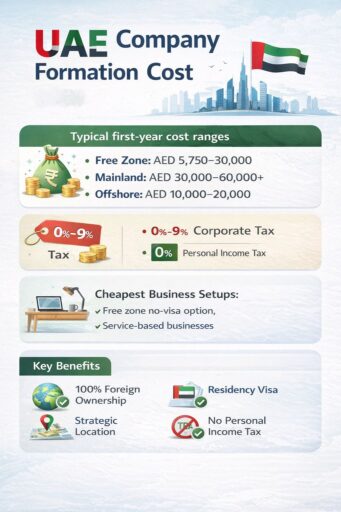
For a company in the UAE, corporate tax is 0% on profits up to AED 375,000 and 9% on profits above that threshold, as per KPMG.
VAT and personal income tax rules also apply.
Corporate Tax
- 0% on profits up to AED 375,000
- 9% on profits above AED 375,000
Certain qualifying free zone companies may still benefit from 0% corporate tax on qualifying income.
VAT
- 5% VAT applies if annual taxable turnover exceeds AED 375,000
Personal Income Tax
- 0% (No personal income tax in UAE)
Which is the cheapest business registration in UAE?
The lowest-cost business registration in the UAE is a free zone company without a visa, with first-year fees starting from AED 5,750.
These setups are ideal for entrepreneurs or freelancers who want to start a business with minimal upfront investment.
They are typically established in cost-effective free zones such as:
- RAKEZ
- Sharjah Media City
These low-cost packages generally include a business license, access to a shared workspace (flexi-desk), and do not come with a visa quota.
While they allow registration and legal business operations within the free zone, these companies cannot directly trade in the mainland UAE without appointing a local distributor or opening a branch.
What is the cheapest business to start in the UAE?
The cheapest businesses to open in the UAE are service-based ventures that require little to no inventory, minimal office space, and low initial investment.
Examples include:
- Digital marketing agency
- IT consulting
- Social media management
- Business consultancy
- E-commerce (dropshipping model)
These businesses can often be launched under a free zone consultancy license, allowing entrepreneurs to begin operations with minimal overhead and simplified setup requirements.
What are the benefits of registering a company in UAE?
Registering a UAE company provides tax advantages, full foreign ownership in most sectors, and access to a strategic business hub with residency opportunities.
Key benefits include:
- 100% Foreign Ownership
Now allowed for most activities in both mainland and free zones. - Low Corporate Tax
Only 9% on profits above AED 375,000. - Strategic Global Location
Serves as a gateway between Europe, Asia, and Africa. - Strong Banking & Financial Infrastructure
Offers an internationally connected banking system. - Residency Visa Access
Company formation can qualify investors and employees for UAE residency. - No Personal Income Tax
A major advantage for entrepreneurs relocating to the UAE.
What are the challenges of doing business in UAE?
The main challenges of doing business in the UAE include high renewal and setup costs, strict banking and regulatory requirements, mandatory office space for mainland companies, and intense market competition.
Key considerations include:
- Ongoing Renewal Costs
Licenses and visas must be renewed annually. - Banking Compliance
Corporate bank account approval can be strict. - Office Requirements
Mainland companies must maintain physical office space. - VAT & Corporate Tax Compliance
Businesses must maintain proper bookkeeping and reporting. - Market Competition
Competition is intense, especially in saturated sectors like trading and consulting.
Free Zone vs Mainland vs Offshore: Costs, Ownership, and Business Access
Free zone companies are generally the cheapest and fastest to set up, mainland companies cost more but allow full UAE market access, and offshore companies are mainly for international business and asset holding.
Free zone entities cannot trade directly in the UAE mainland but can operate there legally by appointing a licensed distributor or opening a mainland branch.
Each setup differs in ownership rights, licensing requirements, visa eligibility, office needs, and operational flexibility, making jurisdiction choice a key factor in long-term business planning.
| Feature | Free Zone | Mainland | Offshore |
| Ownership | 100% foreign | 100% foreign for most activities | 100% foreign |
| Market Access | Limited; can operate in mainland via distributor or branch | Full UAE mainland access | Cannot trade in UAE |
| Corporate Tax | 0% on qualifying income | 0% up to AED 375,000; 9% above | Depends on jurisdiction and structure |
| Setup Cost (AED) | 5,750 – 30,000 | 30,000 – 60,000+ | 10,000 – 20,000 |
| Visa Eligibility | Usually 1–5 visas | Multiple visas depending on business size | No UAE visa |
| Office Requirement | Flexi-desk or small office | Physical office required | No office in UAE |
Key Insights:
- Free Zone: Ideal for low-budget startups, service-based businesses, and international ventures not immediately targeting the mainland market.
- Mainland: Suited for businesses seeking full market access, government contracts, and broader credibility, despite higher setup costs.
- Offshore: Best for international trading, asset protection, or tax planning, with limited operational presence in the UAE.
Conclusion
Establishing a company in the UAE requires careful consideration of both cost and long-term business strategy.
Low-cost free zone options make it possible to enter the market with minimal upfront investment, but companies must evaluate how jurisdiction, licensing, and operational requirements affect growth potential.
Mainland setups, while more expensive, provide broader market access and credibility, which can be critical for scaling operations.
Strategic planning around compliance, banking, and workspace ensures that setup costs translate into operational efficiency rather than unexpected obstacles.
By leveraging the UAE’s tax advantages, strong financial infrastructure, and global connectivity, businesses can build a flexible foundation that supports sustainable growth and regional expansion.
FAQs
What is the difference between Ltd and LLC in UAE?
In the UAE, an LLC (Limited Liability Company) is the standard legal structure for mainland businesses.
Ltd is not commonly used; free zone companies typically register as FZE, FZCO, or similar entities.
Can you own 100% of a company in Dubai?
Yes. Since regulatory reforms, most activities allow 100% foreign ownership in both mainland and free zones in Dubai.
However, certain strategic sectors may still require local involvement.
What business can start with 10k in UAE?
With AED 10,000, it is possible to start a small business in the UAE such as a free zone consultancy, e-commerce store, or online service company.
This budget generally covers the license, registration, a flexi-desk, and basic administrative fees.
Can a free zone company do business in the mainland, UAE?
A free zone company cannot trade directly in the UAE mainland. To operate there, it must either appoint a mainland distributor or open a mainland branch.
How long does it take to register a company in the UAE?
Registering a company in the UAE typically takes 3–7 working days for a free zone and 7–14 working days for a mainland setup.
Timelines may be longer if additional government or banking approvals are required or if the business activity is complex.
Pained by financial indecision?

Adam is an internationally recognised author on financial matters with over 830million answer views on Quora, a widely sold book on Amazon, and a contributor on Forbes.