Starting a business in the United Kingdom or the United Arab Emirates involves choosing between two globally recognized jurisdictions with very different advantages—one focused on credibility and financial access, the other on tax efficiency and strategic location.
Comparing UK vs UAE company formation across factors such as company structures, setup requirements, costs, taxes, and timelines, can help entrepreneurs decide which jurisdiction best aligns with their business goals.
This article covers:
- What is the better country to start a company?
- What are the types of companies in UAE?
- What are the types of companies in the UK?
- What are the requirements to open a company in the UK?
- What documents are required to open a company in UAE?
- How much does it cost to set up a company in UAE?
- How much is it to start a company in the UK?
Key Takeaways:
- UK companies are cheaper and faster to register, often within 24 hours.
- UAE companies offer lower corporate taxes, currently around 9% on qualifying profits.
- The UK provides stronger global credibility and financial infrastructure.
- The UAE offers residency options and strategic access to Middle East, Africa, and Asia markets.
My contact details are hello@adamfayed.com and WhatsApp +44-7393-450-837 if you have any questions. We also offer bespoke structuring solutions tailored to your situation.
The information in this article is for general guidance only, does not constitute financial, legal, or tax advice, and may have changed since the time of writing.

Why Entrepreneurs Compare Company Formation in the UK vs UAE
Entrepreneurs compare company formation in the United Kingdom and the United Arab Emirates because both jurisdictions are among the world’s most active business hubs but offer different strategic advantages.
The UK has one of the largest corporate ecosystems globally, with more than 5.6 million active companies and roughly 800,000 new businesses formed each year on the national register.
This scale reflects a mature business environment supported by strong legal protections, access to international finance, and a globally recognized corporate reputation.
The UAE, meanwhile, has rapidly positioned itself as a global entrepreneurship hub thanks to pro-business regulations, tax advantages, and modern infrastructure.
Cities such as Dubai and Abu Dhabi host a fast-growing startup ecosystem, with thousands of international companies and more than 5,600 startups operating in the country.
Foreign founders are increasingly attracted to the Emirates.
For example, over 2,500 UK companies registered in Dubai in 2024 alone, bringing the total number of British firms operating in the UAE to more than 5,000.
What types of companies are there in the UK and UAE?
The United Kingdom and the United Arab Emirates offer several company structures, with the most common being Private Limited Companies in the UK and Free Zone or Mainland LLC companies in the UAE.
Both jurisdictions provide multiple legal structures depending on ownership, liability, and business activity.
UK company types
The most common company structures in the UK include:
- Private Limited Company (Ltd)
The most popular structure for startups and international founders. Shareholders’ liability is limited to their share capital. - Public Limited Company (PLC)
Suitable for large companies planning to raise capital through public markets. - Limited Liability Partnership (LLP)
Common for professional services firms such as law or accounting partnerships. - Sole Trader
A simple structure for freelancers or individual entrepreneurs.
Most overseas founders choose the Private Limited Company, which can be registered with Companies House.
UAE company types
The UAE offers several company structures depending on whether a business operates in the mainland or within a designated free zone.
- Mainland Limited Liability Company (LLC)
Allows businesses to operate across the UAE market and work directly with the local economy. - Free Zone Company
Companies established in free zones can enjoy benefits such as 100% foreign ownership, simplified licensing, and tax incentives. - Offshore Company
Often used for international trading, holding assets, or global structuring without conducting business within the UAE domestic market.
Popular free zones include Dubai Multi Commodities Centre and Abu Dhabi Global Market, both of which attract international founders and multinational firms.
Is it easy to start a company in the UAE?
Yes, the UAE has streamlined its business registration process significantly in recent years.
Entrepreneurs can often establish a company through free zones with minimal bureaucracy.
Many jurisdictions allow 100% foreign ownership, and the government has introduced digital platforms to simplify registration.
However, the process may involve additional steps such as licensing approvals, office space requirements, or visa quotas depending on the free zone or mainland authority.
Is it easy to start a company in the UK?
The UK is widely considered one of the easiest places in the world to start a company.
Registering a company online through Companies House can take less than a day in many cases.
The process is highly standardized and does not typically require physical presence in the country.
However, opening a UK business bank account may require additional documentation and compliance checks, especially for non-resident founders.
What is required to open a company in the UK vs UAE?
Opening a company in the United Kingdom or the United Arab Emirates generally requires identity documents for owners, a registered business address, and official registration with the relevant government authority.
Naturally, each jurisdiction has additional requirements specific to its regulatory system.
Common requirements
Typical documentation for company formation in both countries includes:
- Passport copies of shareholders and directors
- Proof of address
- Company name reservation
- Description of business activities
Requirements unique to the UK
When forming a UK company, founders typically need:
- A registered UK business address
- At least one director
- A shareholder (can be the same person as the director)
- Company registration with Companies House
Additional obligations include annual filings and compliance with corporate governance rules.
Requirements unique to the UAE
UAE company formation may include additional requirements depending on jurisdiction:
- A trade license from the relevant authority
- Office or desk space in many free zones
- Business activity approval from regulators
- Visa eligibility quotas linked to office size
Companies operating on the mainland may also require approval from local government departments.
Is the UK or the UAE more expensive?
Setting up a company in the United Kingdom is generally much cheaper than in the United Arab Emirates, although the UAE can offer long-term tax advantages that may offset higher initial costs.
Costs vary depending on company structure, licensing requirements, and service providers.
Government registration fees are minimal in the UK, and many service providers offer incorporation packages at relatively affordable prices.
UAE company formation costs, particularly in free zones, can be significantly higher because they often include licensing fees, office space packages, and visa allocations.
Typical cost comparison:
| Jurisdiction | Typical Setup Cost (First Year) |
| UK | ~£350 – £900 for a private limited company when using an agent (including registration, virtual office address, and basic support services). |
| UAE | ~£2,000 – £4,500+ for a basic free zone company setup (license, registration, flexi desk/office options), with total first‑year costs often £3,000 – £7,500+ when including visas and office requirements, and £7,000 – £15,000+ for more comprehensive free zone or mainland packages. |
The UAE may involve higher upfront costs but can provide tax advantages that offset the expense for profitable businesses.
How much tax does a UK company pay?
A UK company pays 19% corporation tax on profits up to £50,000, 25% on profits over £250,000, and a tapered rate between those thresholds.
- Small profits rate (≤ £50,000): 19% of taxable profits.
- Main rate (≥ £250,000): 25% of taxable profits.
- Between £50,001 and £250,000: marginal relief applies, meaning an effective tax rate that gradually increases from 19% toward 25%.
These rates apply for the corporation tax year beginning 1 April 2026 and remain unchanged from recent years.
Companies must register for corporation tax with HM Revenue & Customs and submit annual accounts and tax returns.
The UK also has an extensive international tax treaty network that helps reduce double taxation on overseas income.
How much is company tax in the UAE?
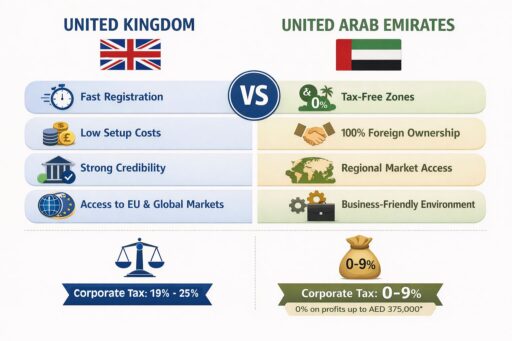
A standard UAE company pays 0% corporate tax on profits up to AED 375,000 and 9% on profits above that threshold, with certain free zone companies eligible for additional exemptions.
Key points include:
- 0% tax on profits up to AED 375,000
- 9% corporate tax on profits exceeding AED 375,000
- 0% for qualifying free zone companies if compliance requirements are met
- Applies to most UAE resident companies, with special rules for large multinationals under the OECD Pillar Two framework
The UAE maintains a highly competitive corporate tax environment compared with most global jurisdictions.
How long does it take to set up a business in the UAE vs UK?
Setting up a company in the UK can often be completed within 24 hours online, while in the UAE it typically takes 3–10 business days, influenced by the chosen jurisdiction, licensing steps, and any visa or office requirements.
UK company formation
- Often completed within 24 hours when registered online
- Additional time may be required to open a bank account
UAE company formation
- Usually takes 3–10 business days depending on the free zone or mainland authority
- Visa processing and office arrangements may extend the timeline
Despite the longer process, the UAE remains one of the faster jurisdictions for international company setup.
Which country is best to set up a company?
The UK is often the better choice for businesses seeking global credibility and access to financial markets, while the UAE is more attractive for entrepreneurs prioritizing low taxes, international mobility, and strategic access to markets across the Middle East, Africa, and Asia.
Advantages of the UK
- Strong legal system and investor confidence
- Global reputation for corporate credibility
- Online company registration
- Low initial costs
- Simple corporate structure requirements
- Strong legal protections for businesses
- Access to European financial networks
Disadvantages of the UK
- Higher corporate tax rates
- Strict compliance and reporting requirements
- Bank account approvals can be difficult for non-residents
Advantages of the UAE
- Low corporate taxes
- 100% foreign ownership in many sectors
- Fast company formation procedures
- Strategic location between major global markets
- No restrictions on repatriation of profits
- Access to entrepreneur residency visas
Disadvantages of the UAE
- Higher formation costs
- Licensing requirements depending on activity
- Free zone companies may face restrictions on mainland operations
Conclusion
Jurisdiction choice ultimately shapes how a business is perceived, taxed, and scaled internationally.
The UK tends to anchor companies within the global financial system, making it easier to interact with investors, international partners, and institutional markets.
The UAE, meanwhile, reflects a broader shift toward mobile, globally distributed businesses that prioritize operational flexibility and tax efficiency.
As cross-border entrepreneurship grows, founders increasingly evaluate company structures not just by cost or speed, but by how well they support long-term geographic expansion.
In practice, the most effective setup is the one that aligns the company’s legal base with where value is created and where growth opportunities are strongest.
FAQs
What is the double taxation agreement between the UK and the UAE?
The UK–UAE Double Taxation Agreement (DTA) prevents businesses and individuals from being taxed on the same income in both the United Kingdom and the United Arab Emirates.
It allocates taxing rights between the two countries for income such as business profits, dividends, interest, and royalties.
What is the UAE entrepreneur visa?
The UAE entrepreneur visa allows foreign founders who establish a business in the United Arab Emirates to obtain residency in the country.
It is often issued through company formation packages in UAE free zones and can also allow residency sponsorship for family members.
What is a founder visa in the UK?
The Innovator Founder visa allows entrepreneurs to start and run an innovative business in the United Kingdom.
Applicants must have a scalable business idea endorsed by an approved organization and meet certain investment and eligibility requirements.
Pained by financial indecision?

Adam is an internationally recognised author on financial matters with over 830million answer views on Quora, a widely sold book on Amazon, and a contributor on Forbes.