Canadian expatriates living in Panama may still be required to file Canadian taxes if they remain Canadian tax residents.
Relocating to Panama does not automatically eliminate the obligation for filing Canadian taxes from Panama with the Canada Revenue Agency.
This article covers:
- How do you determine tax residency in Canada?
- Do I have to pay taxes in Canada if I live abroad?
- How to file Canadian taxes from panama?
- Do expats pay taxes in Panama?
- Is there a tax treaty between Canada and Panama?
- Is there a way to decrease income tax?
Key Takeaways:
- Canada tax is based on residence status, not citizenship.
- Panama taxes only Panama-source income.
- Becoming a non-resident of Canada requires proper departure steps.
- Canada and Panama have a tax treaty to help prevent double taxation.
My contact details are hello@adamfayed.com and WhatsApp +44-7393-450-837 if you have any questions.
The information in this article is not tax advice and may have changed since the time of writing. I can connect you with expert tax support for your specific situation.

Can I Live in Panama as a Canadian Citizen?
Yes. Canadian citizens can enter Panama visa-free for short stays (typically up to 180 days). For long-term residence, popular options include: Friendly Nations Visa, Pensionado (retiree) visa, and investment-based residence programs.
Panama is considered one of the easier Latin American jurisdictions for Canadians seeking residency.
However, immigration status and tax residency are two different things.
Becoming a resident of Panama does not automatically end Canadian tax residency.
How Are Expats Taxed in Panama?
Expats in Panama are taxed only on Panama-sourced income, not on foreign income.
Panama operates under a territorial tax system, which means:
- Only income generated within Panama is taxable
- Foreign-sourced income, including Canadian investments, rental properties in Canada, or foreign dividends, is generally not taxed in Panama
For income earned inside Panama, personal income tax rates are progressive, as per PwC:
- 0% up to a certain threshold
- 15% on mid-tier income
- 25% on higher income brackets
This territorial structure is one of the main reasons Panama is attractive to retirees, investors, and digital entrepreneurs.
Canadian employment income earned remotely but paid from Canada is usually treated as foreign-source and not taxable in Panama, while Panama-sourced employment income is taxable.
However, if expatriates remain Canadian tax residents, Canada may still tax worldwide income, even if Panama does not.
If living entirely off foreign income, Canadian expats may have little to no Panamanian income tax exposure.
Do Canadian Citizens Living Abroad Pay Canadian Taxes?
Yes, Canadian citizens living abroad are subject to Canadian taxation only if they remain Canadian tax residents.
Canada taxes individuals based on residency, not citizenship. Unlike the United States, holding a Canadian passport alone does not trigger tax obligations.
Determining obligations requires establishing whether the individual is:
- Factual resident
- Deemed resident
- Non-resident
Canadian tax residents must report worldwide income to the Canada Revenue Agency.
Non-residents of Canada are generally required to:
- File a departure return in the year residency ends
- Pay Canadian tax only on Canadian-source income
- Comply with withholding taxes on dividends, pensions, or rental income
Residency status is assessed based on:
- Primary ties (home, spouse, dependents in Canada)
- Secondary ties (bank accounts, driver’s license, provincial health coverage)
- Length and permanence of stay abroad
Ultimately, residency status (not passport ownership) determines whether Canadian taxes must be filed from Panama.
What Tax Forms Do I Need to Submit to Canada?
Most Most Canadian expatriates will file a T1 General Income Tax and Benefit Return, while some may also need additional forms such as T1135 (Foreign Income Verification Statement) or departure tax forms when leaving Canada permanently.
For individuals who remain Canadian tax residents, the typical filings include:
- T1 General Income Tax and Benefit Return
- T1135 (Foreign Income Verification Statement), if applicable
- T776 (rental income), if applicable
- T2125 (self-employment income), if applicable
For those leaving Canada permanently and establishing non-resident status, filings may include:
- Departure return (final resident return)
- Form T1161, for specified property above the reporting threshold
- Form T1243, to calculate deemed disposition (departure tax)
Non-residents earning Canadian-source income may need:
- Section 216 return (for rental income)
- Non-resident withholding tax compliance forms
Because changes in residency can trigger departure tax and reporting obligations with the Canada Revenue Agency, professional guidance is strongly recommended to ensure compliance.
How to Process Tax Filing from Panama?
Canadian expatriates in Panama must file Canadian taxes based on their residency status, starting with confirming whether they are still Canadian tax residents.
1. Confirm Canadian Tax Residency Status
Determining whether an individual is a factual or deemed resident, or has become a non-resident, dictates whether worldwide income or only Canadian-source income must be reported to the Canada Revenue Agency.
2. Gather Required Income Documents
Relevant documents may include:
-Canadian T-slips (T4, T5, T3, etc.)
-Rental income statements
-Investment income summaries
-Foreign income records (if still a Canadian tax resident)
-Departure documentation (if emigrated during the year)
Accurate reporting of foreign assets may also require disclosure forms such as T1135.
3. Determine Filing Obligations in Panama
If income is sourced within Panama, local filing may be required under Panama’s territorial tax system.
Foreign-source income is generally not reportable in Panama, but Panamanian-source employment or business income may trigger filing obligations.
4. File the Appropriate Canadian Return
-Canadian tax residents file a T1 General Income Tax and Benefit Return reporting worldwide income.
-New non-residents file a departure return for the year residency ends.
-Non-residents earning Canadian rental income may file under Section 216 to calculate net tax instead of default withholding rates.
Returns can typically be filed electronically (if eligible) or by mailing forms to the CRA’s international tax services office.
5. Review Withholding and Treaty Benefits
The Canada–Panama tax treaty may reduce withholding rates on certain payments such as dividends or pensions.
Ensuring proper withholding elections are in place can prevent overpayment and unnecessary refund delays.
6. Maintain Records and Monitor Future Status
Residency status can change if ties to Canada are re-established.
Maintaining documentation of departure, foreign residence, and tax filings is essential in case of future review or reassessment.
For Canadian expats in Panama, tax filing is primarily about residency determination, proper documentation, and compliance timing, not just the location of income.
Does Canada Have a Tax Treaty with Panama?
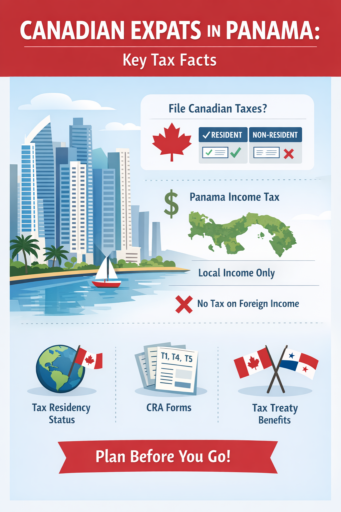
Yes. Canada and Panama signed a tax treaty to prevent double taxation and reduce withholding rates on certain types of income.
The treaty:
- Allocates taxing rights between the two countries
- Reduces withholding tax on dividends and other payments
- Helps avoid double taxation scenarios
However, the existence of a tax treaty does not automatically change Canadian tax residency.
Residency determination continues to follow Canadian domestic rules.
What Happens If You Don’t File Taxes While Living Abroad?
Canadian tax residents who fail to file taxes while living abroad face penalties, interest, and potential enforcement actions.
Consequences include:
- Accrual of penalties and interest
- Possible CRA enforcement actions
- Impact on future benefits, such as CPP or OAS adjustments
- Compliance reviews triggered upon re-entry to Canada
Non-residents earning Canadian-source income who ignore filing obligations can also face penalties and withholding complications.
Non-compliance with Canadian tax obligations does not disappear over time.
How to Reduce Canadian Income Tax?
Canadian expatriates relocating to Panama can reduce income tax in Canada by carefully planning residency status, income reporting, and treaty benefits.
Strategies may include:
- Properly establishing non-resident status – clearly severing Canadian tax ties can limit taxation to Canadian-source income only.
- Timing departure to manage deemed disposition rules – planning the exit year strategically can reduce or defer departure (exit) taxes on assets.
- Structuring investment income efficiently – selecting tax-efficient accounts or income types can minimize Canadian taxation while abroad.
- Using treaty-based withholding reductions – the Canada–Panama tax treaty can lower withholding on dividends, interest, and other cross-border payments.
- Corporate or trust planning (case-specific) – utilizing legal structures can optimize tax outcomes for high-net-worth expatriates or complex portfolios.
Aggressive tax avoidance can trigger the GAAR (General Anti-Avoidance Rule) under Canadian law.
The most effective planning tool is accurately determining and documenting Canadian tax residency.
Canadian Expats in Panama: Population Trends and Practical Implications
Panama has emerged as a notable destination for Canadian expatriates, with estimates suggesting around 8,000 Canadians living in the country as part of a broader expatriate community that totals over 150,000 permanent foreign residents.
Many Canadians concentrate in areas like Panama City, Boquete, and Coronado, where established support networks and English‑speaking services make settling in easier.
These demographic patterns reflect more than lifestyle choices, as they also shape financial behavior.
Canadian retirees and remote workers frequently maintain Canadian bank accounts, investment portfolios, and pension streams, generating cross‑border income flows that must be managed for both Canadian and Panamanian tax purposes.
This means understanding how to report income, complete required forms like T1135, and make treaty‑based withholding elections becomes a practical necessity for sustaining financial stability abroad.
The presence of organized Canadian expat groups and networking activity such as Canadian members joining local expat communities, further highlights the extent to which Canadians are settling into Panama’s social and economic fabric.
This community presence underscores that cross‑border tax planning isn’t theoretical. It is a routine part of life for many Canadians in Panama who juggle local residency, foreign income streams, and CRA compliance.
Taken together, these trends show that the interplay between Panama’s territorial tax environment and Canada’s residency‑based system is not an abstract tax topic, but a lived reality for a growing number of Canadians.
Recognizing community dynamics, economic patterns, and reporting obligations helps expatriates make informed decisions that align both with their lifestyle goals and their long‑term financial responsibilities.
Conclusion
For Canadian expatriates in Panama, effective tax planning hinges on clarity of residency status and proper documentation, not just minimizing rates.
Recognizing how Panama’s territorial system interacts with Canada’s residency-based taxation allows residents and non-residents to manage income and assets more efficiently.
Early planning, including timing of departures, structuring investments, and leveraging treaty benefits, can prevent unexpected liabilities and optimize cross-border tax outcomes.
Beyond compliance, thoughtful tax planning provides financial flexibility, peace of mind, and the ability to make long-term decisions confidently while living abroad.
FAQs
Do Dual Citizens Pay Taxes in Both Countries in Canada?
Canada does not tax individuals based on citizenship, including dual citizens.
Dual citizens are taxed in Canada only if they are Canadian tax residents, in which case worldwide income is reportable.
Can I Live on $3,000 a Month in Panama?
Yes, in many areas of Panama this is comfortable for a single person or couple outside prime expat neighborhoods.
Major cities like Panama City are more expensive, while smaller towns offer lower cost of living.
Is Panama a Tax Haven Country?
Panama is often deemed a tax haven due to its territorial tax system and favorable corporate structures.
However, it complies with international transparency standards and tax treaties, making it more accurately classified as a territorial-tax jurisdiction rather than a traditional tax haven.
Is There an Exit Tax for Leaving Canada?
Yes. When Canadian tax residency is terminated, Canada generally applies a deemed disposition tax (departure tax) on certain assets as if they were sold at fair market value on the date of departure.
Certain assets such as Canadian real estate, RRSPs, and other excluded property, are not subject to deemed disposition, making pre-departure planning critical.
Is It Easy for a Canadian to Move to Panama?
Yes, relocating from Canada to Panama is relatively easy thanks to accessible residency programs and a well-established expat community.
However, tax residency and departure planning should be completed before relocation to avoid unintended Canadian tax consequences.
Pained by financial indecision?

Adam is an internationally recognised author on financial matters with over 830million answer views on Quora, a widely sold book on Amazon, and a contributor on Forbes.