To file your Canadian taxes from abroad, you must first determine your tax residency status and then file the appropriate return reporting either worldwide income or only Canadian-source income.
Your filing obligation determines how to file your Canadian taxes, based on whether you are classified as a resident, deemed resident, or non-resident under rules administered by the Canada Revenue Agency.
This article covers:
- Do I need to pay Canadian taxes if I don’t live in Canada?
- Who is required to file a tax return in Canada?
- What happens if I don’t report my foreign income?
- What are the tax changes for 2026 in Canada?
Key Takeaways:
- Canada taxes based on residency, not citizenship.
- Residents report worldwide income; non-residents generally report Canadian-source income only.
- Leaving Canada may trigger departure tax on unrealized gains.
- Non-compliance can result in penalties, interest, and enforcement action.
My contact details are hello@adamfayed.com and WhatsApp +44-7393-450-837 if you have any questions.
The information in this article is not tax advice and may have changed since the time of writing. I can connect you with expert tax support for your specific situation.

Do I have to file taxes in Canada if I live abroad?
Yes, you may have to file taxes in Canada even if you live abroad. Your obligation is determined by whether you are classified as a Canadian tax resident.
Under the rules administered by the Canada Revenue Agency (CRA), Canada taxes individuals based on residency, not citizenship.
You may still need to file if you fall into one of the following categories:
1. Factual Residents
You maintain significant residential ties, such as:
- A home in Canada
- A spouse or dependents in Canada
- Provincial health coverage
- A Canadian driver’s license or bank accounts
If you remain a factual resident, you must file a Canadian return reporting worldwide income.
2. Deemed Residents
You may be considered a deemed resident if you:
- Sojourn in Canada for 183 days or more in a calendar year
- Work abroad for the Canadian government
Deemed residents are also required to report worldwide income.
3. Non-Residents
You are generally a non-resident if:
- You severed major residential ties
- You established permanent residence abroad
- You spend most of the year outside Canada
Non-residents typically file only if they:
- Earn Canadian-source income
- Dispose of taxable Canadian property
- Owe departure tax
- Are specifically requested to file by the CRA
4. Deemed Non-Residents
If a tax treaty between Canada and another country considers you resident of that other country, you may be treated as a deemed non-resident under treaty rules.
Even if you have no tax owing, filing may still be necessary to maintain benefits, claim refunds, properly establish non-resident status, or formally close your Canadian tax residency.
What are the departure tax rules in Canada?
When you leave Canada and cease tax residency, you are generally required to pay departure tax on certain unrealized capital gains.
Departure tax applies to assets as if they were sold at fair market value on your departure date.
Common assets subject to deemed disposition:
- Investment portfolios
- Shares in private corporations
- Certain trusts
Excluded assets may include:
- Canadian real estate
- RRSPs and certain registered plans
You may also:
- Elect to defer payment
- Provide security for large tax liabilities
Departure tax is one of the most significant potential tax exposures for Canadians leaving the country.
Do I need to report foreign income in Canada as a non-resident?
If you are a non-resident, you generally do not report foreign income to Canada.
However:
- Residents and deemed residents must report worldwide income.
- If you maintain Canadian tax residency, all global income must be declared.
- Foreign tax credits may apply to avoid double taxation.
Failure to report foreign income while still a Canadian tax resident can trigger penalties and interest
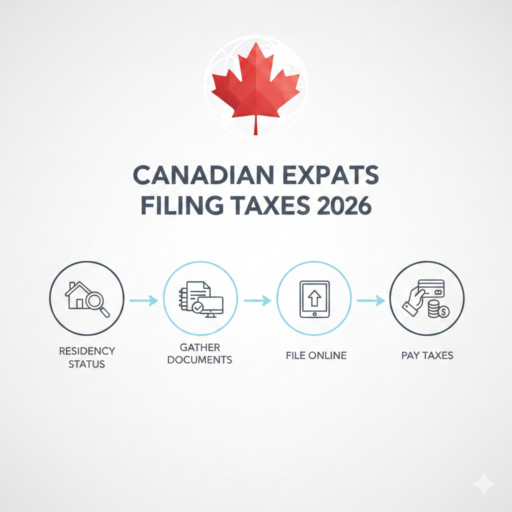
How To File Canadian Taxes from Abroad
Filing Canadian taxes from abroad in 2026 requires confirming your residency classification, completing the correct return, and submitting it through approved CRA channels.
It is manageable as long as your residency status and reporting obligations are clear.
Step 1: Confirm Residency Status
If you left Canada, you may need to:
-Indicate your departure date on your final resident return
-Complete Form NR73 if clarification of residency status is required
Step 2: Gather Required Documents
-T4, T5, and T3 slips
-Foreign income statements
-Investment and rental income records
-Documentation of capital gains or asset disposals
Step 3: File Electronically or by Mail
You can file:
-Using CRA-certified tax software
-Through a Canadian accountant
-By mailing a paper return internationally
Even while abroad, you can access your account through the Canada Revenue Agency My Account portal.
Step 4: Pay Any Taxes Owing
Payments can be made:
-Through international wire transfer
-Via a Canadian bank account
-Through authorized financial institutions
Ensuring accuracy at each step reduces the risk of penalties, reassessments, or delays in processing.
When can I file taxes in 2026 in Canada?
You can begin filing your 2025 Canadian tax return as early as February 2026, with most taxpayers required to file by April 30, 2026, as per the CRA.
For the 2025 tax year:
- Filing season typically opens in February 2026
- The standard deadline is April 30, 2026
- If self-employed, the filing deadline is June 15, 2026
- The payment deadline remains April 30, 2026
Non-residents generally follow the same deadlines unless specific elections or withholding regimes apply.
What are the new tax rules for Canada in 2026?
Canada’s tax rules for 2026 include key federal income tax updates especially a lower starting tax rate, adjusted brackets, and increased personal amounts that affect how much tax you pay.
Here’s what’s new for the 2026 tax year:
- New federal income tax brackets: The lowest federal rate drops to 14% on the first portion of taxable income, and all federal brackets are indexed for inflation, slightly adjusting thresholds upward for 2026.
- Adjusted basic personal amount (BPA): The amount you can earn before federal tax rises to $16,452 in 2026.
- Digital and filing changes: The Canada Revenue Agency is enhancing digital services, including online access to notices and slips, and a shift away from mailed tax packages.
- Modernization of reporting systems: CRA is moving toward automated reporting that reduces manual entries and improves accuracy.
Because tax law changes are enacted through federal budgets and updated annually, it’s important to consult CRA resources to stay current with any additional measures that may affect your filing obligations.
What is the most common mistake made on taxes?
The most common mistake for Canadians living abroad is incorrectly determining their tax residency status.
Other frequent errors include:
- Failing to file a departure return
- Not reporting worldwide income when required
- Ignoring foreign asset reporting requirements
- Missing filing deadlines
- Assuming leaving Canada automatically ends tax obligations
Residency determination remains the area most misunderstood in Canadian expat taxation.
What happens if I live abroad and don’t file taxes?
If you are required to file Canadian taxes while living abroad and fail to do so, you can face penalties, interest, and other serious consequences.
Failing to file when required can result in:
- Late filing penalties
- Interest on unpaid taxes
- Loss of refunds
- CRA enforcement actions
- Difficulty re-establishing Canadian tax residency cleanly
Even non-residents must file if they earn Canadian rental income, employment income, or dispose of taxable Canadian property.
Canadian Expat Taxes Compared to Other Countries
When filing taxes from abroad, Canada’s system is residency-based, meaning your obligation to file depends on whether you are a resident, deemed resident, or non-resident.
This directly affects what income must be reported, which forms to file, and whether departure or exit taxes apply.
United States (US)
US citizens and green card holders must file and report worldwide income annually even if they live abroad.
Like Canada, this requires tracking foreign income, but the filing burden can be heavier since citizens cannot avoid filing simply by leaving the country.
Forms like the FBAR and FATCA reporting are unique requirements not present in Canada.
United Kingdom (UK)
Non-residents in the UK file only on UK-source income, while residents report worldwide income.
Filing from abroad is simpler than Canada if you qualify as a non-resident, but similar reporting rules apply for residents with foreign income, requiring careful documentation.
Australia
Australian residents who move abroad may face departure tax on certain assets, similar to Canada’s departure tax rules.
Filing obligations while living overseas include reporting worldwide income until residency officially ends, making timing and documentation critical.
Singapore and UAE
In Singapore and the UAE, foreign-source income is generally not taxed, so expats living abroad rarely need to file for foreign earnings.
This contrasts sharply with Canada, where residents and deemed residents must continue reporting worldwide income even if they physically live outside the country.
France
France imposes departure taxes for high-net-worth individuals and requires non-residents to file on French-source income.
Filing from abroad is similar in principle to Canada, though the scope of reportable assets and income can differ.
Filing Insights for Canadians Living Overseas
Canada requires expats to track residency, report worldwide income if still resident, and consider departure taxes, which makes timely filing and documentation crucial.
Compared to other countries, Canada sits between low-tax jurisdictions like Singapore or the UAE and more citizen-focused systems like the US.
Understanding these differences helps expats manage compliance efficiently while living overseas.
Conclusion
Living abroad doesn’t erase your connection to Canada’s tax system. It simply changes how you interact with it.
The key to staying ahead is clarity. Know your residency status, track your global income, and plan for departure tax if applicable.
Small oversight can escalate into costly penalties or missed opportunities, so approaching filing strategically, whether through digital tools, careful record-keeping, or professional advice, ensures compliance while minimizing stress.
Ultimately, understanding the rules allows expats to manage their taxes confidently rather than reactively.
FAQs
What happens if you live outside of Canada for more than 6 months?
Living outside Canada for more than six months does not automatically make you a non-resident for tax purposes.
The CRA considers your residential ties, intention to return, length and purpose of stay, and whether you have established a permanent home abroad.
Do I need to inform the CRA if I leave Canada?
Yes, you must inform the CRA when you leave Canada permanently.
This includes providing your departure date, new foreign address, and, if needed, filing Form NR73 to clarify your residency status.
How much does it cost to hire an accountant for taxes in Canada?
Hiring an accountant for Canadian taxes typically costs CAD 150 to CAD 500 for a simple return and CAD 1,000 to CAD 5,000 or more for complex filings.
Cross-border tax planning, departure returns, or foreign asset reporting can increase the cost further.
Pained by financial indecision?

Adam is an internationally recognised author on financial matters with over 830million answer views on Quora, a widely sold book on Amazon, and a contributor on Forbes.