Legally reducing tax on investment income abroad starts by choosing the right residency and using tax treaties and territorial systems to limit or eliminate levies on foreign dividends, capital gains, and interest.
By understanding how countries treat offshore income, you can reduce taxes on your investments, structuring them to pay only what the law requires—no more, no less.
This article covers:
- What is considered investment income?
- How do taxes work on foreign investments?
- How to pay less tax on investments
- Which country has the lowest taxes in the world?
- How do tax treaties prevent double taxation?
Key Takeaways:
- Tax residency has a bigger impact than the investment itself.
- Territorial tax countries can legally exempt foreign investment income.
- Tax treaties are one of the most effective tools for lowering taxes.
- Compliance and reporting determine whether savings remain legal.
My contact details are hello@adamfayed.com and WhatsApp +44-7393-450-837 if you have any questions.
The information in this article is for general guidance only. It does not constitute financial, legal, or tax advice, and is not a recommendation or solicitation to invest. Some facts may have changed since the time of writing.

What would be considered investment income?
Investment income is income generated from owning assets rather than performing work or providing services.
Tax authorities typically classify the following as investment income:
- Dividends from stocks, ETFs, and mutual funds
- Interest from savings accounts, bonds, and fixed-income products
- Capital gains from selling stocks, real estate, or other assets
- Rental income from property investments
- Royalties from intellectual property
- Certain cryptocurrency gains, depending on jurisdiction
Investment income is usually taxed under separate rules from employment income and may be subject to withholding taxes, capital gains rates, or exemptions based on your tax residency and the income’s source.
How are taxes calculated on investment income abroad?
Taxes on foreign investment income are determined by your residency, the income’s source, the type of asset, and any applicable tax treaties.
Key factors include:
- Tax residency status – determines whether you are taxed on worldwide or local income
- Source country – the country where the income originates may apply withholding tax
- Type of investment income – dividends, interest, capital gains, and rental income can be taxed differently
- Tax treaties – can reduce or eliminate double taxation
Some countries tax residents on all foreign income, while others tax only locally sourced income.
Rates may be flat, progressive, or vary by investment type.
Foreign withholding taxes are often applied at the source but may be reduced or offset through tax credits or treaty exemptions.
How to minimize taxes on investment income
Minimizing taxes on investment income legally involves structure, timing, and jurisdictional choices rather than concealment.
Common strategies include:
1. Tax residency
Establish residency in favorable jurisdictions to reduce or exempt foreign investment income.
Choosing the right country can determine whether your worldwide income is taxed or if only local income is subject to tax.
2. Tax treaties
Use treaties to lower or eliminate withholding taxes on dividends, interest, and capital gains.
Treaties prevent double taxation and can significantly reduce the effective tax rate on foreign income.
3. Tax-efficient accounts
Hold investments in accounts or structures designed to minimize taxable events. These can include offshore accounts, retirement funds, or special investment vehicles recognized by local law.
4. Long-term gains
Prioritize long-term capital gains where lower tax rates apply. Holding assets for longer periods often qualifies for favorable treatment compared with short-term trading gains.
5. Timing sales
Align asset sales with residency changes to optimize tax outcomes. Selling at the right time can take advantage of lower tax periods or newly applicable exemptions.
6. Income diversification
Spread income across jurisdictions to reduce overall tax exposure.
By diversifying, you can avoid concentrating taxable income in a high-tax jurisdiction and take advantage of more favorable rates elsewhere.
What is the most tax-efficient way to invest money?
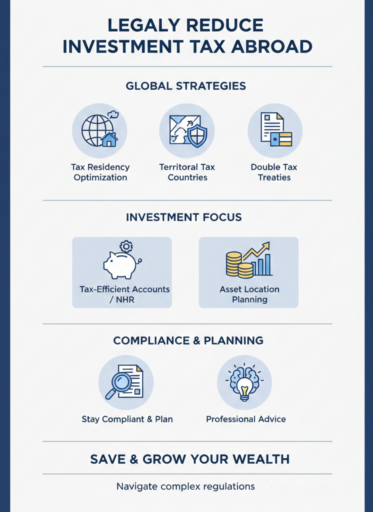
The most efficient way to invest money legally is by using specialized accounts, such as offshore investment accounts, which allow dividends, interest, and capital gains to grow tax-deferred or exempt.
Key approaches:
- Offshore investment accounts – Recognized investment accounts in low-tax or territorial jurisdictions can legally shelter dividends, interest, and capital gains until withdrawn.
- Retirement or pension funds – Many countries allow contributions to retirement accounts that defer taxes on investment income until withdrawal, often at lower rates.
- Special investment vehicles – Certain trusts, foundations, or corporate structures in favorable jurisdictions provide tax-efficient ways to hold diversified portfolios.
Using tax-efficient accounts is fully legal when reported correctly and combined with proper residency planning.
The structure determines whether your investment returns are taxed now, later, or not at all.
Territorial Tax Countries
Territorial tax countries like Panama and Malaysia tax only income earned within their borders, leaving most foreign investment income exempt.
Popular territorial tax countries include:
- Panama
- Malaysia
- Thailand
- Costa Rica
- Georgia
- Hong Kong
- Singapore
- Paraguay
- Guatemala
- El Salvador
- Uruguay
For investors with offshore portfolios, territorial tax systems can significantly reduce or even eliminate taxes on dividends, interest, and capital gains earned abroad.
What countries are low tax jurisdictions?
Low tax jurisdictions like the United Arab Emirates and Singapore have minimal or zero taxes on investment income, capital gains, or overall personal income.
These countries are often used as residency bases rather than places where assets are physically held.
Examples and relevant tax programs/rates:
- United Arab Emirates – No personal income tax or capital gains tax. Expat residency can be obtained through employment or investment visas; investors legally pay 0% tax on foreign dividends and capital gains.
- Singapore – Personal income tax is progressive, capped at 22%, but foreign-sourced dividends and capital gains are generally exempt for residents. Programs like the Global Investor Program (GIP) offer residency for high-net-worth individuals.
- Hong Kong – Territorial taxation applies; foreign-sourced income is generally not taxed. Dividends, interest, and capital gains from offshore assets are exempt. The Quality Migrant Admission Scheme can provide residency for investors.
- Monaco – No personal income tax in Monaco for most residents. While corporate and indirect taxes exist, individuals can enjoy 0% income tax, including on dividends and capital gains. Residency is available via property purchase or business establishment.
- Bahamas – No personal income or capital gains tax. Residency can be obtained through property ownership or economic contribution; expats pay 0% tax on offshore investment income.
- Cayman Islands – Zero personal, corporate, or capital gains tax. Residency can be gained through investment or work permits; investors legally pay 0% tax on all offshore portfolio returns.
Which country has the most double tax treaties?
The United Kingdom, with over 100 double tax treaties, has one of the largest networks in the world, providing investors substantial protection against being taxed twice on the same income.
Double tax treaties allocate tax rights between countries and reduce withholding taxes on dividends, interest, and royalties, helping clarify which country has the primary right to tax specific income types.
Jurisdictions known for large treaty networks include:
- France – Maintains an extensive treaty network with over 100 countries, reducing double taxation on many cross‑border income types.
- Germany – Has concluded double tax agreements with around 90 countries, preventing double taxation on foreign income.
- Netherlands – Uses its network of almost 100 treaties to minimize withholding taxes and clarify tax obligations for cross‑border investors.
- Singapore – Maintains over 80 double tax treaties, reducing exposure to double taxation and promoting cross-border investment flows.
Comparing Tax Outcomes Across Common Expat Profiles
Even with identical investment portfolios, expats experience very different tax outcomes based on residency status, local rules, and treaty coverage.
Understanding these profiles helps investors structure their finances efficiently and remain fully compliant.
Digital Nomad (Non-Resident Everywhere)
Digital nomads who maintain no formal tax residency often pay only withholding taxes on foreign investment income.
However, they face the risk of inadvertently triggering tax residency if they spend too much time in a single country or establish economic ties.
Careful tracking of days abroad, bank accounts, and permanent home status is critical to avoid unexpected liabilities.
Territorial Tax Resident
Residents of territorial tax countries typically pay tax only on locally sourced income.
Foreign investment income is usually exempt if kept offshore, allowing for significant tax efficiency.
Investors must ensure income is not remitted or considered locally sourced to fully benefit from the territorial system.
Low-Tax Treaty Country Resident
Residents in low-tax treaty jurisdictions may pay reduced rates on investment income, while treaties help prevent double taxation.
These countries often provide tax credits or exemptions that can be leveraged strategically, making them favorable for individuals with multiple cross-border income streams.
High-Tax Worldwide Resident
High-tax countries that levy taxes on worldwide income require residents to report and pay tax on all investment income.
While foreign tax credits can offset some double taxation, compliance is complex, and planning opportunities are limited compared with territorial or low-tax residency models.
Note that selecting the right residency model often has a greater impact on after-tax investment income than the specific assets held.
Understanding how residency, treaties, and income sourcing interact is essential to optimizing global tax outcomes.
Conclusion
Reducing tax on investment income overseas is ultimately a structural decision, not an investment one.
Aligning tax residency, income sourcing, and treaty use often has a greater impact on after-tax returns than changing assets or chasing short-term tax advantages.
For globally mobile investors, long-term efficiency comes from clear residency planning, disciplined compliance, and understanding how jurisdictions interact.
Sustainable tax outcomes are built on structure and foresight, not constant optimization or avoidance tactics.
FAQs
What classifies as a tax resident?
Tax residency is usually determined by physical presence, permanent home, center of economic interests, or legal residency status.
Spending more than 183 days in a country commonly triggers tax residency.
How to report foreign investment income?
Foreign investment income is typically reported on annual tax returns, often with additional disclosure forms for offshore accounts and assets.
What happens if I don’t report foreign income?
Failure to report foreign income can result in penalties, back taxes, interest, and in severe cases, criminal charges.
What is the foreign earned income exclusion for digital nomads?
The Foreign Earned Income Exclusion (FEIE) (under US tax law) allows qualifying individuals to exclude a portion of earned income (such as wages or self-employment income) from US federal income tax if they meet the physical presence or bona fide residence test.
Pained by financial indecision?

Adam is an internationally recognised author on financial matters with over 830million answer views on Quora, a widely sold book on Amazon, and a contributor on Forbes.