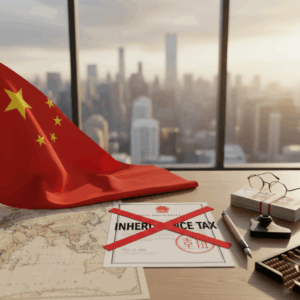
There is no inheritance tax or estate tax in China, regardless of the value of the assets inherited.
For foreigners, expats, residents, and non-residents, the real issues are not tax rates but legal ownership rules, property rights, residency status, and what happens when inherited assets are later sold or transferred.
This article covers:
- What are the inheritance laws in China?
- How much is inheritance tax in China?
- How long have you got to sell an inherited property?
Key Takeaways:
- China has no inheritance tax and no inheritance tax threshold.
- Residents and non-residents are treated the same for inheritance tax purposes.
- Foreigners can inherit property, but ownership and transfer rules apply.
- Taxes may arise later when inherited assets are sold or generate income.
My contact details are hello@adamfayed.com and WhatsApp +44-7393-450-837 if you have any questions.
The information in this article is for general guidance only. It does not constitute financial, legal, or tax advice, and is not a recommendation or solicitation to invest. Some facts may have changed since the time of writing.

What are the rules for inheritance in China?
Inheritance in China follows statutory succession rules unless a legally valid will states otherwise. It is governed primarily by the Civil Code, which came into force in 2021.
The law sets out who can inherit, in what order, and how estates are distributed when there is no will.
China recognizes both testate succession, where a valid will exists, and intestate succession, where assets are distributed according to statutory rules.
Spouses, children, and parents generally rank as first-order heirs. Second-order heirs include siblings and grandparents.
A valid will can override statutory succession rules, but it must comply with Chinese legal formalities.
Oral wills, handwritten wills, and notarized wills are all recognized, though notarized wills typically carry greater evidentiary weight.
For foreigners, Chinese courts will usually apply local laws to assets located in the country.
Can foreigners inherit property in China?
Yes, foreigners can inherit property in China, and their right to do so is governed by China’s succession law as applied to immovable property located within the country.
Under Chinese property law, individuals (including foreigners) can own the buildings and structures on land while the land itself remains state‑owned, with land‑use rights typically granted for up to 70 years.
Inheritance passes the remaining land‑use term along with the property.
Foreign heirs must still comply with local registration, documentation, and applicable property regulations to complete the transfer after inheritance.
What is the inheritance tax rate in China?
China currently has no inheritance tax and no estate tax. Despite periodic discussions about introducing an inheritance or estate tax, no such levy has been implemented as of today.
This means there is no percentage-based inheritance tax rate applied to estates or beneficiaries.
However, this does not mean inherited assets are entirely tax-neutral.
Taxes may arise later if inherited property is sold, transferred, or generates income, particularly under China’s individual income tax rules.
How much can you inherit from your parents without paying inheritance tax in China?
There is no cap on how much you can inherit from your parents in China, as the country does not levy tax at the point of inheritance.
Such is true whether the estate is modest or substantial.
That said, subsequent transactions can trigger tax exposure.
Do non-residents have to pay inheritance tax in China?
Non-residents do not pay inheritance tax in China either. However, non-residents face additional procedural and regulatory hurdles.

These can include notarization requirements, foreign document authentication, court recognition of foreign wills, and restrictions on transferring inherited funds abroad due to China’s currency controls.
While the absence of inheritance tax applies equally to residents and non-residents, the practical administration of inheritance can be more complex for non-resident heirs.
Who is responsible for paying the inheritance tax bill?
Because China does not impose inheritance tax, there is no inheritance tax bill for heirs or estates to pay.
That said, heirs may still be responsible for settling outstanding debts of the deceased, up to the value of the inherited estate.
Creditors’ claims are typically settled before assets are distributed.
If inherited assets later generate taxable income or are sold, the beneficiary, not the estate, is generally responsible for any resulting tax liabilities.
Is there capital gains tax on selling inherited property in China?
Yes, in China, selling inherited property can trigger tax on the gain. This is typically under the individual income tax rules, rather than a separate capital gains tax.
The taxable amount is generally calculated as the difference between the sale price and the original value of the property (or the value at inheritance, depending on local rules).
Rates and exemptions vary by region, property type, and holding period.
Do wives lose inheritance rights in China?
No, wives can still claim a husband’s property in China under the Civil Code.
However, whether a wife inherits a portion of her husband’s assets depends on how the property is classified.
Property acquired during marriage is usually treated as joint marital property and included in estate division.
Premarital assets, gifts, or inheritances designated to the husband remain separate and are distributed according to a will or statutory succession rules.
A wife’s share is determined by documentation, registration, and contribution evidence under the Civil Code and recent judicial clarifications.
Conclusion
China’s inheritance system may seem straightforward due to the absence of inheritance tax, but practical challenges remain for foreigners, expats, and non-residents.
Ownership documentation, property classification, and legal formalities play a central role in ensuring assets are correctly transferred.
Careful planning and awareness of local rules can help heirs navigate property rights, potential tax exposure on sales, and cross-border inheritance smoothly.
FAQs
What is the 6 year rule in China?
The 6 year rule in China relates to individual income tax residency, not inheritance or inheritance tax.
An individual who lives in China for six consecutive years, without leaving for more than 30 days in any year, may become taxable on worldwide income instead of only China-sourced income.
Is it true that 90% of people in China own their own homes?
Yes, according to reports including Forbes citing Nomura data, about 90% of families in China own their home, one of the highest homeownership rates in the world.
Many of these homes, around 80%, are owned outright without mortgages or liens, and a significant share of urban households own more than one property.
However, this reflects land‑use rights for fixed terms (commonly 70 years) rather than perpetual freehold ownership as understood in some other countries.
Do you own property forever in China?
No. Property ownership in China is based on land-use rights.
Residential land-use rights are typically granted for 70 years.
While renewals are generally expected, they are not identical to freehold ownership in many Western countries.
How much is China’s pension?
Urban workers in developed cities often receive around ¥3,000 to ¥6,000 per month from the basic state pension, with wealthier retirees in government or public sector roles at the higher end of that range.
Rural or basic resident pensioners often receive much lower amounts, sometimes only a few hundred yuan per month.
Pained by financial indecision?

Adam is an internationally recognised author on financial matters with over 830million answer views on Quora, a widely sold book on Amazon, and a contributor on Forbes.