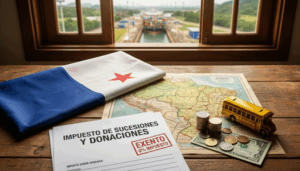
There is no inheritance tax in Panama. Beneficiaries can inherit assets without paying tax, regardless of amount or relationship.
This makes Panama one of the most straightforward jurisdictions in the world for succession planning, shifting the focus away from tax exposure and toward documentation, asset location, and cross-border coordination.
This article covers:
- What is the maximum amount of inheritance without tax?
- Who is liable for inheritance tax in Panama?
- What taxes do expats pay in Panama?
- Is Panama a territorial tax system?
Key Takeaways:
- Panama has effectively no inheritance tax.
- Beneficiaries do not pay tax on inheritances.
- Minimal administrative or legal fees may apply for asset transfers.
My contact details are hello@adamfayed.com and WhatsApp +44-7393-450-837 if you have any questions.
The information in this article is for general guidance only. It does not constitute financial, legal, or tax advice, and is not a recommendation or solicitation to invest. Some facts may have changed since the time of writing.

What is the inheritance tax rate in Panama?
Inheritance in Panama is generally not subject to traditional tax, making it highly favorable for estate planning.
Unlike countries in Europe or the US, where inheritance tax rates can exceed 30%, beneficiaries in Panama can receive assets without paying a percentage-based tax.
Certain administrative or procedural fees may apply for legal transfers or registration of property, particularly real estate, but these costs are minimal compared to inheritance taxes abroad.
What is the maximum amount you can inherit without paying tax?
There is no maximum threshold for inheritance tax in Panama. Whether you inherit $10,000 or $10 million, Panama does not impose IHT.
Do beneficiaries pay tax on their inheritance?
No. Beneficiaries in Panama do not pay tax on their inheritance. This applies to cash, investments, real estate, and other assets.
The only costs might be related to the legal process of asset transfer, which are minimal compared to traditional inheritance taxes in other countries.
What taxes do you pay in Panama?
You pay no inheritance tax in Panama, but you may pay property tax, capital gains tax, and income tax based on how inherited assets are held or used.

Property-related taxes apply when real estate is involved, including annual property tax assessed on the registered value of the property.
If inherited property is later sold, capital gains tax may apply to the profit, even though the inheritance itself remains tax-free.
Under Panama’s territorial tax system, only income earned within Panama is taxable, meaning rental or business income generated locally from inherited assets may be subject to income tax.
Beneficiaries should also expect probate-related costs, including notary fees, court filings, and property registration charges.
While these are not taxes, they are unavoidable when transferring ownership of inherited assets, particularly real estate.
Offshore assets and foreign-sourced income remain outside Panama’s tax net, so inheritances originating abroad are not taxed locally.
How to Structure an Inheritance in Panama to Minimize Ongoing Taxes
You minimize taxes on an inheritance in Panama by structuring how assets are held, used, and disposed of, rather than by reducing inheritance tax itself, which does not exist.
Although Panama imposes no IHT, post-inheritance decisions determine whether property tax, capital gains tax, or income tax applies.
Effective planning focuses less on avoiding tax and more on controlling when and how tax exposure arises.
Key considerations include:
- Holding inherited property efficiently
Keeping real estate for personal use generally limits exposure to annual property tax, while converting it into a rental introduces income tax on Panama-sourced earnings. - Timing asset sales
Capital gains tax applies only when assets are sold. Delaying a sale or structuring it carefully can help manage taxable gains, particularly for high-value real estate. - Separating personal and income-producing assets
Distinguishing between assets held for use versus income simplifies reporting and reduces unnecessary tax friction. - Leveraging Panama’s territorial tax rules
Offshore investments and foreign-sourced income remain outside Panama’s tax net, preserving efficiency when assets are held internationally. - Planning for probate and transfer costs
While not taxes, notary, court, and registration fees are unavoidable. Clear documentation and ownership structures help reduce delays and expense.
Panama’s real advantage lies not only in the absence of inheritance tax, but in the flexibility it gives heirs to decide when taxation arises, if at all.
Conclusion
The framework of inheritance in Panama stands out for its simplicity rather than complexity.
With no inheritance tax, no thresholds, and no beneficiary-based charges, the primary focus shifts from tax avoidance to proper asset structuring and documentation.
For expats and international families, the real risk lies not in Panama itself but in how foreign assets and cross-border obligations are handled.
Careful planning ensures that Panama’s favorable rules are fully preserved.
FAQs
What country has the highest inheritance tax in the world?
Japan inheritance tax is the highest in the world, with top marginal rates reaching 55%, followed by South Korea and France, where rates can also exceed 45–50% based on the heir and estate size.
Is Panama tax free for foreigners?
No. Panama is not fully tax free for foreigners, but it taxes only Panama-sourced income under its territorial tax system.
Foreigners do not pay Panamanian tax on offshore income, foreign investments, or assets held outside Panama, but local income, property, and business activities may still be taxed.
What country has no inheritance tax?
Countries like Panama, Australia, and New Zealand do not levy inheritance taxes on beneficiaries, making them popular for estate planning.
Can I live on $3,000 a month in Panama?
Yes. $3,000 a month is sufficient for a comfortable expat lifestyle in Panama, covering housing, food, utilities, and leisure in most regions, especially outside Panama City.
Pained by financial indecision?

Adam is an internationally recognised author on financial matters with over 830million answer views on Quora, a widely sold book on Amazon, and a contributor on Forbes.