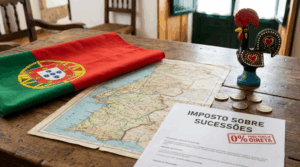
Portugal does not impose a general inheritance tax, and most direct heirs, including spouses and children, are exempt from the minimal stamp duty that applies to other beneficiaries.
For foreigners, expats, residents, and non-residents, inheritance rules are straightforward but require careful planning for property transfers, gifts, and non-family beneficiaries.
This article covers:
- What are the inheritance laws in Portugal?
- Is there inheritance tax in Portugal for foreigners?
- What is the gift tax in Portugal?
- What is included in transfer fees?
Key Takeaways:
- Direct heirs (spouses, children, parents) pay no Portuguese inheritance tax.
- Non-family beneficiaries face a 10% stamp duty.
- Inherited property must be formally transferred and registered.
- Gift tax follows the same exemption rules as inheritance.
My contact details are hello@adamfayed.com and WhatsApp +44-7393-450-837 if you have any questions.
The information in this article is for general guidance only. It does not constitute financial, legal, or tax advice, and is not a recommendation or solicitation to invest. Some facts may have changed since the time of writing.

What are the inheritance tax rules in Portugal?
Portuguese inheritance tax rules are simple: direct family members pay no tax, while distant relatives and non-family beneficiaries face a 10% stamp duty.
Inheritance in Portugal is governed primarily by Portuguese civil law.
For residents and non-residents alike, the rules depend on your relationship to the deceased and the type of assets inherited.
- Direct relatives such as spouses, children, and parents are generally exempt from inheritance tax.
- Non-relatives may face a stamp duty of 10% on the value of inherited assets.
- Portuguese law also applies different rules depending on whether the assets are real estate, financial holdings, or personal property.
What is the inheritance tax rate in Portugal 2025?
As of 2025, inheritance tax in Portugal remains largely unchanged; there is no broad estate tax, and stamp duty is only 10% for non-direct heirs.
- For residents, inheritance of property or financial assets by direct family members does not trigger taxation.
- For non-residents, the rules are similar, but Portugal still applies a 10% stamp duty for distant relatives or unrelated beneficiaries.
What is the stamp duty in Portugal?
Portuguese stamp duty is a transactional tax applied to certain legal acts, including inheritances and gifts.
In the context of inheritance, stamp duty effectively replaces a traditional inheritance tax and is charged at a flat rate of 10% on assets transferred to non-exempt beneficiaries.
Stamp duty applies to Portuguese-situated assets such as real estate, bank accounts, shares in Portuguese companies, and other locally held property.
The tax is calculated based on the market value of the assets at the time of death.
For distant relatives, unmarried partners, or unrelated beneficiaries, the 10% stamp duty is payable before assets can be legally transferred or registered in the beneficiary’s name.
Failure to settle stamp duty can delay property registration and estate administration.
What is the inheritance process in Portugal?

Portugal’s inheritance process involves identifying the heirs, valuing the estate, settling any stamp duty, and formally transferring assets under Portuguese law.
The process can vary depending on whether the deceased left a valid will.
- With a will: The executor administers the estate according to the deceased’s wishes while complying with Portuguese law.
- Without a will: Assets are distributed according to statutory inheritance rules, generally prioritizing spouses, children, and parents.
Who is exempt from inheritance tax in Portugal?
In Portugal, inheritance passed to spouses, civil partners, children, and parents is fully exempt from stamp duty.
This exemption also extends to adopted children and grandparents, allowing close family members to inherit property and assets without triggering inheritance tax.
The exemption does not apply to more distant relatives, friends, or charitable organizations, which are generally subject to stamp duty on inherited assets.
What are the rules for inherited property?
Inherited Portuguese property must be formally transferred and registered with the land registry before heirs can take ownership.
Any applicable stamp duty must be paid prior to the transfer, and in some cases, heirs may face capital gains tax if they later sell the property at a profit.
What is the property transfer fee in Portugal?
Property transfer in Portugal requires payment of notary and land registry fees, even when the inheritance itself is exempt from taxes.
Notary fees typically amount to a few hundred euros depending on the property value, while land registry fees vary based on property type and location.
Transfer tax (IMT) only applies if the property is sold, not inherited.
Heirs should budget for these administrative costs to ensure a smooth transfer of ownership.
Does Portugal have a gift tax?
Portugal does not impose a separate gift tax, but a 10% stamp duty may apply to gifts made to non-family recipients.
Gifts are treated under the same stamp duty framework as inheritances, with exemptions available for close family members.
Gifts made to spouses, children, parents, and grandparents are generally exempt from stamp duty.
By contrast, gifts to distant relatives or unrelated individuals may trigger stamp duty on the value of the asset transferred, particularly where Portuguese-situated property or funds are involved.
Conclusion
Portugal’s approach to inheritance makes it one of the more straightforward countries for estate planning, particularly for expats and foreign investors.
While close family members enjoy broad exemptions, planning is still important for non-family beneficiaries and property transfers.
Understanding local regulations, administrative requirements, and potential costs ensures that heirs can receive assets efficiently and with minimal complications.
FAQs
Can I move to Portugal to avoid inheritance tax?
You do not need to be a resident to benefit from Portugal’s inheritance rules.
Close family members are fully exempt from stamp duty, and non-family beneficiaries face a relatively low 10% charge on Portuguese-situated assets.
Relocating solely for tax avoidance is generally unnecessary, as the rules already favor direct heirs.
What is the 10 year tax rule in Portugal?
Portugal has a 10-year rule for certain tax residency benefits, particularly for foreign retirees and high-net-worth individuals.
It does not directly affect inheritance tax but may influence overall estate planning and residency status.
What is the downside to moving to Portugal?
The downsides to moving to Portugal include complex property laws, higher living costs in major cities, and bureaucratic hurdles for legal and financial matters.
Additionally, while close family members enjoy broad inheritance exemptions, distant heirs have limited relief and may still face stamp duty.
Pained by financial indecision?

Adam is an internationally recognised author on financial matters with over 830million answer views on Quora, a widely sold book on Amazon, and a contributor on Forbes.