
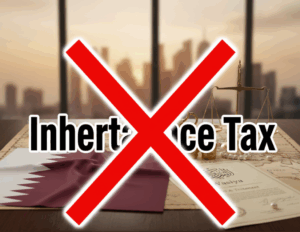
Inheritance tax in Qatar does not exist, and the country does not impose estate tax or any tax on assets passed on at death.
Both residents and non-residents, including foreigners and expats, can inherit property, money, and other assets without paying taxes in Qatar.
This article covers:
- What is the tax if you inherit money?
- Does inheritance tax apply to foreigners in Qatar?
- Who is responsible for inheritance taxes in Qatar?
Key Takeaways:
- Qatar has no inheritance tax, estate tax, or gift tax.
- Foreigners and expats are treated the same as residents regarding inheritance.
- Inherited assets from abroad are not taxed in Qatar.
- There are no minimum thresholds or exemptions required to inherit.
My contact details are hello@adamfayed.com and WhatsApp +44-7393-450-837 if you have any questions.
The information in this article is for general guidance only. It does not constitute financial, legal, or tax advice, and is not a recommendation or solicitation to invest. Some facts may have changed since the time of writing.

What are the inheritance tax rules in Qatar?
Qatar does not have a formal inheritance tax system.
There is no legal obligation for heirs to pay tax on assets inherited, regardless of their value. This applies to all types of assets, including cash, property, and investments.
How much inheritance tax is there in Qatar?

Since there is no inheritance tax, estate duty, or related levy, the amount of inheritance tax in Qatar is effectively 0% for all beneficiaries.
However, beneficiaries should consider:
- Foreign taxes – Inherited assets located outside Qatar may be subject to estate, inheritance, or capital gains taxes in the country where they are situated.
- Legal and administrative fees – Probate or succession fees, notary costs, and lawyer fees may apply when transferring assets.
- Property registration fees – Small fees may apply for transferring real estate in Qatar, but these are not inheritance taxes.
Who is exempt from paying inheritance tax in Qatar?
All heirs are exempt from inheritance tax in Qatar. These include:
- Residents
- Non-resident foreigners
- Expats
- Qatari nationals
What countries do not pay inheritance tax?
Several countries do not impose inheritance tax, including Qatar, UAE, Kuwait, Saudi Arabia, New Zealand, and Australia.
In these countries, heirs receive inherited assets without paying a formal inheritance or estate tax, though other taxes (like capital gains or property registration fees) may apply in specific situations.
Conclusion
Qatar’s inheritance framework is exceptionally straightforward: there are no local taxes on wealth passed down, removing a common layer of complexity seen in other countries.
This simplicity allows heirs to focus on efficiently transferring and managing assets rather than navigating tax rules.
While international inheritances may carry obligations elsewhere, within Qatar itself, the process is largely administrative, making it a uniquely favorable environment for estate planning.
FAQs
Is Qatar tax free for foreigners?
Yes. Foreigners and expats are generally tax-free on inheritance, income, and most personal assets in Qatar.
Do I pay tax if I inherit from abroad?
Qatar does not tax foreign inheritances either. However, heirs may need to comply with the tax laws in the country where the assets originated
Which country pays the most inheritance tax?
Among countries that do impose inheritance or estate taxes, Japan has the highest top inheritance tax rate at 55%, followed by South Korea at around 50%.
Other high‑rate countries include France and the United Kingdom, with top rates of 45% and 40% respectively.
Pained by financial indecision?

Adam is an internationally recognised author on financial matters with over 830million answer views on Quora, a widely sold book on Amazon, and a contributor on Forbes.


My girlfriend inherited a large amount of gold from her father in Qatar. Her father is not a citizen of Qatar and neither is my girlfriend. She she has submitted all the proper paperwork and claimed the gold. She has sold the gold and deposited the money in a bank. The deposit of the money has been cleared. The bank has put a freeze on the account until she pays taxes on the money because her father nor she are residents of Qatar. My understanding is that there aren’t taxes on inheritance in Qatar regardless of citizenship. Can you clarify?