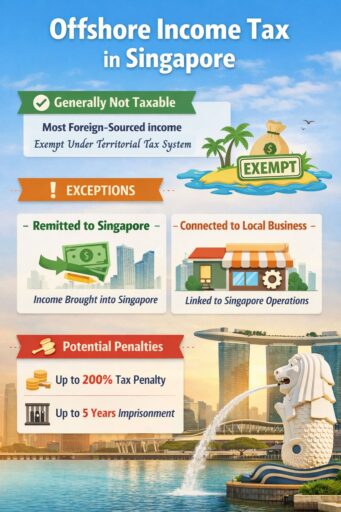
Offshore income is generally not taxable in Singapore, as most foreign-sourced income is exempt under the country’s territorial system.
Only in specific situations, such as income remitted under IRAS rules or income linked to Singapore-based business activities, can offshore income become taxable.
This article covers:
- What is the meaning of offshore income?
- Is foreign source income taxable in Singapore?
- How to determine if income is foreign sourced?
- What happens if you don’t declare foreign income?
Key Takeaways:
- Singapore taxes primarily Singapore-sourced income.
- Offshore income brought into Singapore is mostly exempt.
- Certain offshore funds can enjoy full tax exemptions under IRAS schemes.
- Non-declaration of taxable income can lead to fines, interest, and legal issues.
My contact details are hello@adamfayed.com and WhatsApp +44-7393-450-837 if you have any questions.
The information in this article is not tax advice and may have changed since the time of writing. I can connect you with expert tax support for your specific situation.

What is the meaning of offshore income?
Offshore income refers to earnings that are generated from sources outside Singapore.
In tax terms, it is commonly referred to as foreign-sourced income, meaning money, profits, or financial benefits earned in another country rather than within Singapore.
Common examples of offshore income are:
- Business profits earned by companies operating overseas
- Dividends from foreign shares or investments
- Interest from foreign bank accounts, bonds, or other financial instruments
- Royalties received from intellectual property used outside Singapore
- Rental income from properties located abroad
Offshore income can arise in many forms, including passive income like dividends or interest, as well as active income such as earnings from business operations conducted in another country.
Understanding this definition is crucial for identifying and tracking your global earnings.
Is offshore income taxable in Singapore?
Most offshore income from foreign jurisdictions is not taxable in Singapore, as the country follows a territorial tax system that taxes only income sourced within its borders.
In most cases, money earned overseas and brought into Singapore is exempt from tax.
However, in rare situations, offshore income may become taxable.
For example, certain foreign-sourced income remitted through a Singapore bank account by individuals who are tax residents can be subject to tax if it falls under IRAS guidelines.
Similarly, income connected to Singapore-based trade or business activities, even if earned abroad, may also be considered taxable.
These exceptions are narrowly defined, so careful attention to IRAS rules and proper documentation is essential to determine when remitted income could trigger tax liability.
How to determine the source of income?
Singapore determines the source of income based on where the income-generating activity or transaction occurs.
The IRAS considers factors such as where services are performed, where an investment is located, and where a transaction takes place.
To support this determination, individuals and businesses should maintain documentation like contracts, invoices, or bank statements showing the location and nature of the income.
Income arising outside Singapore with no connection to Singapore operations is generally classified as offshore, which is essential for applying any relevant tax exemptions.
How to reduce income tax in Singapore for foreigners?
Foreigners can legally reduce tax on their foreign-sourced or offshore income by using exemptions, structuring, and investment strategies approved by IRAS.
1. Use tax treaties: Take advantage of Singapore’s network of tax treaties to avoid double taxation on foreign-sourced income.
2. Structure income wisely: Channel earnings through offshore companies or trusts where permitted to optimize your tax position.
3. Claim exemptions: Apply relevant tax exemptions for foreign-sourced income to minimize taxable amounts.
4. Invest strategically: Invest in approved offshore funds under Section 13X or 13R to enjoy specific income tax exemptions.
With careful planning and adherence to IRAS rules, foreigners can legally minimize tax exposure while staying fully compliant with Singapore regulations.
What is the offshore fund tax exemption scheme in Singapore?
The offshore fund tax exemption scheme allows qualifying offshore funds to receive full tax exemption on certain foreign-sourced income.
This scheme, under Sections 13CA, 13R, and 13X, is specifically designed for funds that earn income outside Singapore but are managed or administered from Singapore.
To qualify, funds must meet conditions regarding structure, investor base, and investment strategy, and only income from designated offshore investments is eligible.
By applying these exemptions, offshore funds can legally avoid Singapore tax on foreign-sourced earnings while benefiting from Singapore’s regulatory framework, making the country an attractive base for global fund management.
How do you declare overseas income?
You declare overseas income in Singapore by reporting it to the IRAS if it falls under taxable or reportable categories.
While foreign-sourced income is often tax-exempt, certain remitted income or income connected to Singapore operations must be included in your tax filings.
Individuals typically declare income using the IRAS Form B (for residents) or Form B1 (for non-residents) when filing annual taxes, with the deadline usually on 15 April for paper filings or 18 April for e-filing.
Supporting documents such as bank statements, dividend slips, contracts, or fund statements should be kept for at least five years, as the IRAS may request verification.
Failing to report income accurately or on time can lead to penalties, interest, or compliance issues.
What happens if you don’t report taxable income?
Failing to report taxable income, including certain remitted offshore income, can result in significant penalties and legal consequences under Singapore law.
The IRAS may impose fines and penalties for inaccurate or late reporting, and interest charges can accrue on any unpaid tax amounts.
In serious cases, failure to report can lead to legal action or prosecution.
Even if the income is partially exempt, it is crucial to maintain proper documentation and transparency to demonstrate compliance and avoid disputes with the tax authorities.
What is the penalty for tax evasion in Singapore?
Deliberate tax evasion in Singapore can incur financial penalties of up to 200% of the unpaid tax, in addition to potential imprisonment.
In serious cases, individuals or companies may face criminal prosecution, with prison terms of up to five years.
The IRAS actively enforces compliance, including audits and investigations, to detect underreporting or false declarations.
Maintaining accurate records, timely reporting, and full transparency is essential to avoid these severe consequences.
How Singapore Compares to Other Low-Tax Jurisdictions
Singapore taxes only locally-sourced income, making offshore income largely exempt, which distinguishes it from many other low-tax jurisdictions.
Jurisdictions often compared to Singapore include Hong Kong, UAE, and Switzerland, each with different approaches to offshore income.
Like Singapore, Hong Kong uses a territorial system, generally taxing only local income but offering fewer exemptions for foreign-sourced dividends.
The UAE has zero personal income tax and no corporate tax for most sectors, though its banking and compliance infrastructure differs from Singapore’s highly regulated system.
Switzerland applies a mix of cantonal tax rates and exemptions, but compliance is typically more complex and costly.
Singapore’s balance of low taxes, regulatory transparency, and strategic global connectivity makes it a preferred jurisdiction for individuals and companies managing offshore income.
Understanding these differences helps global investors and expatriates choose the jurisdiction that best fits their income structure and compliance preferences.
Conclusion
Singapore’s territorial tax system offers clarity and significant benefits for individuals and businesses earning offshore income, but the rules are nuanced.
Effectively managing foreign-sourced earnings requires more than knowing exemptions, it calls for strategic planning, careful documentation, and awareness of the rare situations where remitted income may be taxable.
For foreigners and global investors, understanding these subtleties can turn compliance into an advantage, enabling legally optimized tax positions while reducing exposure to penalties.
Ultimately, Singapore’s framework rewards transparency, proper structuring, and proactive engagement with IRAS, making it a compelling jurisdiction for managing international income.
FAQs
What is the tax rate for offshore companies in Singapore?
The standard corporate tax rate in Singapore is 17%, but companies can often reduce their effective tax burden through exemptions, incentives, and territorial tax rules that exempt qualifying foreign‑sourced income from tax.
What is the offshore tax regime in Singapore?
Singapore’s offshore tax regime exempts foreign-sourced income remitted into Singapore, provided it meets IRAS criteria.
Offshore funds may also benefit from Section 13X/13R exemptions.
What are the 4 income categories?
The four main types of income in Singapore are employment, trade or business, rental, and investment income.
These categories cover most earnings that individuals or companies may receive.
What makes Singapore so wealthy?
Singapore’s wealth comes from its strategic location as a global trade hub, highly developed financial and services sector, strong governance, pro-business policies, and a focus on innovation and foreign investment.
Pained by financial indecision?

Adam is an internationally recognised author on financial matters with over 830million answer views on Quora, a widely sold book on Amazon, and a contributor on Forbes.