Countries that don’t tax foreign income like the United Arab Emirates and Panama either impose no personal income tax or operate a territorial tax system.
If you earn abroad through remote work, investments, or international business, understanding how zero foreign income tax countries work can help you legally reduce or eliminate tax on your income sourced overseas.
This article covers:
- What is classed as foreign income?
- Countries with 0% tax on foreign income
- What is the difference between tax avoidance and tax evasion?
- What is the territorial system of taxation?
Key Takeaways:
- Some countries tax only local income, not worldwide income.
- Zero personal income tax jurisdictions make foreign income irrelevant locally.
- Anti-avoidance rules like GAAR and CFC laws prevent aggressive tax planning.
- Your home country’s tax rules may still apply even if your new country taxes nothing.
My contact details are hello@adamfayed.com and WhatsApp +44-7393-450-837 if you have any questions.
The information in this article is not tax advice and may have changed since the time of writing. I can connect you with expert tax support for your specific situation.

What is included in foreign income?
Foreign income generally refers to income such as wages from a foreign employer or rental income from overseas property earned outside the country in which you are a tax resident.
This can also include:
- Business profits earned overseas
- Investment income like dividends, interest, and capital gains received abroad
In most worldwide tax systems, foreign income is included in your taxable base if local law taxes you on worldwide income.
However, some jurisdictions only tax domestic-sourced income, meaning foreign-sourced earnings are exempt from local tax liability if correctly classified and reported.
Which countries do not tax on foreign income?
Countries such as the United Arab Emirates and The Bahamas do not impose personal income tax at all, meaning foreign income is not taxed locally regardless of where it is earned.
Below is a list of countries where foreign income is not taxed, either because of zero personal income tax or a territorial/remittance-based tax system.
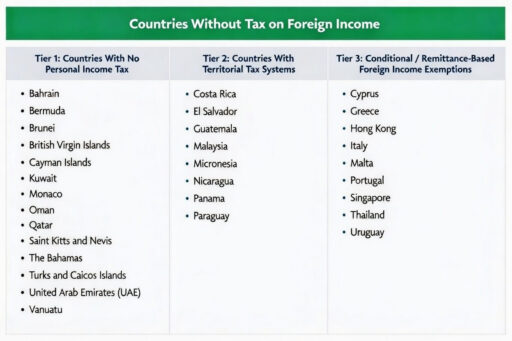
Tier 1: Countries With No Personal Income Tax (Foreign Income Irrelevant)
These countries do not levy personal income tax, so foreign income is generally untaxed.
Most residents enjoy full exemption on foreign earnings.
- United Arab Emirates (UAE)
- Bahrain
- Kuwait
- The Bahamas
- Cayman Islands
- British Virgin Islands
- Vanuatu
- Saint Kitts and Nevis
- Turks and Caicos Islands
- Brunei
For these countries, foreign and domestic income is untaxed at the individual level; corporate or indirect taxes may still apply, but do not affect personal foreign income.
- Monaco
Monaco has zero personal income tax for residents, so foreign income isn’t taxed locally; corporate profits tax is 25%, mainly for commercial entities.
- Bermuda
Bermuda does not levy personal income tax on individuals, meaning foreign income remains untaxed at the individual level.
However, from 2025, a 15% corporate income tax applies to large multinational enterprises under global minimum tax rules, PwC said.
- Oman
According to EY, Oman has traditionally not imposed personal income tax, but a new law effective January 1, 2028, will introduce a 5% tax on worldwide income above 42,000 Omani rials for residents.
- Qatar
Qatar does not levy personal income tax, meaning individuals pay no tax on foreign or local earnings.
The country has a corporate tax regime under Law No. 24 of 2018, where resident and non‑resident corporate entities pay 10% tax on Qatar‑sourced profits, with specific exemptions tied to ownership and dividends.
Tier 2: Countries With Territorial Tax Systems (Foreign Income Exempt)
These countries tax residents only on local-source income, meaning foreign income earned abroad is generally exempt from local taxation.
Residents can earn abroad without paying domestic tax, although local income remains subject to standard tax rules.
- Panama
- Costa Rica
- Paraguay
- Guatemala
- Nicaragua
- El Salvador
- Malaysia
- Micronesia
Tier 3: Conditional / Remittance‑Based Foreign Income Exemptions
These countries may levy worldwide tax, but foreign income is exempt if not remitted or under specific residency rules.
Uruguay
Uruguay historically used a territorial tax system, but starting in 2026, certain foreign-sourced income including rental income and capital gains, may be taxed for residents.
Some exemptions remain under tax holidays or incentive programs, making it a conditional foreign income option.
Hong Kong
Hong Kong’s territorial tax regime generally exempts foreign-sourced income from tax when the economic activity generating it occurs outside Hong Kong.
For individuals, foreign income remains untaxed; certain passive foreign-sourced income received by multinational enterprises may be taxable under FSIE rules.
Singapore
Singapore operates a modified territorial system: foreign‑sourced income is generally exempt from tax for resident individuals unless it is received (remitted) in Singapore and has not been subject to tax abroad, in which case it may become taxable.
Thailand
Thailand used to exempt foreign‑sourced income from personal tax if it was remitted into the country in a later year, but since January 1, 2024, foreign income remitted into Thailand by tax residents is generally taxable regardless of when it was earned.
Proposed legislation may introduce a limited exemption period (e.g., one‑to‑two years from the year earned) for remitted foreign income, but this has not yet been fully enacted.
Malta
Malta’s remittance basis for non‑dom residents exempts foreign income not brought into the country, subject to specific conditions.
Cyprus
Cyprus offers a non‑dom regime where certain foreign income streams can be exempt from tax for qualifying residents.
Portugal
Portugal generally taxes residents on worldwide income, including foreign pensions.
The classic Non‑Habitual Resident (NHR) regime, which provided preferential treatment and 10% tax on foreign pensions, is closed to new applicants from 2024.
However, existing beneficiaries or transitional cases can still retain benefits for the remainder of their 10‑year NHR period.
A new tax incentive regime with different criteria now exists.
Italy
Italy offers a flat-tax regime for qualifying new residents that allows foreign-sourced income and gains to be taxed at a fixed annual amount instead of regular progressive rates, with Italian-sourced income still taxed normally.
The flat-tax rate is evolving under 2026 budget laws, currently rising toward €300,000 for new elections.
Greece
Greece offers special tax regimes for qualifying new residents: under Article 5A, foreign income can be taxed at a flat €100,000 per year if the individual has not been a Greek tax resident for 7 of the previous 8 years.
Under Article 5B, foreign pensions may be taxed at a flat 7% if the individual has not been a resident for 5 of the last 6 years.
These regimes apply for up to 15 years and provide preferential treatment instead of normal progressive taxation.
Which country has the fairest tax system?
Countries with zero personal income tax, such as the UAE, Bahamas, Bermuda, Cayman Islands, and Monaco, are often considered the fairest for those seeking minimal tax on global earnings.
- For minimal tax on global earnings: Countries with zero income tax like the UAE, Bahamas, Bermuda, Cayman Islands, and Monaco are often considered the fairest from a tax burden perspective, because they do not levy personal income tax at all.
- For balanced public services and progressive taxation: Many European and OECD countries levy taxation on worldwide income but use progressive rates and comprehensive social benefits, which some view as more equitable even if the tax burden is higher.
Ultimately, fairest is subjective. It can mean lowest tax, most transparent rules, or best trade-off between services and taxes.
What is the tax avoidance rule?
Tax avoidance is the legal use of tax laws and provisions to reduce one’s tax liability.
Individuals and businesses may arrange their affairs, such as choosing a jurisdiction with favorable tax rules, using territorial taxation, or structuring payments, in ways that lower taxes while remaining fully compliant.
Unlike tax evasion, which is illegal and involves hiding income or falsifying records, tax avoidance operates entirely within the law.
Governments often monitor and regulate aggressive tax avoidance to ensure fairness, introducing rules or reporting requirements to prevent excessive or abusive use of legal tax benefits.
What are the anti-avoidance measures in international taxation?
Governments and international organizations use anti-avoidance measures, such as General Anti-Avoidance Rules (GAAR), to prevent individuals and companies from exploiting loopholes to reduce taxes.
1. General Anti-Avoidance Rules (GAAR)
GAAR allows tax authorities to disregard transactions that lack commercial purpose and are structured mainly to obtain tax benefits.
2. Transfer Pricing Rules
These ensure that multinational enterprises price cross-border related-party transactions at arm’s length to prevent profit shifting.
3. Controlled Foreign Company (CFC) Rules
Countries tax the income of foreign subsidiaries held by residents to prevent low-tax offshore shelters from sheltering profits indefinitely.
4. Thin Capitalization and Interest Limitation Rules
These limit excessive interest deductions designed to shift profits through debt financing.
5. Withholding Taxes
Governments may impose withholding on dividends, interest, and royalties to prevent profit extraction without taxation.
6. International Cooperation & Transparency Standards
Agreements like the OECD’s BEPS initiative push for information exchange and coordinated anti-avoidance strategies.
These measures work together to safeguard tax bases and ensure taxpayers don’t exploit loopholes unfairly.
Other Taxes to Consider Beyond Foreign Income Exemption
Even in countries with zero foreign income tax, residents may still owe other types of taxes such as local income, corporate, VAT, property, or inheritance taxes.
Understanding these is essential for accurate financial planning and assessing the true cost of living or doing business abroad.
- Domestic Income Taxes. Some countries exempt foreign income but still tax locally earned income. For example, Malaysia and Singapore may impose tax on income generated within the country, even if foreign income remains exempt under remittance or territorial rules.
- Corporate Taxes. Owning or operating a business can trigger corporate income taxes. Jurisdictions like Bermuda and Monaco exempt personal income but levy corporate taxes on certain business profits, especially for large or multinational companies.
- Value-Added Tax (VAT) / Goods and Services Tax (GST). Zero personal income tax doesn’t mean no consumption taxes. The UAE, for instance, applies a 5% VAT on most goods and services, affecting everyday costs and business expenses.
- Property and Real Estate Taxes. Owning property can still result in taxes such as transfer fees, stamp duties, or annual property taxes. Even in low- or no-income-tax jurisdictions, these levies can significantly impact real estate investments.
- Social Security and Payroll Contributions. Some countries require contributions to fund healthcare, pensions, or unemployment benefits, even when income is untaxed. Expatriates may also face obligations under agreements with their home country.
- Inheritance and Gift Taxes. No tax on foreign income does not automatically remove taxes on wealth transfers. While countries like the UAE or Bahamas exempt close family members, others may impose inheritance or gift taxes that need careful planning.
Conclusion
Choosing countries without tax on foreign income can be a powerful strategy for reducing your global tax burden, but it is only one piece of a broader financial puzzle.
The interplay between local laws, corporate structures, remittance rules, and international anti-avoidance measures means that effective planning requires a holistic view, not just a focus on income tax rates.
Beyond tax savings, lifestyle, political stability, legal transparency, and access to services often define the real value of relocating.
Ultimately, the smartest approach combines strategic tax planning with practical, long-term considerations to optimize both wealth and quality of life.
FAQs
What is the most tax free country in the world?
Countries such as the United Arab Emirates, Bahamas, and Bermuda are among the world’s most tax-free, with no personal income tax and broad exemptions on foreign income.
These jurisdictions attract residents seeking minimal taxation on global earnings.
What happens if I don’t declare foreign income?
Failing to declare foreign income in a country that taxes worldwide income can lead to penalties, interest on unpaid taxes, and even criminal charges in serious cases.
You must report foreign income accurately under your country’s tax laws to avoid legal and financial consequences.
What are the best countries to retire to?
Countries such as Panama, Costa Rica, the United Arab Emirates, Portugal, and Malta are often considered among the best places to retire for favorable tax treatment.
These destinations offer combinations of low or zero income tax, territorial systems, or special retiree-focused regimes that can reduce tax on foreign income.
Can you claim foreign tax back?
Yes. You can often claim a foreign tax credit or refund in your home country for taxes paid abroad, provided your home country’s rules and any applicable tax treaties allow it.
Pained by financial indecision?

Adam is an internationally recognised author on financial matters with over 830million answer views on Quora, a widely sold book on Amazon, and a contributor on Forbes.