In Canada, succession planning has become increasingly urgent as aging business owners approach retirement, and private business assets are being prepared for transfer.
As of 2026, this landscape is shaped by evolving tax rules, higher capital gains inclusion rates, and reformed intergenerational transfer legislation under Bill C-59.
New tools such as Employee Ownership Trusts and enhanced tax incentives create opportunities, but also introduce complexity that demands careful planning.
Without structured planning, owners face risks including avoidable tax leakage, operational disruption, and family disputes.
A structured, multiyear approach is now essential to protect wealth, ensure continuity, and secure long-term business success.
This article covers:
- What is the succession planning process in Canada?
- What is succession planning for business owners in Canada?
- What are the advantages and disadvantages of succession planning in Canada?
- Tips for Succession Planning in Canada
Key Takeaways:
- Bill C-59 reshapes intergenerational business transfers in Canada.
- Capital gains tax changes make 2026 timing critical.
- Early, documented planning preserves wealth and business continuity.
- Professional advice is essential for compliant, tax-efficient transitions.
My contact details are hello@adamfayed.com and WhatsApp +44-7393-450-837 if you have any questions.
The information in this article is for general guidance only. It does not constitute financial, legal, or tax advice, and is not a recommendation or solicitation to invest. Some facts may have changed since the time of writing.

What is Succession Planning in Canada?
Succession planning is the documented strategy for transferring business ownership, leadership, and management to successors while minimizing tax, legal, and operational disruption.
Succession planning in Canada involves more than simply handing over keys to the next generation.
It is a comprehensive, forward-looking strategy that addresses ownership transfer, management continuity, tax optimization, and family or employee alignment.
Unlike many countries, Canada’s succession planning must navigate federal and provincial regulations, tax incentives, and increasingly sophisticated legal frameworks.
The Canadian context differs significantly from other jurisdictions.
Canadian business owners benefit from tax tools like the Lifetime Capital Gains Exemption (LCGE), which shields up to $1.25 million in capital gains on qualified small business shares.
They also face anti-avoidance rules under section 84.1 of the Income Tax Act, which historically penalized family transfers but have been reformed through Bill C-59 (effective January 1, 2024).
For 2026 specifically, succession planning takes on new urgency due to the implementation of higher capital gains inclusion rates beginning January 1, 2026.
Owners selling before this date benefit from the current 50% inclusion rate on capital gains. Those selling after January 1 will face a 66.67% inclusion rate on gains exceeding $250,000.
This deadline creates a significant planning window for owners considering exits in early 2026.
Succession Planning Framework in Canada
Canada’s succession planning framework combines corporate law, tax regulations, and family governance to guide the smooth transfer of business ownership and leadership.
Federal and provincial rules, including Bill C-59, shape legal, financial, and operational requirements for intergenerational transfers.
The Legal and Tax Foundation
- Canadian succession planning rests on three pillars: tax law, corporate law, and family and business law.
- Tax Law governs capital gains, exemptions, and tax-efficient structures under the Income Tax Act, administered by the CRA, including Form T2066 for intergenerational transfers.
- Corporate Law regulates share transfers, shareholder agreements, and post-transfer obligations under provincial statutes or the Canada Business Corporations Act.
- Family and Business Law addresses governance, dispute resolution, and relationship dynamics that often determine succession success or failure.
Bill C-59 and Intergenerational Business Transfers
Enacted in June 2024, Bill C-59 reformed intergenerational business transfers and introduced two statutory pathways.
Immediate Transfer (Section 84.1(2.31))
- Child gains control within 36 months
- Parent exits ownership and control within 36 months
- Requires share sale for capital gains treatment
- Simpler compliance, tighter timelines
Gradual Transfer (Section 84.1(2.32))
- Child gains control over 5 to 10 years
- Parent phases out involvement
- Full exit required by prescribed deadlines
- Greater flexibility, longer compliance period
Both pathways require a fair market valuation, joint filing of CRA Form T2066, and detailed documentation. Eligible successors now include grandchildren, nieces, nephews, and in-laws.
Succession Planning Process in Canada
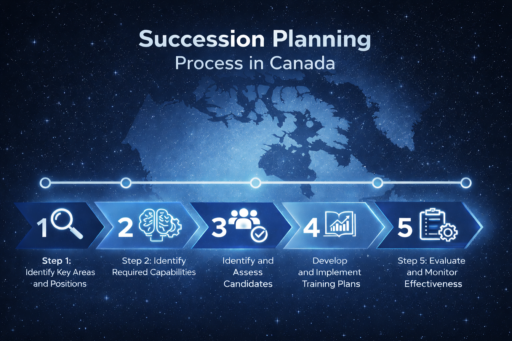
The succession planning process in Canada involves defining objectives, identifying key roles and successors, developing training, documenting the plan, and monitoring outcomes.
Following this structured approach reduces business disruption and ensures continuity across generations.
Step 1: Identify Key Areas and Positions
Begin by auditing your business structure.
— Which roles, if vacant, would cripple operations?
— Where does critical institutional knowledge reside?
For small businesses, this often includes the owner-operator role itself, key sales relationships, technical expertise, and financial management. Document this formally; don’t rely on memory.
Step 2: Identify Required Capabilities
For each critical position, define required knowledge, skills, certifications, and competencies.
A manufacturing business might require ISO certifications, equipment expertise, and supplier relationships. A professional services firm might require client relationship skills, technical credentials, and industry reputation.
Be specific and measurable.
Step 3: Identify and Assess Candidates
Internal candidates should be interviewed formally about their interest and career goals. External candidates may be recruited.
Create objective assessment criteria and evaluate all candidates against them fairly. This prevents bias and ensures the best person advances, whether internal or external.
Step 4: Develop and Implement Training Plans
High-potential candidates need structured development. This may include:
— Job shadowing with the current leader.
— Formal education or certifications.
— Gradual assumption of responsibilities.
— Mentoring relationships.
— Cross-functional projects.
For family transfers, this often takes 2-5 years. For external hires, assume 6-12 months minimum.
Step 5: Evaluate and Monitor Effectiveness
Once the successor assumes the role, monitor performance regularly. Track key metrics: revenue, customer retention, employee satisfaction, and profitability.
Provide feedback and adjust support as needed. Document the transition for future institutional memory.
Succession Planning for Business Owners in Canada
Succession planning for Canadian business owners focuses on transferring ownership and leadership while protecting wealth and minimizing tax exposure.
Early planning, professional valuations, and advisory teams are critical to secure a smooth and financially efficient transition.
Key Steps for Business Owners:
- Determine Your Succession Path Early (2-5 years before desired exit).
Decide whether you will:
- Sell to a family member.
- Sell to key employees or managers.
- Sell to an external buyer.
- Establish an Employee Ownership Trust (EOT).
- Liquidate the business.
Each path has distinct tax, legal, and emotional implications.
- Obtain a Professional Business Valuation
A certified business appraiser will determine fair market value (FMV) using industry-standard methodologies (comparable sales, discounted cash flow, asset-based).
This valuation is mandatory for all transfer paths and becomes evidence if disputes arise.
Budget $5,000–$20,000 for a thorough valuation.
- Assemble Your Advisory Team
Engage a tax accountant, corporate lawyer, and financial advisor early. These professionals coordinate to ensure tax optimization, legal compliance, and financial structuring align.
Many business owners delay this step, which is a critical mistake.
- Document Current Ownership Structure
Understand your shares’ class and characteristics.
- Are they Qualified Small Business Corporation (QSBC) shares?
- Do they qualify for the Lifetime Capital Gains Exemption?
- Are there preferred vs. common shares?
Ensure shareholder agreements exist and are current.
- Plan for Transition Logistics
If selling, negotiate a purchase price, payment terms, non-compete clauses, and earnout structures.
If transferring to family, determine whether it’s a gift, sale-at-FMV, or installment sale.
Document everything in a formal agreement.
- File Required Tax Elections
For intergenerational transfers, file CRA Form T2066 jointly in the year of transfer.
Other elections may apply depending on the structure (estate freeze, section 85 rollover, etc.).
Succession Planning for Family Business in Canada
Family business succession in Canada requires formal governance, merit-based leadership selection, and transparent communication.
Clear structures help prevent disputes, balance fairness among heirs, and preserve both family wealth and business continuity.
Family businesses represent 37% of Canadian GDP and 49% of Canadian employment. Yet only 30% survive to the second generation and just 12% to the third.
Unique Challenges in Family Succession:
- Conflicting Objectives: The owner wants financial security; children want autonomy; inactive family members want fairness.
- Emotional Attachment: A 40-year business is not just an asset; instead, it’s identity, legacy, and community contribution.
- Fairness Among Siblings: If only one child enters the business, how are non-business siblings treated fairly in the estate?
- Governance Gaps: Without formal structures (family councils, voting agreements), decisions default to sentiment rather than strategy.
Succession Planning for Foreign Companies in Canada
Foreign companies operating in Canada (subsidiaries, branches, or partnerships) face succession planning complicated by two jurisdictions’ tax and corporate rules.
Key Considerations:
- Determine Corporate Structure
Is the Canadian operation a subsidiary (separate legal entity), branch (extension of parent), or partnership?
This determines which Canadian laws apply and how succession unfolds.
- Understand Withholding Tax and Treaty Issues
If foreign owners sell Canadian assets, they face Canadian capital gains tax plus potential home-country tax.
Tax treaties between Canada and the owner’s country may reduce double taxation. Engage a cross-border tax specialist early.
- Comply with Canadian Succession Laws
Even if the parent company is foreign, any Canadian subsidiary must follow Bill C-59 rules, CRA elections, and provincial corporate law.
- Consider Repatriation of Funds
If the Canadian business is sold and proceeds returned to the foreign parent, withholding tax applies. Optimal structuring can minimize this burden.
- Navigate Foreign Investment Review
Depending on the sale size and sector, Canada’s Investment Canada Act may require approval of foreign buyer purchases. This can add 4-6 months to the transaction timeline.
Pros and Cons of Succession Planning in Canada
Succession planning offers tax efficiency, business continuity, and wealth preservation, but it can be complex, costly, and emotionally challenging.
Advantages:
- Tax Efficiency: Access to LCGE, Canadian Entrepreneurs’ Incentive, and deferral strategies
- Business Continuity: Protects operations, customers, and employees during transition
- Wealth Preservation: Reduces tax leakage and dispute risk
- Legacy Protection: Transfers values and culture alongside ownership
- Employee Retention: Provides clarity and confidence about the future
Disadvantages and Challenges:
- Complexity: Requires coordination among legal, tax, and valuation professionals
- Time and Cost: Typically costs 3 to 7 percent of business value
- Emotional Risk: Family dynamics can trigger conflict
- Uncertainty: Health, market, or personal changes may disrupt plans
- Regulatory Change: Tax rules require ongoing review
- Successor Gaps: Many owners struggle to find or assess successors
- Valuation Issues: Uncertain valuations complicate negotiations
Succession Planning Best Practices in Canada
Best practices for Canadian succession planning include starting early, documenting all processes, developing successors, communicating transparently, and leveraging professional advisors.
Applying these strategies ensures smoother leadership transitions and reduces financial and operational risks.
- Start Early: 2-5 Years Before Desired Exit
Most businesses require 2-5 years for thoughtful succession planning.
This allows time for candidate development, documentation, professional advice, and course correction.
Waiting until retirement age creates rushed decisions and sub-optimal outcomes.
- Bring in a Professional Advisory Team
Tax accountants, corporate lawyers, business valuators, and financial advisors each bring specialized expertise.
Coordinate them from the start to ensure an aligned strategy. Budget for these costs; they prevent costlier mistakes.
- Document Everything Formally
Succession plans, shareholder agreements, purchase contracts, and family governance structures must be written and signed. Oral understandings evaporate; documents endure.
- Communicate Transparently with Stakeholders
Employees, family members, key customers, and lenders all care about succession. Honest, timely communication reduces rumors, maintains stability, and reduces departures.
- Prepare Your Successor Thoroughly
Whether internal or external, successors need training, mentoring, and gradual assumption of responsibility.
Don’t hand over a complex business to an unprepared person.
- Plan for Post-Succession Integration
The transfer doesn’t end at closing; it begins then.
Plan for: knowledge transfer, customer relationship handoff, employee retention incentives, integration of systems, and ongoing support from the seller if needed.
- Use Tax-Efficient Structures
Bill C-59, the Lifetime Capital Gains Exemption, Employee Ownership Trusts, and other tools can save six figures in tax. Professional advice pays for itself many times over.
8. Timing Strategically
As of January 2026, the capital gains inclusion rate rises from 50% to 66.67% for gains over $250,000.
For business owners considering an exit, this creates a planning opportunity:
- Exit before January 1, 2026: Benefit from the 50% inclusion rate on all capital gains.
- Exit after January 1, 2026: High-gain transfers face 66.67% inclusion on excess amounts; however, the Canadian Entrepreneurs’ Incentive provides relief (33.33% inclusion on up to $2 million of eligible gains).
For a $1 million capital gain in 2025 (50% inclusion), tax on $500,000 in income. For the same gain in 2026 (66.67% inclusion), tax on $667,000 in income.
The difference: significant tax leakage for owners nearing retirement.
Consult with a tax accountant to determine whether accelerating your exit timing offers an advantage.
Conclusion
Succession planning in Canada is a core financial priority for business owners.
More than $2 trillion in Canadian business assets is expected to transfer over the next decade, yet many entrepreneurs still operate without a formal Canadian business succession planning strategy.
Canada’s regulatory framework has evolved through Bill C-59, expanded intergenerational transfer rules, the $1.25 million Lifetime Capital Gains Exemption, the Canadian Entrepreneurs’ Incentive, and Employee Ownership Trusts.
Used early, these mechanisms can materially reduce friction and protect enterprise value.
With higher capital gains inclusion rates beginning January 1, 2026, timing now directly affects after-tax outcomes.
Starting succession planning 2–5 years in advance, following a structured framework, and working with experienced advisors improves continuity, preserves wealth, and lowers transition risk.
For Canadian business owners, postponing succession planning increasingly carries measurable financial and operational consequences.
FAQs
How does estate planning work in Canada?
Estate planning in Canada is the process of organizing how a person’s assets are managed during incapacity and distributed after death.
It typically involves a will, powers of attorney, beneficiary designations, trusts, and tax planning.
Canadian estate planning must account for both federal tax rules and provincial succession laws to minimize disputes and tax consequences.
What are the 5 D’s of succession planning?
The 5 D’s are common triggers that force business succession: death, disability, divorce, distress, and disagreement.
These events can destabilize ownership and management if no succession plan exists. Effective planning prepares for all five scenarios to protect business continuity.
What Does a Successful Succession Plan Look Like in Canada?
A successful plan is written, tax-optimized, legally compliant, and supported by trained successors.
Stakeholders understand the transition, and the owner’s exit and retirement income are secured.
Well-executed plans typically take 2–5 years and deliver significant long-term value.
Is it better to gift or inherit property in Canada?
Canada does not have inheritance tax, but gifting property can trigger capital gains tax because it is treated as a sale at fair market value.
Inheriting property may defer tax until a later sale, depending on estate structure. The better option depends on tax timing, family goals, and estate planning strategy.
How much money can be legally given to a family member as a gift in Canada?
Canada has no formal gift tax and no legal limit on how much money can be gifted.
However, large gifts may trigger tax consequences if they involve appreciated assets, affect income-tested benefits, or create attribution rules for investment income.
Professional advice is recommended for substantial transfers.
Pained by financial indecision?

Adam is an internationally recognised author on financial matters with over 830million answer views on Quora, a widely sold book on Amazon, and a contributor on Forbes.