Creating a will in Australia involves drafting a legally valid document, signing it with two witnesses, and clearly outlining how your assets will be distributed after death.
You can create a will through a solicitor, an online platform, or a DIY method, with each option suited to different levels of estate complexity.
This article covers:
- What is the easiest and cheapest way to do a will?
- What are the requirements for a will to be valid in Australia?
- How much does it cost to create a will in Australia?
- How long does it take for a will to be settled in Australia?
Key Takeaways:
- A valid will in Australia must be written and signed with two adult witnesses.
- Solicitors are optional, but recommended for complex estates or overseas assets.
- DIY and online wills are legal, but carry higher risk of probate disputes.
- Costs range from free (Public Trustee/charity programs) to $1,000+, with complex estates costing more.
My contact details are hello@adamfayed.com and WhatsApp +44-7393-450-837 if you have any questions. We also offer bespoke structuring solutions tailored to your situation.
The information in this article is for general guidance only, does not constitute financial, legal, or tax advice, and may have changed since the time of writing.

What is a legal will in Australia?
A legal will in Australia is a written document that meets specific legal requirements under state and territory succession laws, making it enforceable for distributing your estate after death.
The primary laws governing wills are based on each jurisdiction’s Succession Act (for example, the Succession Act 2006 (NSW) or equivalent legislation in other states), which set out the formal rules for validity, execution, and probate.
Beyond asset distribution, a legal will can also formally set out:
- Appointment of an executor to manage the estate
- Guardianship arrangements for minor children
- Instructions for settling debts, taxes, and funeral wishes
It’s also important to note that Australian courts may recognize an informal will (such as a document, email, or even a text message) under special circumstances, but only if the court is satisfied that the deceased intended it to operate as their will.
This process can be costly and uncertain.
What is the easiest way to make a will in Australia?
The easiest way to make an Australian will is by using an online will platform that guides you through a step-by-step questionnaire and generates a legally compliant document you can sign and witness.
These platforms are designed for simplicity and speed, typically requiring you to:
- Answer basic questions about your assets, beneficiaries, and executor
- Review an automatically generated will document
- Print and sign it in front of two witnesses to make it legally valid
Most online wills can be completed in under an hour and cost significantly less than hiring a solicitor, making them a popular option for individuals with straightforward estates.
Other easy options include:
- Public Trustee services – Government-backed providers that may offer low-cost or even free will drafting, though they may appoint themselves as executor in some cases
- Solicitor-drafted wills – While more expensive and time-consuming, this option provides tailored legal advice and reduces the risk of errors or disputes
- Working with a wealth manager – Some individuals prepare their estate plans in coordination with a financial advisor or wealth manager, who can help ensure the will aligns with investment accounts, beneficiary designations, and broader financial planning before the document is finalized by a legal professional
While online platforms are the easiest and fastest route, they are best suited for simple situations.
If your estate involves multiple properties, blended families, business interests, or overseas assets, a more customized approach may be necessary to ensure your will is clear and legally robust.
How to write a will in Australia?
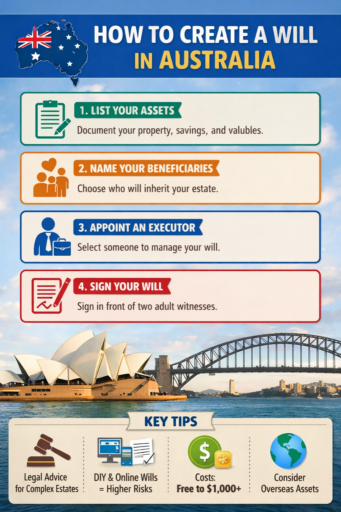
To write a will in Australia, the key steps are listing your assets, naming your beneficiaries, appointing an executor, and signing the document in front of two witnesses to make it legally valid.
1. List your assets and liabilities: Include all property, bank accounts, investments, and debts to provide a complete picture of your estate.
2. Identify your beneficiaries: Decide who will inherit your assets, including family members, friends, or charitable organizations.
3. Appoint an executor: Choose a trusted person to manage your estate and ensure your wishes are carried out.
4. Nominate guardians: If you have children under 18, designate guardians to care for them.
5. Detail distribution instructions: Clearly explain how each asset should be allocated to avoid ambiguity.
6. Sign and witness the will: Sign the document in front of two independent adults who also sign to make the will legally binding.
Clarity and precision are essential as unclear wording or missing elements can lead to disputes or a will being invalidated.
Do I need a solicitor to make a will in Australia?
No, you do not legally need a solicitor to make a will in Australia.
Any adult with testamentary capacity can draft, sign, and witness their own will, as long as it meets the legal requirements in their state or territory.
However, hiring a solicitor is strongly recommended for certain situations, including:
- Multiple properties or businesses: Complex ownership structures may require professional advice to ensure assets are distributed correctly.
- Blended families: If you have children from different relationships, a solicitor can help prevent disputes between beneficiaries.
- Overseas assets: Assets held outside Australia may need special legal arrangements to ensure your will is recognized internationally.
- Large or complex estates: High-value estates often involve trusts, tax planning, and other considerations that a DIY will may not adequately address.
Using a solicitor provides more than just legal compliance. They can:
- Draft clear and unambiguous language to reduce the risk of challenges
- Advise on tax implications and estate planning strategies
- Ensure your will is properly executed according to legal standards
Even for straightforward estates, consulting a solicitor can give peace of mind, particularly if your circumstances may change in the future.
A professionally prepared will is less likely to be contested, helping your loved ones avoid unnecessary stress and legal costs after your passing.
What are the requirements for a will in Australia?
To be legally valid in Australia, a will must be in writing, signed by the testator, and witnessed by at least two adults, among other requirements set by state and territory laws.
- Minimum age: The testator must be at least 18 years old.
- Mental capacity: The testator must understand the nature of making a will and the extent of their assets.
- Written form: The will must be documented in writing, either typed or handwritten.
- Signed by the testator: The testator must sign the will voluntarily.
- Witnessed by two adults: Two independent adults must witness the signing to make it legally binding.
Witnesses should not be beneficiaries, as this may invalidate their inheritance or part of the will.
How long do wills take to process in Australia?
In Australia, the processing of a will including obtaining probate and administering the estate, commonly takes several months to over a year before the executor can finalize distribution of assets.
Typical time frames are:
- Obtaining a grant of probate: Often 4–8 weeks after application in straightforward cases, once required notices and forms are lodged with the Supreme Court.
- Estate administration after probate: Once probate is granted, executors typically take 3–12 months or more to collect assets, settle debts and taxes, and distribute to beneficiaries.
Overall, simple estates with clear documentation and no disputes may be wrapped up in around 6–12 months, while more complex estates can take a year or longer.
Can I make a will for free in Australia?
Yes, it is possible to make a will for free in Australia, though options are usually limited to simpler estates.
Free wills are generally available through government or community programs, and can be a good starting point if your assets and family circumstances are straightforward.
Common ways to make a free will include:
- Public Trustee services: Many states and territories offer Public Trustee offices that provide basic will drafting at no cost or for a minimal fee. Some may offer additional services, such as acting as executor, but check for any limitations.
- Community legal centers: Certain not-for-profit legal organizations assist eligible individuals with preparing simple wills at no charge. Availability may vary by region.
- Free will campaigns: Charities or professional law associations occasionally run free will programs, often in exchange for naming the charity as a beneficiary or as part of estate-planning awareness initiatives.
While these options can save money, free wills tend to be basic and may not address more complicated situations, such as:
- Ownership of multiple properties or businesses
- Blended or large families
- International assets or cross-border estate issues
- Complex tax or trust planning
If your estate is more complex, a paid will can ensure your wishes are clearly documented and legally robust.
Even for simple estates, reviewing a free will with a professional can provide peace of mind and help avoid disputes later.
How much does it cost to make a legal will in Australia?
In Australia, the cost to make a legal will ranges from very low-cost DIY options to professional legal drafting, with most people paying between $0 and several thousand dollars based on the complexity of their estate and the service chosen.
Typical cost ranges:
- Free options: Public Trustee services, community legal centers, or charity will campaigns can provide a basic will at no cost.
- DIY or online will services: Usually $30–$300, offering guided templates and legal review options.
- Solicitor-drafted will: Typically $300–$1,000+ for a straightforward estate.
- Complex estate planning: Estates involving trusts, businesses, blended families, or overseas assets can cost $1,500–$3,000+.
While cheaper options like DIY or basic online services can seem attractive, they carry higher risks of mistakes or invalid execution that may lead to disputes or costly legal issues later on.
Beyond a Will: Estate Planning Tools Available in Australia
In Australia, you can complement or even partially replace a will with other estate planning tools, such as trusts, powers of attorney, and beneficiary nominations, to manage how your assets are handled during and after your lifetime.
- Testamentary Trusts: Created within a will, a testamentary trust allows you to control how and when beneficiaries receive their inheritance. This can provide tax advantages, protect assets from creditors, and support beneficiaries who are minors or have special needs.
- Living Trusts (Inter Vivos Trusts): Unlike a will, a living trust is established during your lifetime and allows assets to bypass probate, potentially speeding up distribution to beneficiaries. They are less common in Australia than in some other countries, but can be useful for families with complex estates or multiple properties.
- Powers of Attorney: While not a substitute for a will, powers of attorney let you appoint someone to make financial or medical decisions if you become incapacitated. This ensures your affairs are managed according to your wishes while you are still alive.
- Superannuation Binding Death Benefit Nominations: In Australia, superannuation funds often allow you to nominate beneficiaries directly. This can sometimes override instructions in your will, so it’s important to coordinate these choices carefully.
- Nomination of Beneficiaries for Accounts or Policies: Certain bank accounts, insurance policies, or investment funds allow for direct beneficiary nominations. Like superannuation, these may operate outside your will and should be aligned with your overall estate plan.
While a will provides the legal framework for asset distribution after death, combining it with these alternatives can offer greater flexibility, protection, and clarity for your estate in Australia.
Conclusion
Creating a will in Australia is not only about distributing assets; it’s a lens into how we anticipate uncertainty and exercise control over the future.
The process forces reflection on priorities, relationships, and responsibilities, highlighting the choices that matter most in life as much as in death.
Combining a will with tools like trusts, powers of attorney, and beneficiary nominations doesn’t just protect your estate.
It shapes how your intentions, values, and care for others continue to have impact.
Thoughtful estate planning is, in essence, a form of foresight: it turns legal and financial decisions into a lasting blueprint for how your legacy interacts with the world you leave behind.
FAQs
What is more powerful than a will?
A testamentary trust can be more powerful than a will because it allows ongoing control of assets after death, offering tax benefits and asset protection for beneficiaries.
Can a non-citizen make a will in Australia?
Yes, non-citizens can make a will in Australia. As long as you own assets in Australia, you can create a valid will under local laws.
Are DIY wills legal in Australia?
Yes, DIY wills are legal in Australia if they meet all legal requirements.
However, poorly drafted DIY wills are more likely to be contested or deemed invalid.
Do I need a lawyer for a will in Australia?
No, a lawyer is not required. But for complex estates or to minimize disputes, legal advice is strongly recommended.
Pained by financial indecision?

Adam is an internationally recognised author on financial matters with over 830million answer views on Quora, a widely sold book on Amazon, and a contributor on Forbes.