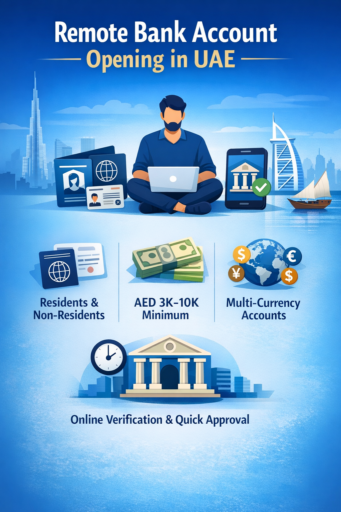
Remote bank account opening in the UAE allows residents to open and manage accounts online without visiting a branch.
Non-residents can start the process remotely but must complete verification, such as notarized documents, a UAE-based representative, or video KYC, before the account is activated.
This approach makes banking convenient for expatriates, freelancers, and international business owners.
Accounts often include multi-currency options, digital verification, and support for both personal and business use.
This article covers:
- Can I open a bank account in the UAE without living there?
- How long will it take to open a bank account online?
- Which bank has 0 minimum balance in the UAE?
Key Takeaways:
- Remote UAE bank accounts are possible for residents and certain non-residents.
- Eligibility requires valid ID, proof of address, and sometimes income or business documents.
- Some banks offer zero balance accounts, while others require a minimum deposit.
- Account approval takes 1–5 days for residents and 1–3 weeks for non-residents.
My contact details are hello@adamfayed.com and WhatsApp +44-7393-450-837 if you have any questions.
The information in this article is for general guidance only. It does not constitute financial, legal, or tax advice, and is not a recommendation or solicitation to invest. Some facts may have changed since the time of writing.

Can I open a bank account in UAE without residency?
Yes, you can open a bank account in the UAE even if you are not a resident, though options are more limited than for residents.
Several banks provide non-resident accounts designed for international clients, freelancers, and foreign investors.
These accounts allow you to receive and transfer funds, hold multiple currencies, and access online banking services without having a UAE residency visa.
However, there are key points to keep in mind:
- Higher minimum deposits: Non-resident accounts usually require a larger initial deposit, typically AED 10,000–100,000 or more, while premium or multi-currency accounts may demand even higher deposits.
- Limited account types: Some savings, premium, or credit accounts may not be available to non-residents.
- Document requirements: Banks generally require a valid passport, proof of address in your home country, and sometimes evidence of income or business activity.
- Compliance checks: Non-resident accounts undergo stricter Know Your Customer (KYC) and anti-money laundering (AML) checks, which may extend processing time.
Opening a non-resident bank account in the UAE is feasible, but it’s important to research which banks offer these accounts and review their terms carefully before applying.
Can I open a bank account online in the UAE?
Yes, many banks in the UAE allow customers to apply for a bank account online through mobile apps or digital banking platforms.
These online services are commonly offered to UAE residents and are designed to simplify the account opening process without requiring an in-person branch visit.
However, the process is still subject to banking regulations and compliance requirements, including identity verification, Know Your Customer (KYC) procedures, and anti-money laundering (AML) checks.
Applicants typically need to upload identification documents, provide personal information, and sometimes complete a digital or video verification step.
While some UAE banks allow fully online account opening for residents, non-residents may face additional requirements such as submitting documents by email or courier, or completing extra verification before the account is approved.
As a result, the level of online access depends on the bank, the applicant’s residency status, and the type of account being opened.
How to open a bank account virtually?
You can open a bank account virtually in the UAE by completing the bank’s online application, submitting identification documents digitally, and passing the required verification checks.
Many UAE banks now allow applicants to complete most of the onboarding process through mobile apps or secure online portals, making it possible to start banking without visiting a branch.
The exact steps may vary slightly by bank, but the virtual account opening process usually follows a similar structure:
1. Choose a bank that supports virtual account opening.
Start by selecting a UAE bank that offers online or remote onboarding through its website or mobile banking app.
Some banks provide fully digital accounts, while others allow remote applications that are finalized after verification.
2. Upload your required documents.
Submit scanned copies or clear photos of identification documents such as your passport, proof of address, and residency documents if applicable.
Some banks may also request proof of income or business registration documents for business accounts.
3. Complete identity verification.
Banks must verify your identity as part of regulatory compliance.
This usually involves completing the Know Your Customer (KYC) process, which may include uploading additional information or participating in a short video verification call.
4. Fund your account.
Once the application is approved, you may need to transfer an initial deposit to activate the account.
The amount depends on the bank’s minimum balance requirements and the type of account being opened.
5. Receive your banking access and account details.
After activation, you will receive your account number and access to online or mobile banking.
In many cases, the bank can also send a debit card to your registered address via courier.
By following these steps, applicants can complete most of the bank account opening process remotely while still meeting UAE banking regulations.
Can I open a UAE bank account remotely?
Non-residents or applicants outside the UAE can start opening a bank account remotely, but the process is not fully digital for most banks.
Applicants can submit forms and documentation online or via secure portals, but banks require verified identity checks before the account is fully activated.
These checks often involve notarized or apostilled documents, video KYC, or a UAE-based representative to complete the process.
Email / Document Submission
- Non-residents or applicants outside the UAE often use email or secure upload portals to submit required documents.
- This method may require notarized or apostilled copies of identification, proof of address, and financial statements.
- Some banks also request documents be sent via courier or postal service for verification purposes.
Using a UAE-Based Representative
- In certain cases, banks allow applicants to authorize a power of attorney (POA) for a UAE-based representative to complete the account opening on their behalf.
- The POA holder submits documents, signs forms, and sometimes completes verification in person at the branch.
- This method is particularly common for international business owners and investors.
Video Verification
- Certain banks offer video KYC as part of the remote account opening process. Applicants may be asked to participate in a live video call to confirm their identity and provide signatures.
- While this reduces the need for in-person visits, it does not always replace the need for notarized documents or POA.
Additional Considerations
- All remote account openings are subject to strict due diligence, including identity checks, KYC, and AML procedures.
- Some nationalities may face additional screening before account approval.
- The level of remote access ultimately depends on residency status, type of account, and the bank’s internal policies.
How much money do you need to open a bank account in the UAE?
Resident bank accounts in the UAE require a minimum balance of AED 3,000 to AED 10,000.
Maintaining this balance prevents monthly maintenance fees and keeps the account active.
Some banks offer zero balance accounts, particularly through digital banking platforms or entry-level accounts for residents, though these may have limited features or require salary transfers.
For non-resident accounts opened remotely, banks require higher initial deposits and may also request additional financial documents to meet compliance and risk assessment requirements.
How long does it take to open a bank account in the UAE?
Opening a bank account in the UAE takes 1–5 business days for residents and 1–3 weeks for non-residents.
The exact time varies based on the institution, the type of account, and how complete your documents are.
Some fully digital banks can approve resident accounts within 48–72 hours if the Know Your Customer (KYC) verification is smooth.
Non-resident accounts often take longer due to stricter compliance checks, additional documentation requirements, and verification of international documents.
Preparing all required documents in advance, such as your passport, proof of address, and proof of income or business activity, can help speed up the process.
Once approved, applicants typically gain immediate access to online banking, with physical items like debit cards delivered by courier in a few days.
Which bank can open a zero balance account in the UAE?
For UAE residents looking to open a zero balance account remotely, Emirates NBD (Liv. account) and Mashreq Neo are two of the most accessible options.
These accounts are digital-first, allowing applicants to complete the application online through mobile apps or the bank’s website, with no minimum balance required to maintain the account.
Other banks that support remote or partially online zero balance accounts include:
- RAKBANK – Fast Saver / RAKstarter – Residents can apply online, complete KYC digitally, and receive online banking access.
- FAB iSave – Some onboarding steps can be done digitally, but verification or documents may require courier submission.
- HSBC UAE – E-Saver – Digital account opening is possible, though some verification steps may need in-person or document submission.
These accounts typically provide full online and mobile banking access, debit cards, and standard banking services.
Remote applications require a valid Emirates ID, proof of residence, and sometimes a short video KYC call.
Once verified, online banking access is immediate, and debit cards are usually delivered by courier within a few business days.
Important Note: Zero balance accounts are primarily for residents. Non-residents generally cannot open these accounts remotely and may be required to maintain higher initial deposits for eligibility.
The Rise of Remote Banking in the UAE: A Global Perspective
The UAE has become a preferred destination for remote bank accounts, particularly for professionals, freelancers, and international businesses seeking efficient digital banking with regional reach.
Unlike some European or Asian banking hubs, the UAE allows non-residents to open accounts remotely, though with stricter compliance and higher minimum deposits, reflecting its strong regulatory environment.
Compared to countries like Singapore or Hong Kong, which offer highly internationalized banking but often require local presence or corporate structures for non-residents, UAE banks provide more flexibility for freelancers and international businesses operating in the Middle East.
In contrast to EU countries such as Portugal or Germany, where remote banking is often limited to residents or digital nomads under specific visa schemes, the UAE enables faster onboarding for expatriates already in the region or with international business ties.
UAE banks also distinguish themselves in multi-currency handling, regional payment integration, and GCC-focused financial services, which many global hubs lack.
While international banks abroad may excel in global investment products, UAE banks provide a unique combination of regional convenience and digital accessibility that caters specifically to cross-border trade, payroll management, and MENA-focused operations.
Ultimately, while no system is perfect, the UAE offers a competitive balance of remote accessibility, regulatory oversight, and regional utility, positioning its remote banking ecosystem as a strong option for global professionals seeking both digital efficiency and Middle East presence.
Advantages and Challenges of Opening a Remote Bank Account in the UAE
Opening a remote bank account in the UAE, such as Emirates NBD Liv. for residents, provides the convenience of applying from anywhere in the world, but applicants may face higher minimum deposits or strict compliance requirements if they are non-residents.
Advantages:
- Convenience: Apply from anywhere in the world without visiting a branch.
- Time-saving: Avoid lengthy paperwork and in-person processes.
- Access to UAE banking: Use UAE bank services for international transactions, payroll, or business operations.
- Digital banking tools: Most remote accounts come with mobile apps and online transfer capabilities, allowing full digital management.
Challenges and Limitations:
- Limited eligibility: Some banks restrict remote account opening to specific nationalities, residents, or professions.
- Higher minimum deposits for non-residents: Non-resident applicants often face larger initial deposit requirements.
- Strict compliance requirements: Banks conduct thorough KYC and AML checks, which can delay approval.
- Limited services: Certain remote accounts may not offer cheque books, credit cards, or full banking features compared to standard resident accounts.
Conclusion
Remote bank accounts in the UAE are becoming more accessible as banks expand digital onboarding and mobile banking services.
However, fully remote account opening is still largely limited to UAE residents with Emirates ID, while non-residents usually face stricter verification requirements or may need to visit the country to complete the process.
Understanding each bank’s eligibility rules, documentation requirements, and compliance checks is essential before applying.
With the right preparation, UAE bank accounts can still provide useful access to international banking, global payments, and financial services in one of the world’s leading financial hubs.
FAQs
What are the different types of bank accounts?
UAE banks offer current accounts for daily transactions, savings accounts with interest, business accounts for corporate or freelance use, and zero balance accounts with no minimum deposit.
Can I open a bank account in the UAE without Emirates ID?
Yes, non-residents can open accounts without an Emirates ID, but UAE residents usually need one for verification.
Is video KYC mandatory for bank account?
Yes, video KYC is mandatory for most UAE banks when opening an account remotely, especially for non-residents or digital-only accounts.
What are the rules for money transfer in UAE?
Banks in the UAE must follow AML regulations, may require extra documentation for transfers above AED 50,000, and apply fees and exchange rates for international transfers.
Pained by financial indecision?

Adam is an internationally recognised author on financial matters with over 830million answer views on Quora, a widely sold book on Amazon, and a contributor on Forbes.